Showing posts with label Timothy Geithner. Show all posts

Tuesday, April 7, 2009

"David Weidner Brings the Crazy"

Somehow I doubt we'll see a post with that headline on Megan McCardle's Atlantic blog in response to Weidner's MarketWatch column today, which questions the influence Goldman Sachs has exerted on the government's response to the financial crisis ("Government Sachs is in control"1). Last month Megan used a similar headline when a Member of Congress raised similar questions about Goldman Sachs ("Maxine Waters brings the crazy"). In that post, Megan embedded the video below, of Rep. Waters questioning Treasury Secretary Geithner, and opined that,

She seems to get all of her questions off of the fringier conspiracy sites.


Some commenters dismissed Waters because of her previous comments, or because she flubbed some basic terminology in this video (e.g., referring to Geithner's deputy -- a Goldman Sachs alumnus -- as his "CEO"), but as I wrote in the comment thread of Megan's post at the time,

Maxine Waters is neither crazy nor stupid, as some here seem to think. She and her family members seem to have done quite well in business dealings trading off of her position2: she has to have some savvy to have been able to do that and not get in trouble with the law (at least so far). Since her family's success in business seems to have been from rent-seeking, she probably assumes that's how big business works too, which may explain her apparent contempt for corporate CEOs. In the case of Goldman Sachs, she may not be entirely off base. It's certainly not unreasonable to ask questions about the ubiquity of Goldman Sachs alumni in influential positions, and how that may have influenced government policies that, so far, have been very good for Goldman Sachs.


1In his column, Weidner wrote,

Since the fall of Bear Stearns Cos. a little more than a year ago, Goldman has taken more than $20 billion in taxpayer cash through loans, payments and backstops.

[...]

In the last year, Goldman has benefited from Paulson's selective bailouts, a fortuitously timed ban on short selling, a liberal interpretation of bank holding company rules and soon, an easily gamed auction of distressed securities run by the government.

A conspiracy theorist might think this run of fortune has something to do with the former Goldman executives having influential roles in the Treasury Department.


2See this previous post for some examples, "Peering Under the TARP: Foul Waters"

Tuesday, March 24, 2009

John Hussman's Latest Market Commentary


In his market commentary yesterday ("Fed and Treasury - Putting off Hard Choices with Easy Money (and Probable Chaos)"), Dr. Hussman reiterated his call for the government to require bond holders in financial institutions to assume some losses in order to recapitalize those firms:

Make no mistake - we are selling off our future and the future of our children to prevent the bondholders of U.S. financial corporations from taking losses. We are using public funds to protect the bondholders of some of the most mismanaged companies in the history of capitalism, instead of allowing them to take losses that should have been their own. All our policy makers have done to date has been to squander public funds to protect the full interests of corporate bondholders. Even Bear Stearns' bondholders can expect to get 100% of their money back, thanks to the generosity of Bernanke, Geithner and other bureaucrats eager to hand out the money of ordinary Americans.


Though I believe that the consequences (via credit default swaps and the like) are overstated of letting bondholders take a haircut, and will ultimately be no worse than having the public take the losses, the fact is that we don't even need the bonds of major financial institutions to go into default. What we do need to do is offer those bondholders a choice:


1) The U.S. government takes receivership of the financial institution, changes the management, wipes out the stockholders and a chunk of the bondholders claims entirely, continues the operation of the institution in receivership, eventually reissues the company to private ownership, and leaves the bondholders with the residual. This is not “nationalization,” but receivership – a form of “pre-packaged bankruptcy” that protects the customers and allows the institution to continue to operate, followed by re-privatization. As I've previously noted, this would fully protect all of the customers and depositors at no probable expense to the public. Alternatively;


2) The bondholders voluntarily agree to move a portion of their claims lower down in the capital structure, swapping debt for equity (preferred or common), allowing the bank to have a larger cushion of Tier-1 capital, avoiding insolvency, and hopefully allowing the bank to recover by its own bootstraps, preferably assisted by debt restructuring on the borrower side (via property appreciation rights and the like). Similar debt/equity swaps would be an appropriate strategy toward failing U.S. automakers as well.


Hussman also added a note on inflation:

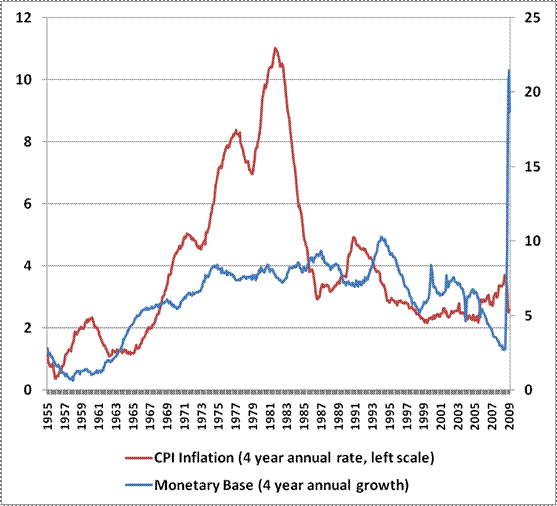
The reason we're not seeing inflation here and now is that despite a near doubling in the monetary base, we've seen a buildup in goods inventories combined with a surge in safe-haven demand for government liabilities. So investors have absorbed the increased supply of government liabilities without a collapse in their marginal utility. This will not persist indefinitely, so unfortunately, any nascent economic recovery in the next couple of years will be against the headwinds of both Alt-A mortgage defaults (coming to your neighborhood in 2010), and inflationary pressures as soon as safe haven demand for Treasuries eases back even moderately.


The graph above, of 4 year annual CPI growth versus 4 year annual growth in government spending, accompanied Hussman's column.

Sunday, March 22, 2009

Son of TARP

The Wall Street Journal explains the Obama Administration's new plan to buy bad assets off of the books of banks ("U.S. Sets Plan for Toxic Assets"). Economist and New York Times columnist Paul Krugman criticizes it ("Despair of Financial Policy"), and criticizes it again ("More on the bank plan"); economist Brad DeLong defends it ("The Geithner Plan FAQ" -- Hat Tip: Matt Yglesias), and Krugman responds to Brad DeLong's defense ("Brad DeLong's Defense of Geithner").

Since this new plan is, essentially, a return to the original, rejected, tack of the TARP plan last fall, it's also worth revisiting John Hussman's objections to the original TARP plan, ("You can't rescue the financial system if you can't read a balance sheet"). I suspect Dr. Hussman will reiterate some of those objections in his market commentary this week.

Thursday, March 12, 2009

More Obama Supporters Concerned by the President's Recent Actions


Last week we noted the concern expressed by two supporters of President Obama, Jim Cramer and Stewart Taylor, about the President's recent statements and actions (see "Buyer's Remorse" and ""More Buyer's Remorse"). This week brings more notes of concern from Obama supporters. On Monday on CNBC, Warren Buffett made a point similar to the one Taylor and Cramer made: in an economic emergency, the president's primary focus ought to be dealing with that emergency, not trying to enact other policy priorities. To underline the point, Taylor used the metaphor of a burning house: you put the fire out first; you don't water the lawn. Buffett used the analogy of World War II, saying that we have been hit with an "economic Pearl Harbor". From the transcript of his CNBC appearance Monday:

[I]f you're in a war, and we really are on an economic war, there's a obligation to the majority to behave in ways that don't go around inflaming the minority. If on December 8th when--maybe it's December 7th, when Roosevelt convened Congress to have a vote on the war, he didn't say, `I'm throwing in about 10 of my pet projects,' and you didn't have congress people putting on 8,000 earmarks onto the declaration of war in 1941.

[...]

[J]ob one is to win the war, job--the economic war, job two is to win the economic war, and job three. And you can't expect people to unite behind you if you're trying to jam a whole bunch of things down their throat. So I would--I would absolutely say for the--for the interim, till we get this one solved, I would not be pushing a lot of things that are--you know are contentious, and I also--I also would do no finger-pointing whatsoever. I would--you know, I would not say, you know, `George'--`the previous administration got us into this.' Forget it. I mean, you know, the Navy made a mistake at Pearl Harbor and had too many ships there. But the idea that we'd spend our time after that, you know, pointing fingers at the Navy, we needed the Navy. So I would--I would--I would--no finger-pointing, no vengeance, none of that stuff. Just look forward.


Warren Buffett may not have much else in common with the "dissident" feminist intellectual Camille Paglia, but she supported Obama as well -- and like Buffett, is concerned by some of what she has seen since he was inaugurated. In the first part1 of her Salon column Wednesday ("Obama's Clumsy, Smirky Staff is Sinking Him"), Paglia blamed the problems on Obama's staff:

Yes, free the president from his flacks, fixers and goons -- his posse of smirky smart alecks and provincial rubes, who were shrewd enough to beat the slow, pompous Clintons in the mano-a-mano primaries but who seem like dazed lost lambs in the brave new world of federal legislation and global statesmanship.

Heads should be rolling at the White House for the embarrassing series of flubs that have overshadowed President Obama's first seven weeks in office...

[...]

First it was that chaotic pig rut of a stimulus package, which let House Democrats throw a thousand crazy kitchen sinks into what should have been a focused blueprint for economic recovery. Then it was the stunt of unnerving Wall Street by sending out a shrill duo of slick geeks (Timothy Geithner and Peter Orszag) as the administration's weirdly adolescent spokesmen on economics. Who could ever have confidence in that sorry pair?


1The second part of the column is, inexplicably, about something completely different: Paglia's recent trip to experience Carnival in Bahai, Brazil, as the guest of a popular Brazilian singer.

Saturday, March 7, 2009

Former Australian PM Blames Financial Crisis on Geithner


Today's Sydney Morning Herald reports comments made by former Australian Prime Minister Paul Keating about Tim Geithner at a recent speech in Sydney ("Obama's economic saviour savaged as Keating lets rip"). Excerpts:

When Barack Obama announced his champion to rescue the world from economic ruin, it was the first time most Americans had ever heard the name Tim Geithner.

The initial impression was good. The stockmarket surged and the pundits swooned.

[...]

If anyone in the US media had thought to ask a former Australian prime minister for his assessment, they would have heard a different view. And they would not have been so surprised at Geithner's performance since.

In a speech to a closed gathering at the Lowy Institute in Sydney on Thursday, Paul Keating gave a starkly different account of Geithner's record in handling the Asian crisis: "Tim Geithner was the Treasury line officer who wrote the IMF [International Monetary Fund] program for Indonesia in 1997-98, which was to apply current account solutions to a capital account crisis."

In other words, Geithner fundamentally misdiagnosed the problem. And his misdiagnosis led to a dreadfully wrong prescription.

[...]

Geithner thought Asia's problem was the same as the ones that had shattered Latin America in the 1980s and Mexico in 1994, a classic current account crisis.

[...]

But the Asian crisis was completely different.

[...]

But Geithner, through his influence on the IMF, imposed the same cure the IMF had imposed on Latin America and Mexico. It was the wrong cure. Indeed, it only aggravated the problem.

Keating continued: "[former Indonesian leader] Soeharto's government delivered 21 years of 7 per cent compound growth. It takes a gigantic fool to mess that up. But the IMF messed it up. The end result was the biggest fall in GDP in the 20th century. That dubious distinction went to Indonesia. And, of course, Soeharto lost power."

Exactly who was the "gigantic fool"? It was, obviously, the man who wrote the program, Geithner, although Keating is prepared to put the then managing director of the IMF, the Frenchman Michel Camdessus, in the same category.

Worse, Keating argued, Geithner's misjudgment had done terminal damage to the credibility of the IMF, with seismic geoeconomic consequences: "The IMF is the gun that can't shoot straight. They've been making a mess of things for the last 20-odd years, and the greatest mess they made was in east Asia in 1997-98, so much so that no east Asian state will put its head in the IMF noose."

China, in particular, drew hard conclusions from the IMF's mishandling of the Asian crisis. It decided that it would never allow itself to be dependent on the IMF, or the US, or the West generally, for its international solvency. Instead, it would build the biggest war chest the world had ever seen.

[...]

"These reserves are so large at $US2 trillion as to equal $US2000 for every Chinese person, and when your consider that the average income of Chinese people is $US4000 to $US5000, it's 50 per cent of their annual income. It's a huge thing for a developing country to not spend its wealth on its own development."

[...]

Keating went on to argue that, by frightening the Chinese into building their vast $US2 trillion foreign reserves, Geithner was responsible for the build-up of tremendous imbalance in the world financial system. This imbalance, in turn, according to Keating, contributed to the global financial crisis which has since devastated the world economy.


Hat tip to a couple of commenters in the comment thread of a post ("Should Geithner Go?") on Megan McCardle's Atlantic blog.

The photo above, of Tim Geithner, is from the Affordable Housing Institute.

Monday, February 23, 2009

"Saving Capitalist Banking from Itself"


In addition to his weekly newsletter, John Mauldin1 occasionally e-mails articles written by others as part of his "Outside the Box" series. Today's "Outside the Box" e-mail included a couple of good ones (both of which can be read in full here). To keep this post from getting too long, I'll post an excerpt from the second one in a separate post. The graphic above comes from the first, "Saving Capitalist Banking from Itself", by PIMCO Managing Director Paul McCulley2. McCulley starts with a recap of the basics of fractional reserve banking and continues with a description of the shadow banking system. The excerpt below is from the "bottom line" part of his essay:

The United States government now has both the tools and the will to save the private banking system, and more importantly, the real economy, from its own debt-deflationary pathologies. Not that it will be easy. But it can be done, notwithstanding the catcalls that greeted Secretary Geithner last week.

And the essential game plan is clear: use the power of the Fed, the FDIC and the Treasury to create government-sponsored shadow banks, such as the Term Asset-Backed Securities Lending Facility (the TALF) and the Public-Private Investment Fund (the P-PIF).

The formula? Take a small dollop of the Treasury's free-to-spend taxpayer money (there is still $350 billion left) to serve as the equity in a government sponsored shadow bank, and then lever the daylights out of it with loans from the Federal Reserve, funded with the printing press. That's the formula for the TALF, to provide leverage, with no recourse after a haircut, to restart the securitization markets.

The same formula applies for the P-PIF, with the addition of FDIC stop out loss protection for dodgy bank assets that private sector players might buy. With such goodies, such players, it is hoped, will be able to pay a sufficiently high price for those assets to avoid bankrupting the seller bank.

Unfortunately, Secretary Geithner hasn't laid out the precise parameters of how to mix these three ingredients, which is driving the markets up the wall. But make no mistake, these are the ingredients, along with continued direct capital infusions into banks where necessary.


1JohnMauldin@InvestorsInsight.com

2You may recall McCulley's name from a previous post where we excerpted one of his essays, "Breaking the Paradox of Deleveraging".

Thursday, February 5, 2009

Are Liberals Less Inclined to Pay Their Taxes?


That question occurred to me on reading the news that a fourth Obama Administration nominee, Labor Secretary nominee Rep. Hilda Solis, has unpaid tax issues (The Washington Post: "Solis Senate Session Postponed in Wake of Husband's Tax Lien Revelations"). This news, of course, comes after the revelations of unpaid taxes by Treasury Secretary Timothy Geithner1,2 (pictured above), former HHS Secretary nominee Tom Daschle, and former "Government Performance Czar" nominee Nancy Killefer. If coincidences don't come in threes, as the saying goes, then they don't come in fours either.

At first blush, it might seem counter-intuitive that affluent liberals would be less inclined to pay their taxes, since they tend to advocate for higher taxes on the affluent. Advocating for higher taxes on the affluent and being eager to pay them yourself are two different things though. Warren Buffett, for example, has famously lamented that he doesn't have a higher tax liability, and yet he deliberately avoids the capital gains tax on the shares of Berkshire Hathaway he donates to the Gates Foundation. I would be interested in any data that compared the level of tax compliance by conservatives and liberals, but I wonder if a similar dynamic is at work with taxes as with charitable donations.

Just as liberals tend to advocate for higher taxes on the affluent, they also tend to advocate for more government assistance to the less fortunate. While this might lead one to believe that liberals are more generous than conservatives, Arthur C. Brooks, professor of public administration at Syracuse, found that conservative households donate 30% more to charity than liberal households. Could it be that liberals feel less obligated to donate to charity or fully comply with tax laws because they feel that their advocacy for more progressive taxes and more generous welfare spending absolves them of some of their responsibility to contribute personally? Perhaps they feel they "gave" at the ballot box?

The photo above, of Treasury Secretary Timothy Geithner, is from the Affordable Housing Institute's website.

1I suspect Geithner's tax avoidance may have been motivated by what David Brooks has termed Status-Income Disequilibrium. As a high official at Treasury, the IMF, and then the New York Fed, Geithner earned a comfortable salary -- one higher than perhaps 99% of Americans -- but a pittance compared to some of the CEOs over whom he wielded authority. He probably thought he was sacrificing enough for the common good by renouncing more lucrative prospects in the private sector and working for the IMF instead, so why should he lower his take-home pay even more by paying his self-employment taxes?

2Atlantic blogger and journalist James Fallows, a former Carter Administration official and liberal in good standing, Had this to say about Timothy Geithner's non-payment of his taxes ("A Word about Timothy Geithner" -- scroll about a quarter of the way down for this):

I do not believe, and will never believe, that his failure to pay his own self-employment tax while at the IMF was an "oversight" or a "mistake." I have many many friends who have worked for this and similar organizations. I have myself over the years juggled the complexities of what is self-employment income and what is W-2 income and how to handle income from non-US sources -- and I have a lot less financial acumen than any Treasury Secretary aspirant should and must have. (Though I also use Turbo Tax!) Not a single person I have known from the IMF or similar bodies, not a one, believes that Geithner could have "overlooked" his need to pay US self-employment tax. When I have received similar income from international sources, the need was obvious even to me -- and I wasn't receiving and signing all the forms to the same effect Geithner would have gotten from the IMF. I could go on with details but I'll just say: if this were a situation more average Americans had experienced personally, he would not dare make his "mistake" excuse because everyone would say, "Are you kidding me???"

Tuesday, December 2, 2008

More on the Obama Transition

In his New York Times column on Sunday ("Everybody's Business: Obama's Team Isn’t Exactly a Break With the Past"), Ben Stein was cautiously optimistic about President-elect Obama's economic picks overall, but had this to say about Obama's pick for Treasury Secretary, Timothy Geithner:

During the presidential campaign, I heard Mr. Obama talk many times about “change you can believe in.” But what does Mr. Geithner have to do with change?

He’s the pre-eminent careerist of old-time finance, and a basic part of the team that got us into this mess. He was pro-deregulation for most of his career. He went along with failing to rescue Lehman Brothers, a decision now generally considered a catastrophic mistake. He led the Federal Reserve Bank of New York while money-center banks made lethal mistakes of faulty risk management — and he did zero to stop it, as far as is known.

In what sense is he “change you can believe in”? How is he part of the solution, not part of the problem? I know he is a protégé of Robert E. Rubin. But isn’t Mr. Rubin himself the essence of the Washington-New York finance axis of power? He was a fine Treasury secretary while the tech boom made all things new, but Citigroup hasn’t exactly thrived during his tenure. Again, where is the change?


In his column in Monday's Financial Times ("Bernanke and the risk of deflation"), Clive Crook asks who, among Obama's economic picks, will actually be in charge:

He has put together a superbly talented team, but with so many strong-willed members one wonders who is in charge. Lawrence Summers at the National Economic Council? Timothy Geithner at the Treasury? This potentially unstable new duumvirate immediately aroused speculation about Mr Bernanke’s future influence and likely tenure at the Fed – an unhelpful development. If this were not complicated enough, next came the announcement of a new Economic Recovery Advisory Board, headed by none other than Paul Volcker.

Mr Obama has emphasised that he will be in command. He better had be. Yet it remains to be seen whether he can control this group of eminences and communicate his policy with sufficient authority. Unlike John McCain, Mr Obama never boasted of his ignorance of economics but the new president is no more master of these issues than his former rival. Boldness seldom comes out of committee, nor does forthright explanation. He is going to need a chief of economic policy – and it would be good if that person, and everybody else, knew who it was.

Monday, October 20, 2008

"Government Sachs"

In Sunday's New York Times, reporters Julie Creswell and Ben White notice the ubiquity of Goldman Sachs alumni in government ("The Guys from 'Government Sachs'"). Does this represent potential conflicts of interest, or are these just the latest examples of selfless public service by Goldman Sachs alumni? The article is more even-handed than is typical for the Times. On the one hand,

“To the extent that they have a portfolio or blind trust that holds Goldman Sachs stock, they have conflicts,” said James K. Galbraith, a professor of government and business relations at the University of Texas. “To the extent that they have ties and alumni loyalty or friendships with people that are still there, they have potential conflicts.”


On the other hand,

For every naysayer, meanwhile, there is also a Goldman defender who says the bank’s alumni are doing what they have done since the days when Sidney Weinberg ran the bank in the 1930s and urged his bankers to give generously to charities and volunteer for public service.

“I give Hank credit for attracting so many talented people. None of these guys need to do this,” said Barry Volpert, a managing director at Crestview Partners and a former co-chief operating officer of Goldman’s private equity business. “They’re not getting paid. They’re killing themselves. They haven’t seen their families for months. The idea that there’s some sort of cabal or conflict here is nonsense.”


On the first hand again,

THIS summer, as he fought for the survival of Lehman Brothers, Richard S. Fuld Jr., its chief executive, made a final plea to regulators to turn his investment bank into a bank holding company, which would allow it to receive constant access to federal funding.

Timothy F. Geithner, the president of the Federal Reserve Bank of New York, told him no, according to a former Lehman executive who requested anonymity because of continuing investigations of the firm’s demise. Its options exhausted, Lehman filed for bankruptcy in mid-September.

One week later, Goldman and Morgan Stanley were designated bank holding companies.

“That was our idea three months ago, and they wouldn’t let us do it,” said a former senior Lehman executive who requested anonymity because he was not authorized to comment publicly. “But when Goldman got in trouble, they did it right away. No one could believe it.”


The article notes that although NY Fed president Geithner isn't a Goldman Sachs alumnus, "Goldman alumni have figured prominently in his ascent", including former Goldman Sachs chief Robert Rubin, who mentored Geithner when Geithner worked in the Treasury Department and Rubin was Treasury Secretary, during the Clinton Administration.