Showing posts with label Infrastructure. Show all posts

Thursday, October 15, 2009

Rumors of the dollar's death: greatly exaggerated

So says Martin Wolf of the Financial Times in his most recent column. Excerpt:

It is the season of dollar panic. These panic-mongers are varied: gold bugs, fiscal hawks and many others agree that the dollar, the dominant currency since the first world war, is on its death bed. Hyperinflationary collapse is in store. Does this make sense? No. All the same, the dollar-based global monetary system is defective. It would be good to start building alternative arrangements.


It's worth reading Wolf's column in full, but he makes a point there similar to one David Merkel made on his Aleph blog1 recently [Merkel]:

Whatever country of our world has the status of reserve currency must issue debt, and a lot of it, that other countries can invest in to park their idle cash balances.


Wolf sketches out the "Triffin dilemma" this leads to: an overhang of debt that eventually undermines confidence in the reserve currency. Wolf's proposed solution is to look for an alternative to the dollar as a reserve currency, but I wonder if a simpler alternative would make sense in the near-term: instead of having surplus countries buy up U.S. debt to satiate their demand for dollar-based assets, why doesn't the U.S. government offer them an equity-like investment instead? Specifically, why not offer shares in a sort of massive master limited partnership that would invest its assets in nuclear power plants and other infrastructure, and pay dividends out of the revenues generated from those infrastructure assets?

Unlike the proceeds from the sale of Treasuries, which can go to fund transfer payments and health care for retirees, or extended military expeditions, proceeds from the sale of shares in this master limited partnership would go toward increasing productive capacity, which would fuel future economic growth in the U.S. This idea is a similar to (but simpler than) one proposed by Professor Yu Qiao of the School of Public Policy and Management, Tsinghua University, Beijing, in the Financial Times last spring.

1Speaking of Merkel's blog, last month he asked if any readers had any stock ideas to share. I mentioned three: USEG, AYSI.OB, and DSNY.OB. As of yesterday's close, they were up 26%, 390%, and 60%, respectively.

Tuesday, June 30, 2009

Seven NYC Valedictorians


The Metro section of Sunday's New York Times featured brief profiles and a group interview with the seven NYC valedictorians pictured above ("In Uncertain Times, Valedictorians Look Ahead"). The print edition of the paper had the above photo on the front page of the section, and another group photo on p.6, where the article continued. The second group photo listed SAT scores and other info for each of the valedictorians. I showed Cheryl the first photo and asked her to guess which kids had the highest and lowest SAT scores, respectively. She guessed them both, based on the names and photos.

From the article,

These seven valedictorians — the five from public schools ranked highest in their class; Mr. Monsalve and Adrienne Edwards of the elite Spence School were selected to give the valedictory — are a tableau of American ideals1. Four are from immigrant families — Uzbekistan by way of Armenia, Colombia, the Dominican Republican and Lebanon. Their parents include an elevator mechanic, two hotel banquet servers and a limousine driver, along with the chairman of the neurology department at Mount Sinai Medical Center. They speak Spanish, French, Russian, Arabic, a little Hebrew.

Like all good New Yorkers, they bemoan the subway system, the hordes and the city’s willful indifference to personal boundaries.


Although these young men and women all bemoan the subway system, none of them plans to do anything about it when they grow up: none plans to be a civil engineer, urban planner, politician, or work in another field where one might try to improve it. I find it interesting, too, that the writer notes the valedictorians all bemoan "the hordes and the city's willful indifference to personal boundaries". Something tells me that if a non-New Yorker expressed similar sentiments, a New York Times reporter would take offense.

Look at the profile of the young woman second from right:

ADRIENNE EDWARDS

LIVES IN St. Albans, Queens

COMING FROM Spence School, 49 seniors

GOING TO University of Pennsylvania

HOPES TO be a litigator

SAT SCORE 21602

Outspoken and assertive, Adrienne commuted 90 minutes by bus and train to Spence, where she enrolled in 7th grade and was head of the hip-hop dance group and the multicultural awareness club. “I don’t think I’ll be able to function at my highest anywhere else but New York because I’ve met all my challenges and had all of my progressions here.”


Might Ms. Edwards be a nominee for the Supreme Court in 2040?

The photo above, of, from left, Jenae Williams, Jordano Sanchez, Adam Sealfon, Kristina Arakelyan, Christian Monsalve, Adrienne Edwards and Muhammad Safa, accompanies the article and is credited to Béatrice de Géa.

1At the risk of seeming picayune, am I the only one who finds this sentence poorly written? I think what the writer is trying to say is that two of the seven valedictorians (Monsalve and Edwards) tied for that top honor at the same school. She could have explained that clearly and simply in a brief parenthetical comment.

2These scores include the new SAT essay section. Unlike the SAT, the GMAT, which also has an essay section, lists the essay score separately: test-takers can earn a maximum score of 800 points on the objective, standardized test portion of the GMAT (the part schools care the most about) and on the essay section, get a separate score of 0-to-6, which is the average of the subjective assessment of two readers. The GMAT's approach makes more sense, in my opinion. Adding the score of a subjectively-graded section to the scores of two objectively-graded sections, as the SAT now does, seems to muddy the waters a bit.

Wednesday, May 6, 2009

KSW Reports Q1 Earnings


From the company's press release, after today's close ("KSW, Inc. Reports First Quarter 2009 Results"):

LONG ISLAND CITY, N.Y.--(BUSINESS WIRE)--KSW, Inc. (NASDAQ: KSW - News) today reported financial results for the first quarter of 2009.

Total revenue for the first quarter of 2009 was $19,706,000 as compared to $20,491,000 for the first quarter of 2008. Net income was $287,000 for the first quarter of 2009 as compared to net income of $840,000 for the first quarter of 2008. This represents earnings per share of $.05 per share (basic and diluted), for the first quarter of 2009 as compared to an earnings per share of $0.13 per share (basic and diluted), for the first quarter of 2008.

As of March 31, 2009, the Company’s backlog was approximately $38,300,000, which does not include the Mt. Sinai Center for Science & Medicine Project, which is currently estimated to have a value between $58 and $61 million. KSW has been notified that the Owner has approved the Company as the trade manager for the construction phase of the project. However, the final contract value has yet to be determined and contract documents have not yet been executed. The March 31, 2009 backlog also does not include two upper west side contracts, which were terminated by the Owner in March 2009. The Company, with the help of union concessions, was able to negotiate new agreements for the completion of those two projects[1].

Chairman of the Board, Floyd Warkol, commented: “Our first quarter revenue and income were impacted by the economic recession and credit crunch, which directly resulted in the cancellation of several large projects. However, our cash position remains strong, and we have aggressively begun bidding on public sector work, where opportunities for new work should expand under the Federal Government’s stimulus program.”


I'll be interested in seeing what the company's balance sheet looks like when it files its 10-Q for the first quarter.

[1]The press release doesn't offer a dollar amount for these two UWS projects, but I wonder if this is the $8.5 million in business KSW corporate counsel Jim Oliviero mentioned in our previous conversation, which we noted in a post at the end of March (KSW Update):

$8.5 million of [the backlog] was terminated by a developer. Oliviero explained that the developer was attempting to negotiate lower costs with the unions, and KSW was hopeful about getting the project back on the backlog if that can be done.


I left a voice mail with Oliviero today and will ask him this if I hear back from him tomorrow.

Saturday, April 4, 2009

Green Energy from Bad Debt?


Professor Yu's idea to transfer some Asian holdings of U.S. Treasuries into an infrastructure fund, which we mentioned in a recent post ("The Latest Warning from China about the U.S. Dollar and Debt"), reminded me of another proposal related to infrastructure and sovereign debt. An article a couple of weeks ago in the Financial Times ("‘Green’ plan to consign Argentina’s debt woes to history") described a proposal by Argentine lawyer Pablo Giancaterino to assuage the hold-outs of Argentina's 2005 debt swap and give Argentina access to the international bond market by closing the books on litigation associated with its default in 2001. According to the FT, Mr. Giancaterino

[P]roposes creating a trust into which hold-outs would deposit the verdicts won against Argentina, in essence “freezing” them, but leaving them as a guarantee that they could be executed if Argentina defaulted on the new deal.

The trust would issue investors with certificates of participation tradable in New York.

Argentina would receive the old bonds and all it would pay would be interest, with a 66 per cent so-called “haircut” on the original capital, similar to the 2005 swap that hold-outs rejected as too cheap.

Interest would be paid into the trust, which would be obliged to invest the funds in tax-free energy and infrastructure projects for 11 years. Those investments would generate returns to pay back the hold-outs without them having to accept a haircut.


The image above, of the Agua del Toro hydroelectric dam in Argentina, comes from Industcards.com.

Friday, March 27, 2009

KSW Update


I spoke with Jim Oliviero today, the corporate counsel for KSW, Inc. (Nasdaq: KSW), to get some clarification on a couple of items in the 10-K the company filed earlier this week. The first item was the company's backlog. The company had a backlog of $62.5 million as of December 31st, but between then and March 6th, $8.5 million of it was terminated by a developer. Oliviero explained that the developer was attempting to negotiate lower costs with the unions, and KSW was hopeful about getting the project back on the backlog if that can be done. Another $9 million of the backlog won't be recognized as revenue until next year, as the projects its associated with won't be completed until then. So the backlog at this point represents about $45 million in potential revenue for 2009 (assuming no other projects are delayed or canceled). Revenues in 2008 were about $93 million.

I also asked Oliviero about this note on the 10-K:

In addition, at December 31, 2008, the Company held marketable securities totaling $1,223,000, a decrease from the $1,892,000 balance at December 31, 2007.


Often "marketable securities" refers to Treasuries, but in this case it refers to equity mutual funds, marked down to their value as of the end of last year. In addition, the company had cash and cash equivalents totaling $16,611,000 at the end of last year, so, given the company's current market cap of $14,840,000 it's trading for less than its cash.

Tuesday, March 17, 2009

Water: Not the Next Oil?


A couple of years ago, articles with titles such as this one by Rohini Nilekani in Yale Global were fairly common: "Is Water the Next Oil?". Today, the pseudonymous author of the blog The Learning Diary of an Israeli Water Engineer suggests otherwise ("Worldwide water sector devalued"):

I continue thinking that the expansion of the water sector is an illusion, it is not happening and will never [...]. The water crisis is more a media event, or an eternal United Nations issue for travelling to exotic places, than a real investment opportunity. People who "bought" the concept of water as the golden investment opportunity - lost [their] money.


In previous correspondence with this water engineer/blogger, I had asked him what investment opportunities he saw in the sector. His response, in a nutshell, was that most countries that could afford water infrastructure already had it, and most of those that didn't, didn't have the money to pay for it.

The photo above accompanied the Yale Global article.

Tuesday, March 10, 2009

KSW Update

Yesterday KSW, Inc. (Nasdaq: KSW) filed an 8-k and issued a press release regarding its 2008 results, "KSW Reports Record 2008 Profits and Revenue". Excerpt:

Net income for 2008 increased by 16% to $4,239,000, or $.68 per share (basic) and $.67 per share (diluted), compared to 2007 net income of $3,662,000, or $.59 per share (basic and diluted).

Revenues in 2008 increased by 20% to $93,027,000, as compared to $77,266,000 in 2007.

As of December 31, 2008, the Company’s backlog was approximately $62,500,000.


The release didn't break out 4Q numbers, but after backing out the previous three quarters' earnings I get earnings of $1,004,000 or about 16 cents per share for 4Q 2008, a sequential drop from 3Q's $1.3 million in earnings.

I spoke with KSW's corporate counsel Jim Oliviero today. He said that the company was focusing more on government work and hoped to position itself to benefit from some of President Obama's stimulus money. He said that KSW was going to bid on two government projects this spring -- a pollution plant in Queens and a part of the Port Authority's new World Trade Center. The value of the Queens contract would be about $40 million, and the value of the WTC project is estimated at between $25 million and $60 million. KSW should know by the end of April whether it wins either of those projects.

I also asked Oliviero about the long-anticipated Second Avenue subway project currently under construction in Manhattan. He said that at this state of the project (tunnel boring) there isn't much role for an HVAC contractor, but KSW would consider bidding on the construction of the stations when the project gets to that point.

Based on the current share price of $2.05 and 3Q balance sheet data, KSW is currently trading for about a third less than its net cash (the 10-k showing year-end balance sheet data should be filed within a couple of weeks).

Thursday, February 26, 2009

"Jindal's Missed Opportunity"


Smart piece by Nicole Gelinas of the Manhattan Institute in its magazine City Journal: "Jindal's Missed Opportunity" (Hat Tip: Real Clear Politics). Excerpts:

Jindal noted that Republicans have an “honest and fundamental disagreement” with Democrats about “the proper role of government.” Regarding the public sector’s ability to rescue Americans from the economic storm, he said, “those of us who lived through Hurricane Katrina—we have our doubts.” Jindal told how, in the immediate aftermath of the 2005 storm, he went to visit Sheriff Harry Lee (now deceased) and found him yelling into the phones. Lee had learned that volunteers in boats were ready to go out and help, but that “some bureaucrat” had told them they couldn’t do so without insurance and registration. The sheriff told the boaters to “ignore the bureaucrats and go start rescuing people.” From this tale, Jindal concluded, America should realize that “the strength of America is not found in our government” but in the “enterprising spirit” of regular people.


The problem with Jindal’s story—and one reason why Republicans are in so much trouble now—is that reasonable people don’t consider providing critical, life-saving support for starving and dehydrated people after an unprecedented natural disaster to be an example of scarily big government. That’s just minimally competent government, even in a country far less developed than ours. In fact, Jindal’s story illustrates the opposite of what he intended. Lee, a longtime government1 official, personified the functional, nimble government that we need. He overrode unnamed bureaucrats and told volunteers that he’d be personally responsible if they ran into any more trouble. Lee made a smart decision on the fly and saved lives. Unfortunately, other officials—at all levels, with only a few exceptions—proved shamefully negligent in their responses. Because they failed at their jobs, people died.


[...]

Americans don’t see abject government incompetence as an argument for no government. They see it as an argument for a government that is at least passably competent at fundamental tasks. Republicans do the country a disservice by not recognizing this truth. And since some Democrats seem to confuse Americans’ desire for a competent government with a desire for a government that does everything—a disastrous misstep in the opposite direction—Republicans need to provide a rational counterweight.


The banner image above comes from the City Journal website.

1To be fair to Jindal, it seemed clear from the context (a response to a POTUS speech) that by "government" he was implicitly referring to the federal government. There are some things only the Federal government can do, but it's not unreasonable for a conservative (or anyone else, for that matter) to prefer to have more responsibility and resources devolved to the state and local levels (e.g., to men like Sheriff Lee).

Sunday, January 11, 2009

Perritt's Annual Reports

Last week I received the hard copy of the annual reports for Perritt's MicroCap Opportunities Fund (maximum market cap $750 million) and its Emerging Opportunities Fund (maximum market cap $350 million), dated October 31st, 2008. Perritt tends to own a lot of stocks in its funds (~100 names), but the annual reports highlighted a few representative ideas. Below are two of them.

From the MicroCap Opportunity Fund:

Northwest Pipe is a leader in the manufacturing of high-pressure steel pipe used in water infrastructure applications including wastewater, hydro-electric power and drinking water systems. The company currently has $235 million in backlog, and earnings have grown in excess of 30 percent annually during the past five years. The growth driver for the company is the need to update water infrastructure in this country. Many of the nation’s current water pipes are made of cast-iron and were installed over a century ago. A ruptured water pipe costs far more to replace than a scheduled pipe replacement.


The Perritt annual report listed the market cap for Northwest Pipe (Nasdaq: NWPX) at $235 million, as of 10/31/08. At Friday's close it was about $383 million, presumably buoyed by expectations of infrastructure spending by the incoming Obama administration.

The annual report for the Emerging Opportunities Fund listed two groups of representative stocks, a "value" group representing stocks trading for less than their liquidation values, and a "growth" group listing attractively valued growth stocks. Below was one of the representative stocks from the growth group:

KSW, Inc. (KSW) furnishes and installs heating, ventilating, and air conditioning (HVAC) systems and process piping systems primarily in New York. The company is benefiting from a strong maintenance and replacement cycle related to the commercial building boom of the late 1970s and early 1980s. This growth in maintenance and replacement revenue is offsetting the decline in multi-unit residential revenues. In the third quarter of 2008 the company reported revenue and earnings growth in excess of 20% and 30%, respectively. The company’s fully financed backlog is currently $141 million not including two large hospital projects announced in October 2008.


Again, that was as of 10/31/08. As of Friday's close, KSW, Inc. (Nasdaq: KSW) had a negative enterprise value, so it would presumably fit in Perritt's value category today.

Saturday, December 20, 2008

A Rough Week for KSW


On Monday, shares of HVAC contractor KSW, Inc. (Nasdaq: KSW) dropped from $4.40 to $3.88. The next day, KSW filed an 8-k stating that the 56 Leonard Street Project in downtown Manhattan, the HVAC contract on which was worth $24 million, had been put on hold by the developer (judging from Monday's price action, someone got the memo early).

On Thursday, KSW released another 8-k stating that another project, this one on 42nd Street and 10th Avenue in Manhattan, was being delayed by the developer, who is seeking a redesign to reduce construction costs, and plans to restart the project within three months. The HVAC contract for this project is approximately $32 million. So within a few days, about $56 million of KSW's previously reported backlog of approximately $139 million was put on hold. It appears that the $32 million contract might get reduced somewhat, but that project could be back online in a few months; the $24 million contract appears to be on hold indefinitely.

In the wake of these two negative 8-ks, KSW shares traded as low as $1.79 on Friday, despite the company having no debt and a little over $3 per share in cash. Late Friday, the company released a press release announcing that its board had authorized a share buyback of $1 million, adding that,

“We will retain the repurchased shares as treasury stock,” said Floyd Warkol, Chairman and CEO of KSW, Inc. “We believe that the market’s response to our latest filings is unwarranted based upon the Company’s financial condition and standing in the industry.”


KSW shares recovered somewhat to close at $3.10 after hours.

Had I been following this in real time on Friday, I would have been a buyer when KSW traded below net cash. The near-term outlook for residential and commercial real estate in Manhattan is grim, but the company also does work in sectors that are less economically sensitive (e.g., hospitals, schools, court houses, etc.), and as I noted in a previous post (KSW Update),

The company also could be positioned to benefit if a new economic stimulus package includes funds for local infrastructure projects, since KSW's CEO sits on the Metropolitan Transportation Authority's Blue Ribbon Panel on Construction Excellence which provides "guidance to the MTA as it pursues its ambitious capital construction program" and the New York City Department of Environmental Protection's Blue Ribbon Panel on Construction Costs, which provides "guidance to the DEP on its capital construction program."


The image above, via Luxury Insider is a rendering of the 56 Leonard Street building designed by the Swiss architects Herzog & de Meuron, the same firm that designed the "Bird's Nest" stadium in Beijing. Condos at 56 Leonard were to range in price from $3.5 million to $30 million. There's obviously less demand in that price range now, given the ongoing effects of the deleveraging process on Wall Street.

Monday, December 8, 2008

A Note on KSW


In a post at the end of October ("KSW Update"), I mentioned that the company's general counsel, Jim Oliviero, had mentioned to me that KSW (Nasdaq: KSW) was still keeping an eye out for potential acquisitions. I had that post in mind when I learned recently about a small HVAC company on sale through a business broker. After speaking with the broker, I called Mr. Oliviero last Friday to see if KSW was still exploring potential acquisitions. Oliviero said KSW is not looking for acquisitions right now, and instead, given the uncertainty stemming from the financial crisis, is holding onto its cash, which increases its ability to get bonded for new projects.

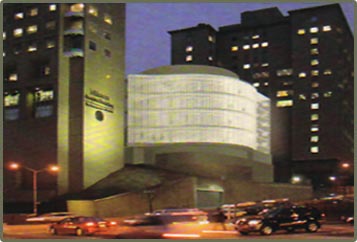
The image above, of one of KSW's current projects, the cardiovascular center at New York Presbyterian Hospital, is from KSW's website.

Sunday, November 9, 2008

The Next Stimulus Package


Some pundits and politicians have called for aid to states to be part of the next stimulus package, since this would fill holes in state budgets and help finance local infrastructure projects that may have been delayed by a lack of funds. At the same time, others have raised concerns that the resulting increases in the federal deficit could spook investors and lead to higher interest rates in the next few years.

If aid to the states is part of the next stimulus package, instead of simply writing checks to the states, the federal government ought to offer to buy an equivalent amount of new general obligation bonds issued by the states. These bonds could be structured with low coupon rates for the first few years, say, 1% above the rate on the U.S. Treasury bonds, with a reset to higher rates after three years. That ought to give the states the funds to cover their budgets and complete infrastructure projects, and give them an incentive to refinance the debt by issuing new bonds to the usual municipal bond investors after the economic downturn ends (with taxes likely higher in a few years, there would be more demand from affluent investors for tax-free municipal bonds). Knowing that the federal government would be repaid in a few years ought to assuage the market for U.S. Treasuries.

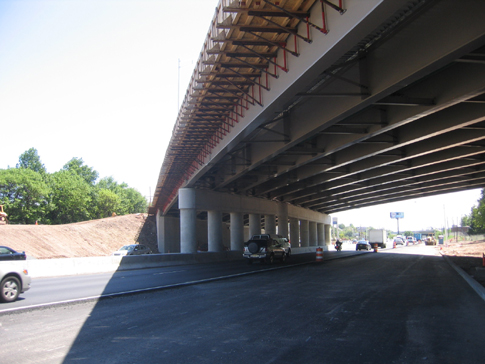
The photo above, from the NJ Department of Transportation website, is of part of a recently completed, federally funded $68 million local infrastructure project, the replacement of the Essex Street bridge and the reconstruction of the Route 17/Essex Street interchange.

Monday, November 3, 2008

KSW Reports


In a recent post ("KSW Update"), we noted that KSW (Nasdaq: KSW) announced it had been awarded a new contract worth between $24 million and $25 million, but that its backlog remained unchanged at $139 million. Today KSW reported that its third quarter revenue was $25.5 million, which explains why the company's backlog remained unchanged: it worked off about as much of its backlog as it added to it. Below are the highlights from KSW's release:

Financial Highlights for the quarter ended September 30, 2008 include:

* Total revenue increased by 21.4% in third quarter 2008 to $25.53 million as compared to $21.03 million in third quarter 2007;
* Net income in third quarter 2008 increased by 36.9%, to $1.32 million, or $0.21 per basic and fully diluted shares, up from $964,000, or $0.16 per basic and $0.15 fully diluted shares in the same period of the prior year;
* As of September 30, 2008, cash, cash equivalents and marketable equity securities totaled $18.96 million;
* The Company is debt-free.

[...]

Chairman of the Board Floyd Warkol commented, “We have been careful to ensure that we have a reserve of cash and cash equivalents, which is the safest way to weather the current economic crisis. Even in harsh economic times, KSW’s ability to save owners money makes us better positioned than other contractors.”

KSW currently has over 20 projects underway in New York City, including the Trump International Hotel and Tower in Manhattan’s Soho area, the 52-story luxury rental and hotel building at 839 Sixth Avenue in Manhattan, an ultra-luxury residential tower at 56 Leonard Street, and the New York Presbyterian Hospital’s Cardiovascular Center in upper Manhattan. KSW has also been selected as the HVAC Trade Manager for pre-construction services on three new hospital projects.


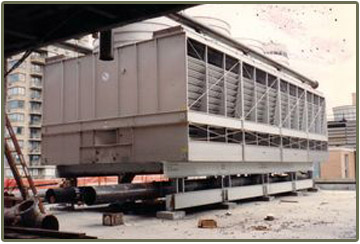
The image above comes from Completed Projects -- Hospitals/Research section of KSW's website.

Sunday, August 10, 2008

Recapping the Alloy Steel Situation


What Happened?

Alloy Steel's shares dropped sharply Thursday after the release of the company's 10QSB, which showed $2,541,776 in sales, and net income of $230,946 or $0.014 per share, versus $4,206,235 in sales, and net income of $1,154,206 or $0.068 per share for the previous quarter.

Why did the stock drop so much?


Mainly because the sequential drop in revenue was so steep, and that suggested to some investors that demand for the company's patented Arcoplate alloy steel wear plates had weakened.

Demand didn't weaken? That was a big sequential drop in sales.

Sales were certainly down sequentially, but part of this appears to have been a timing issue. Since the company has profit margins of about 50%, and it showed $785,000 in finished goods on its balance sheet for the quarter, the $785,000 in finished goods listed on the balance sheet represents about double that amount in sales. So had those sales hit in the June quarter, that would have added about $1.57 million to the top line.

So the shares dropped because of that?

They probably would have gone down even if those sales had hit during the quarter, since even with that ~$1.57 million in sales there would have been a sequential decline, but the decline wouldn't have been as steep (e.g., from $4.2 million to $4 million, instead of from $4.2 million to $2.5 million), so the stock probably wouldn't have gone down as much.

Is the investment thesis still intact?

I think so. In addition to the finished goods which represent pending sales, last month the company released an 8-K announcing a $1.8 million order from Fortesque Metals Group in Australia and a $630k order from a client in Malaysia. A month earlier, the company announced that it was in the last stages of negotiating a joint venture with a Mongolian conglomerate (although this probably won't contribute to revenues until sometime next year).

More generally, the company's product has been accepted by the major mining companies operating in Australia, and if it makes sense to use Arcoplate wear plates on mining equipment in Australia, because Arcoplate reduces downtime and increases the efficiency of mining operations, then it makes sense to use it on mining equipment in Brazil, Canada, the U.S., etc., so there is a significant potential international market for the product.

What is the investment thesis again?

Alloy Steel is a 'picks & shovels' play on the mining industry. Its patented alloy steel wear plates reduce wear, which prolongs the life and reduces the downtime of mining equipment. These wear plates reduce "hang up" and "carry back" -- the tendency of ore and other materials to adhere to the surfaces of truck beds, bulldozer shovels, etc. "Hang up" and "carry back" reduce the efficiency of mining operations, because they reduce the volume of ore being produced per truckload, scoop, etc. Arcoplate also has applications in infrastructure, as these wear plates can perform the same function on earth moving and excavation equipment. The company has also developed a computerized process to apply a layer of alloy steel inside pipes, but has put this application on hold due to demand for the Arcoplate wear plates.

How do you know investors won't be disappointed by next quarter's earnings?

I don't, which is part of what makes this interesting. But I am still confident in the Alloy Steel's longer term growth prospects, so I remain bullish on the company.

Update: Due to the price drop last week, which lowered Alloy Steel's enterprise value as relative to its trailing twelve month earnings, the company is now on the Magic Formula top-100 list. I don't expect this will expose the company to a lot of new investors though. Given its performance since the publication of the book, the Magic Formula probably has fewer adherents today, and my sense (from reading Yahoo's Magic Formula message board) is that most of those who still follow it strictly stick with stocks with a minimum market cap of $100 million (Alloy Steel's market cap is about $30 million).

Saturday, August 9, 2008

A Tall, Cool Drink of... Sewage?


Tomorrow's NY Times Magazine has a general interest article by Elizabeth Royte on the processing of sewage into drinking water, "A Tall, Cool Drink of... Sewage?". The article notes that the reprocessed water is purer (as measured by "T.D.S.", "total dissolved solids") than reservoir water (or even bottled spring water), and yet then Orange County, California treatment plant she profiles pumps the treated water into a reservoir where it filters through sand and gravel for a few months before being pumped into taps by utilities:

In other words, nature messes up the expensively reclaimed water. So why stick it back into the ground? “We do it for psychological reasons,” says Adam Hutchinson, director of recharge operations for the water district. “In the future, people will laugh at us for putting it back in, instead of just drinking it.”


Some have said that the scarcity of potable water in many parts of the world represents a macro trend from which investors can profit, perhaps by investing in the companies that build wastewater treatment plants, or some of the equipment those plants use. I haven't done much homework in this, but I plan to look into it at some point.

Update: Today's NY Times Business Section includes a related article, The Feed: "Can Israel Find the Water it Needs?". The article mentions an Israeli multinational, Netafim, that's active in drip irrigation as well as wastewater treatment and other water resources areas, but it isn't publicly traded.

Also, reader SL directed my attention to this article in the current Barron's, about American Water Works (NYSE: AWK), "The Spigot Reopens at American Water Works".

Tuesday, July 29, 2008

Covered Bonds

Yesterday, the Treasury Department released a best practices guide to covered bonds. Here's a link to press release, which includes a link to the best practices guide: "Treasury Releases Best Practices to Encourage Additional Form of Mortgage Finance". In a nutshell, the way a covered bond works in the context of mortgage financing seems to be like this: instead of selling its mortgage loans to the securitization market, a bank keeps those mortgage loans on its books, and issues a bond using those loans as collateral. On the surface, this would seem to be a more transparent method of financing mortgage loans than the practice of selling those loans to the securitization market, where they are then bundled into MBS (which are then bundled into more complex CDOs and other complex securities).

David Merkel provides a detailed analysis in this post on his Aleph Blog, "Covering Covered Bonds", and in Forbes, Heidi Crebo-Rediker and Douglas Rediker claim that "Covered Bonds can Rebuild America". The co-authors' grandiose claim refers to infrastructure. They write,

Monday's embrace of covered bonds by U.S. Treasury Secretary Henry Paulson and senior representatives of the Fed, the Federal Deposit Insurance Corp. and the country's largest banks to help thaw the U.S. mortgage market is a laudable step, appealing to market proponents and skeptics alike. Introducing covered bonds to the U.S. is a great idea. In fact, covered bonds can help more than just the mortgage market.

At its most basic, a covered bond is a bond issued by a bank and backed by a dedicated group of loans kept on the issuing bank's balance sheet. While the introduction of covered bonds in the U.S. is not a magic bullet, covered bonds may be more than just a way to restart the mortgage market. They may also help unlock sorely lacking investment for U.S. infrastructure.

[snip]

Elsewhere in the world, many commercial banks and specialty public-sector banks use public sector covered bonds as a cheap source of funding. In particular, as a result of the enormous availability of funds for infrastructure projects through securities like covered bonds in Europe, European banks have developed great comfort with infrastructure as a core part of their general banking activities.


Crebo-Rediker and Rediker note that, because of their familiarity with financing infrastructure,

the loans for public-private partnership infrastructure projects like the Chicago Skyway, the Indiana Toll Road, the San Diego Toll Road and the Pocahontas Parkway in Virginia all came from European, not U.S., banks.


The authors slight (unintentionally, I'm sure) Australia's Macquarie, which has been involved in financing American infrastructure projects, including the Chicago Skyway.

Monday, July 21, 2008

Another Op/Ed in support of Increased Infrastructure Spending in the U.S.

The latest call for increased U.S. infrastructure spending comes in this column by Felix Rohatyn and Everett Erlich in today's Financial Times, "Measures to avoid the worst recession in 30 years". One of the measures the authors recommend is the creation of a national infrastructure bank, as proposed by Senators Chris Dodd and Chuck Hagel,

which would provide assistance to state and local governments to inc­rease investment in infrastructure. With an initial capital base of $60bn and the ability to insure the bonds of state and local governments, provide targeted and precise subsidies and issue its own 30-50-year bonds, the bank could easily provide $250bn of new capital to invest in local infrastructure over five years, which would also create several million new jobs, just as the domestic recession threatens to gain momentum.


This isn't the first time Rohatyn has advocated increasing spending on infrastructure. See, for example, this Washington Post op/ed from 2005 coauthored by him and Warren Rudman, "It's Time to Rebuild America: A Plan for Spending More -- and Wisely -- on Our Decaying Infrastructure". In March of this year, Rohatyn and Rudman teamed up again in a Financial Times column titled Infrastructure is America's best Investment". Someone more politically astute than me might know how much influence Rohatyn retains within the Democratic Party. He was prominent during the Clinton administration, and was rewarded with the ambassadorship to France for his efforts, as I recall. It's worth noting that in today's column, Rohatyn teamed up with a fellow Democrat, the former Clinton administration official Erlich, instead of with his Republican friend Warren Rudman. Perhaps Rohatyn sees the current political environment as so tilted toward Democrats that he is less interested in making a bipartisan pitch for his proposals? Or perhaps I am reading too much into his choice of coauthors this time around.

This FT op/ed comes less than a month after the Economist editorialized about the need for increased infrastructure spending in the U.S., as I noted and commented on in this post, The Economist: "The Cracks are Showing".

Thursday, July 3, 2008

Alloy Steel International (AYSI.OB)

Parts of the post below I originally posted on GuruFocus on June 11th, shortly after buying Alloy Steel. Conveniently enough, the stock fell today, closing at the same price I initially bought it for, so the Magic Formula metrics I crunched below are accurate as of today as well. I have also added some additional information and updates below.

About Alloy Steel


Alloy Steel is an Australian company that manufactures its patented "Arcoplate" alloy steel wear plates for various types of mining equipment. In addition to reducing wear, which prolongs the life and reduces the downtime of mining equipment (equipment that is expensive to replace), these wear plates reduce "hang up" and "carry back" -- the tendency of ore and other materials to adhere to the surfaces of truck beds, bulldozer shovels, etc. "Hang up" (see photo below for an example) and "carry back" reduce the efficiency of mining operations, by reducing the volume of product being produced per truckload, scoop, etc. Alloy Steel's website contains this page with handy charts and photos explaining what their wear plates do and the value proposition they offer to mining companies: "Arcoplate Advantages". Take a moment to click on that link, because it will do a better job of conveying what I've tried to summarize above. According to Alloy Steel,


Arcoplate is designed for installation and use where structures and machinery frequently suffer wear problems. Common situations are:


  • the mining of iron, gold, nickel, coal, copper and other ores;
  • brick and cement works;
  • power stations


  • Alloy Steel is building another mill (which should start operating later this summer) to handle additional demand for its Arcoplate wear plates.


    How I Found Out About Alloy Steel

    Researching another company on the Magic Formula list, Manitowoc (MTW), prompted me to start researching steel companies. What I liked about Manitowoc was its exposure to the infrastructure boom overseas through its division that sells enormous cranes. I wondered how its margins would be affected by the rise in steel prices, since steel was obviously a huge input in building those cranes. After asking that question of Manitowoc's investor relations department, they directed me to a presentation their CEO had made at a JP Morgan conference a few days earlier (in early June), noting that the question about steel prices came up in the Q&A.

    The gist of the CEO's answer about dealing with rising steel prices was that Manitowoc would soon add a surcharge to new orders to account for its higher steel costs, and that it was unable to lock in prices with its suppliers for more than a few months out. The questioner asked about an angle I hadn't considered: the effect of higher steel prices on Manitowoc's multi-billion dollar backlog. Ordinarily, having a large backlog is a bullish indicator for a company, but what happens when a company signs contracts to build cranes for $X when steel costs $Y, and then when it's time to actually build the cranes, steel costs $1.5Y? The CEO's answer was that Manitowoc wouldn't attempt to renegotiate the contracts that comprised its backlog, so essentially, Manitowoc would be biting the bullet on the higher steel prices with those contracts. By the end of the presentation, I thought I might be better off owning stock in a company that sells steel than buys it, so I came up with the rudimentary idea of typing the word "steel" into the "get quotes" field on Yahoo! Finance, and looking up info on various steel companies, foreign and domestic.

    What I found, as you might expect, was that most of the steel companies were fairly pricey, since the sector had done well over the last few years (in part, by selling to companies such as Manitowoc, and more generally due to the infrastructure boom in China). Same with the big mining companies that supply the iron ore to the steel companies. Alloy Steel seemed like a great indirect, "picks & shovels" play on the infrastructure boom in China, and the related booms in steel and mining (Alloy Steel also has the potential to be a more direct play on infrastructure, since its wear plates would be of use on excavation equipment used in infrastructure projects, but this isn't currently a significant part of its business). Since, at this point, I was looking at Alloy Steel to fill a place in my Magic Formula portfolio, I decided to run the Magic Formula screens on it.

    Attempting to Apply the Magic Formula Screens to Alloy Steel


    Running the numbers for the first time over the weekend, I got an earnings yield of 12.69% and an ROIC of 93.5%. Rounding them as the Magic Formula list does, that would be an earnings yield of 13% and an ROIC of 75%-100%. Considering that the current MFI top-100 list has companies with both ROIC and earnings yields in that range, AYSI seemed like clear MF-like stock. So I bought it as part of my Magic Formula portfolio.


    Running the numbers again after I bought it, I realized I had made a mistake in getting the trailing twelve month EBIT numbers (the one I used was too high). Using the correct ttm EBIT numbers, I got an earnings yield of 9.6% and a ROIC of about 72% -- probably not high enough in combination for it to be on a Magic Formula top-100 list. With an ROIC in that range, the earnings yield would probably have to be between 15%-20% to be on the MFI top-100 list; i.e., a company as 'good' as Alloy Steel would probably need to be cheaper to be considered a Magic Formula stock.


    I liked the company anyway, so I bought it, but I'll be curious to run the MF screens again when the second quarter numbers are released. If its EV/EBIT and ROIC numbers are in MFI range then, will it appear on Greenblatt's MFI List? On the one hand, it's a foreign company, so maybe not. On the other hand, there have been several foreign Nasdaq-listed stocks on the MFI (e.g., the Chinese ones), and there have been OTC Bulletin Board stocks on the MFI list. I haven't seen a foreign OTC stock on there yet though.


    Updates

    Shortly after I bought Alloy Steel at $2.28, it traded as high as $2.85. After having done some additional research on the company, I was more bullish than I had been before, and thought perhaps I should have bought more initially. So I placed a GTC limit order to buy more shares at one penny over my initial price. That order was filled today.

    I've also tried to follow that old piece of advice from Charlie Munger, to "invert, always invert". So I tried to shoot some holes in the bullish case for Alloy Steel and came up with the following questions for company.

    Questions for Alloy Steel

    - In your SEC filings, I didn't see any specific clients of yours named. Are you unable to disclose their names due to contractual issues?
    - With respect to your current clients, what percentage (roughly) of their equipment that uses wear plates uses Alloy Steel's Arcoplate wear plates?
    - If it is a small percentage, is this because your clients are using Arcoplate on a trial basis?
    - Is it because they are waiting for you to ramp up capacity with your second mill?
    - Have you been materially affected, or do you anticipate being materially affected by the reduced natural gas supply as a result of the Varanus Island explosion earlier this month?
    - Have you, or would you consider, licensing your manufacturing process to other companies?

    After e-mailing these questions to Alloy Steel, I got a prompt response from the company's marketing coordinator letting me know that the CFO would be in on Wednesday and he would respond to me e-mail then (one plus of investing in companies this small, is that you can often get access to the CEO or CFO directly). I haven't heard from that CFO yet. As I write this it's early Friday morning in Western Australia, and when that marketing coordinator fires up his computer, he'll find a follow-up e-mail from me. If and when I get a response to my questions, I'll post the answers here. Based on the response I get to my questions, I may consider increasing my stake in the company, or I may reevaluate my decision to invest in it.

    Sunday, June 29, 2008

    The Economist: "The Cracks are Showing"

    Here's the latest in a series of editorials and op/eds that have appeared in various papers this year on the sorry state of American infrastructure, this time from The Economist: Infrastructure: The Cracks are Showing. The Economist piece repeats the startling estimate from the American Society of Civil Engineers, that $1.6 trillion will need to be spent over five years just to maintain the adequacy of our current infrastructure in the U.S. It also quotes a union president estimating that "47,500 jobs will be created for every $1 billion the government spends on infrastructure."

    There you have two reasons to bet on a significant increase in federal spending on infrastructure in the U.S. over the next few years:
    • We need it.
    • It will create jobs (which can help replace the ones lost in residential construction and other industries hit by the real estate and credit busts).
    There are also the benefits that increased infrastructure spending will stimulate the economy in the short term and potentially increase the productivity of the economy over the longer-term.

    What companies might benefit from this macro trend in U.S. infrastructure spending when it comes? One may be Perini Corp., (PCR), a Magic Formula company I invested in earlier this year (perhaps a little too soon). Here's a link to a description of Perini's infrastructure subsidiary, Perini Civil. Massachusetts-based Perini Corp.'s merger with Tutor-Saliba (announced via this press release in April) will result in a combined company with a presence in infrastructure from coast to coast. From the April press release:

    "Perini’s civil construction projects include portions of the Boston Central Artery/Tunnel project ($650 million); New Jersey Light Rail Transit ($142 million) and rehabilitations of the Triborough, Williamsburg and Whitestone bridges in the New York City area ($443 million). In addition, Perini has started work on the Harold Structures mass transit project in Queens, NY ($139 million) and express toll lanes along Route 95 in Maryland ($87 million)."

    [...]

    "Tutor-Saliba’s major ongoing and completed building projects include the Las Vegas Wynn Encore Hotel ($1.3 billion); the San Francisco International Airport reconstruction ($1.1 billion); the UCLA Westwood Hospital ($537 million); Planet Hollywood Towers in Las Vegas ($490 million) and the Los Angeles Police Headquarters building ($234 million)."

    Saturday, June 28, 2008

    A Macro Trend in Western Australia

    A few weeks ago, I bought shares in Alloy Steel International (AYSI.OB -- I'll post a write-up of it here soon), a company based in Western Australia. Since then, I've started to follow the news from Perth. The big news recently has been the huge natural gas explosion on Varanus Island earlier this month, that has reduced Western Australia's gas supplies by 30%. Today, Perth Now reports that Australia's Treasurer predicts that this will hamper economic growth in Western Australia and throughout the country for the rest of the year. Alloy Steel is scheduled to open a new mill this summer, so this could affect its ability to run at full capacity.

    Another article in Perth Now points to a macro trend worth noting: "Population explosion makes Perth the prime mover". Excerpt:


    A NEW study has found Perth is growing at the fastest rate of any city in Australia's 200-year history.

    Monash University population expert Bob Birrell said Perth's population would increase by 43 per cent between 2005 and 2021, taking the number of people living in the city from about 1.5 million to more than 2.1 million.

    Dr Birrell said that would constitute the fastest rate of growth of any Australian city, at any time.

    "This is absolutely massive, completely unprecedented,'' Dr Birrell said.

    "It's a massive task for building infrastructure."


    Time to start researching what local companies will benefit from this macro trend (infrastructure companies obviously are the first to come to mind), and then drill down further for potential investment opportunities. I'll post a follow-up after I've done some homework on this.