Showing posts with label Hedging. Show all posts

Thursday, January 21, 2010

Introducing Portfolio Armor


What Portfolio Armor is:


A site that enables investors to insure their stock and ETF investments (including ETFs that track indexes such as the S&P 500 and the Dow Jones Industrial Average) against market downturns as well as company- and sector-specific risk with put options.

Why put options?

Only put options protect you against losses when stocks or ETFs jump or "gap" downward. Limit sell orders don't do this. For more on put options, and how they can be used to hedge your risk, see Portfolio Armor for individual investors.

How it works:

You enter your stock and ETF holdings, and the maximum downside risk you are willing to accept for each holding. Then, using its proprietary algorithm, Portfolio Armor shows you the optimal put options to buy to obtain the level of protection you want at the lowest price.

Thursday, December 24, 2009

What would have been spectacular timing


A day late. Damn. Details later.

Update: Here are the details I didn't have time to write about earlier. Sorry about not writing this out earlier, but it takes me a while to write these posts, and I just didn't have the time to do that earlier today, so I posted that as a placeholder.

As I mentioned in a previous post, the biggest risk I see with Alloy Steel International (OTC BB: AYSI.OB) is, "a nasty exogenous event (e.g., a big fall-off in Chinese demand for industrial commodities1)". For companies that have options traded on them, you can of course buy puts on the company to hedge your position. How, exactly, to do that in an optimal way is what the next subscription-based site, Portfolio Armor, is about (Portfolio Armor isn't live just yet, but that's its logo above2). Portfolio Armor's proprietary algorithm tells you exactly how many of which put options to buy to give you the level of protection you specify at the lowest cost.

Of course, Alloy Steel doesn't have any options traded on it, so there would be no way to use options to hedge against any purely idiosyncratic risk, but there are ways to hedge against the exogenous risk. I thought about this last night and figured that a way to do that would be to buy puts on a steel company with significant exposure to China. Then I figured, instead of using just any steel company with exposure to China, why not try to find a financially distressed one? I found just such a company using the screener on Short Screen. To give me a rough idea of how many of which of that company's puts to buy to hedge my AYSI position against the specific exogenous risk I mentioned above, I e-mailed my developers at around 8:30 am, asking them to run the algorithm on the steel company I found. When I got the answer from them later, I went to pull up the option and learned that the financially distressed steel company had announced a secondary offering at around 9am today, and on news of that dilution the stock dropped more than 20%, and the optimal put contract spiked more than 50%. Too bad I didn't think of this a day earlier.


1That's the big question. We presented the positive view on China this post back in September, "China's new self-propelled economy", and the editors of the FT presented the scary view in this editorial last month, "The cost of China’s excess capacity". In a nutshell, the positive scenario: China's big stimulus this year has helped transition its economy to one fueled more by internal demand, in which case there should be continued growing demand for industrial commodities to build infrastructure in underdeveloped parts of China, manufacture first refrigerators for rural Chinese, etc. And the negative scenario: China's stimulus has been mainly hair of the dog, propping up an unsustainable status quo relying on massive trade surpluses that over-extended Western consumers can no longer support.

2Recall our discussion in this recent post of the initial challenges in coming up with this logo.

Thursday, November 5, 2009

Hedging

Took advantage of the up day today to pick up a few more DIA puts. I'm working on a more precise hedging strategy, but these should suffice in the meantime. Hedging plus shorting)
so I'm not swimming naked when the tide goes out.

Saturday, July 18, 2009

Hedging against Job Loss

You can't hedge against the idiosyncratic risk of losing your job, but you can hedge against rising unemployment nationally. The North American Derivatives Exchange (Nadex.com, formerly Hedgestreet.com) offers options on the unemployment rate and other economic events. I did a quick search to see if any financial writer had suggested these options as part of a strategy to hedge against the risk of unemployment. So far, I haven't found any.

I'm curious also about whether the managers of staffing firms have used these options. A number of publicly-traded staffing firms had significant amounts of net cash on their balance sheets last year; did any of them use some of that net cash to hedge against an increase in the unemployment rate? If they did, they'd have even more cash now.

Tuesday, July 7, 2009

Blaming it on the Brooklyn College Guy


Who was responsible for bringing the global financial system to its knees? According to Princeton alumnus Michael Lewis, and MIT alumnus Jake DeSantis (one of the only current or former traders at AIG's Financial Products division willing to speak to Lewis on the record), it was Brooklyn College alumnus Joe Cassano (pictured above), a cop's son whose status insecurities caused him to yell a lot at his underlings over issues as trivial as who left the weights on the Smith machine1. So claims Lewis in his Vanity Fair article on the implosion of AIG's Financial Products division, "The Man Who Crashed the World" (Hat Tip: Real Clear Markets). Allowing a number of AIG F.P.'s traders to impugn Cassano anonymously was apparently the price Lewis had to pay for his access, but the article is worth reading anyway, as Lewis's Wall Street articles usually are.


1Given Lewis's familiarity with sports as well as finance, while reading the anecdote about the Smith machine, I wondered if Lewis would bring the Smith machine up later in the article as a metaphor for hedging risk, but no dice.

Monday, May 4, 2009

Hussman's Latest

In In his latest market commentary, "Comfortable with Uncertainty", Dr. Hussman shares some thoughts on dealing with market uncertainty, describes a new autism-related discovery by the Miami Institute for Human Genomics (with which Hussman is involved via his eponymous foundation), mentions that he was the subject of a Money magazine profile (though doesn't link to the article), and throws in a little self-deprecating humor to boot. A few brief excerpts:

On dealing with uncertainty:

In his book On Being Certain, neurologist Robert A. Burton quotes F. Scott Fitzgerald – “The test of a first rate intelligence is the ability to hold two opposed ideas in the mind at the same time and still retain the ability to function.” Buddhist teacher Pema Chodron calls it “being comfortable with uncertainty” – being willing to take every aspect of reality as the starting point, without wasting energy wishing things were different, without denying reality as it is (even if your next step is to work toward changing things), and without needing to know what will happen in the future. “The truth you believe and cling to makes you unavailable to hear anything new. The best thing we can do for ourselves is to be open to an unknown future.”

Burton offers the same advice. Tolerating the unpleasantness of uncertainty, he writes, “is the only practical alternative to cognitive dissonance, where one set of values overrides otherwise convincing contrary evidence. Each position has its own risks and rewards; both need to be considered and balanced within the overarching mandate: Above all, do no harm. Science has given us the language and tools of probabilities. We have methods for analyzing and ranking opinion according to their likelihood of correctness. That is enough. We do not need and cannot afford the catastrophes born out of a belief in certainty.”


Hussman humor:

See, I really can write a whole weekly comment without repeating that the bondholders of mismanaged financial companies should be required to accept debt-for-equity swaps or haircuts, with the alternative being government receivership. Didn't even mention it.


Oops.


The photo of Hussman above, by Nigel Parry, accompanied the Money article ("Best Bear Market Fund Manager Around") to which Dr. Hussman (perhaps in his excitement about the autism discovery) apparently forgot to include a link in today's market commentary.

Tuesday, March 17, 2009

Marty Whitman Wishes He Had More Liquidity


Investopedia notes (Hat Tip: The Guru Five):

Value investor Marty Whitman, head of mutual fund firm Third Avenue Management, recently had this to say (along with Senior Research Analyst Ian Lapey) about the markets, "Third Avenue wishes it had more liquidity, because then management would have been heavy buyers of high-quality equity securities, which are now as cheap as either of us ever remember them being."


I'm sure Whitman's investors in his Third Avenue funds wish they had more liquidity too. Perhaps they would, if Whitman & Co. hadn't lost so much of their money last year. This raises a question about the role of risk management and hedging in open end mutual funds. Long-time value investors such as Marty Whitman may have the iron stomachs to handle what many value investors term "quotational losses" (or, as most other investors call them, "losses"). But one of the challenges of running an open end mutual fund is that investors with lower risk tolerances will invariably redeem their money while many of the fund's investments are down, forcing the fund manager to sell positions at a loss to meet those redemptions. Wouldn't it make sense to plan for this contingency by hedging, increasing cash levels in up years, or by some other means?

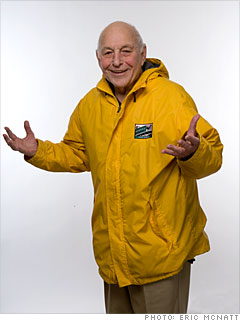
The photo above, of Whitman, comes frm this Fortune article: Five Funds for 2009.

Tuesday, December 16, 2008

Great Name for a Hedge Fund Adviser

From the Financial Times's front pager on the Madoff scandal ("Madoff fallout spreads worldwide"):

“This was the train wreck that happened in broad daylight,” said Jim Hedges, a hedge fund adviser who did not place any investors’ money with Bernard Madoff Investment Securities.

Monday, November 24, 2008

John Hussman Becomes a Guru

Dr. Hussman takes his place among the diverse group of value investors designated as gurus at GuruFocus.com.

Here is Dr. Hussman's latest market commentary: "The Cornerstone of Capitalism". Below are a few excerpts.

On the government's response to the financial crisis:

The two most important actions that government can take to address this crisis are: 1) continue to provide capital directly to the banks, rather than purchasing troubled assets, and 2) reduce the mortgage principal of distressed homeowners in return for a claim on future price appreciation.

[...]

...Treasury was absolutely correct to abandon the awful idea of buying up distressed assets directly from the banks. As I noted in September (9/29/08 – You Can't Rescue the Financial System if You Can't Read a Balance Sheet), if you buy the bad assets off the balance sheet at their market value, nothing changes on the liability side. The only way buying questionable assets would increase capital (particularly “Tier 1” capital, which is what gives depositors confidence) would be for the Treasury to overpay for those assets.


Secretary Paulson has repeatedly said that the Treasury abandoned the plan to buy distressed assets because “the facts changed.” The only fact that changed is that the Treasury realized that this was a really bad idea.

[...]

I don't believe that the U.S. economy needs any massive “stimulus” targeted toward consumers. The force of this economic downturn is coming from mortgage losses, and the interventions we require must be targeted at 1) bank capital and 2) mortgage principal reductions in return for property appreciation rights.

[...]

Boost bank capital and restructure the payment obligations of distressed mortgages, and credit, confidence and consumption will quickly be restored.


On investment returns:

Investment returns aren't “free money.” Over the long-term, they are compensation for providing scarce, useful resources – liquidity, information, and risk-bearing – to other market participants. No useful services are provided to the market by a speculator who follows the crowd and chases glamour stocks higher late in an extended bull market run.

[...]

In contrast, the market compensates investors – not over the short-term, but predictably over the long-term – for the willingness to bear risk when other investors are unwilling; for the willingness to provide liquidity by holding out bids (gradually and at depressed prices) to panicked holders stampeding to get out; and for improving the information content of market prices by reducing the pressure for undervalued stocks to become even more distorted in relation to their probable cash slows. Long-term returns in a market economy are always compensation for providing scarce, useful resources to other participants in that market. If the activity is not scarce, and is not useful to others, there is no reason to expect it to to be profitable.

Sunday, November 2, 2008

Notes from an Investor Who Avoided Large Losses This Year, Part II

Below is the continuation of Buffetteer17's notes on his hedging strategy (click here for Part I):

A few words about those S&P 500 index put options. I bought them at market highs last year. I was concerned that The Portfolio was doing too well. In Oct. 2007, it was yielding a CAGR of 39%. And that was return on assets. The return on equity was higher, about 50%, since I was about 20% on margin. While I might dream that I was the second coming of young Warren Buffett, when I woke up, I knew it wasn't so. It was largely luck, leverage, and a 3 year bull market, and---perhaps---a little bit of skill. I did not predict the bottom would fall out of the market, but I did consider what would happen to a leveraged portfolio if it did. So I decided to sacrifice a few percentage points of returns in exchange for market crash insurance. I bought S&P 500 index puts with a face value (sum of strike prices) of about 2x the size of The Portfolio. Average strike price was around 1250 and average time to expiration around 18 months. The two key objectives were to put in a floor below which The Portfolio is very unlikely to fall, and to provide funds to meet margin calls if they come. Most of my put buying was around S&P 500 level of 1500-1550, so the options would not protect much against moderate drops, say 20%. But they would become extremely valuable on a drop of 40-50%. The cost of the puts was about 6% of The Portfolio. Given that the lifetime of the options is about 18 months, and that the cost is deductable (assuming they expire worthless), this would hurt my total return by about 3%/year. As it happened, the damage is already reduced to about 1%/year, since I sold a few the puts on 1/22/08 and 3/7/08 for incredible percentage gains. Without the puts, my loss this quarter would have been 22% instead of 16%. The puts don't really fully kick in until S&P 500 level of about 1250.

Q2-08 (hedge 13.2%) The hedge comprises a number of S&P 500 index put options, with a face value (sum of strike prices) of about 2x the stock portfolio, with strike prices varying from 1350 to 800, and expirations of 12-18 months. The hedge is doing its job fairly well. That job is to insure against margin calls and put a floor under my net worth. The floor turned out to be a little lower than I planned, because my stock portfolio declined faster than the S&P 500 index. During the market dip in late June, I sold down a little. This reduced my basis cost for the options to 2.5% of my portfolio and the remaining options are up 186%. I'm in no danger of being forced to sell undervalued stocks due to a margin call. If the S&P 500 drops further and my stocks drop proportionally, I'll actually gain quite a bit, since the options are now sufficiently close to the strike prices that they have quite high deltas. I estimate that the existence of the hedge has added 3.7% to my returns since inception.

Q3-08 (hedge 10.8%) The hedge comprises a number of S&P 500 index put options, with a face value (sum of strike prices) of about 1.5x the stock portfolio, with strike prices varying from 1250 to 800, and expirations of 12-18 months. I bought the hedge a little over a year ago, at a cost of about 4% of the portfolio value. I had no idea that the stock market would crash and the economy would enter recession. But I was concerned about the collapsing housing market and early hints of a credit freeze. I figured I would take out some cheap insurance, just in case. The hedge is doing its job fairly well. That job is to insure against margin calls and put a floor under my net worth. The floor turned out to be a little lower than I planned, because my stock portfolio declined faster than the S&P 500 index. This quarter I sold about 1/4 of the options. By now, the profit from the hedge is so much that even if the remaining options expire out of the money, the hedge has more than paid for itself. This has been by far my best investment of the year, with returns north of 300%/year. Too bad I didn't put more money into it.

Notes From an Investor Who Avoided Large Losses This Year, Part I

An individual investor who goes by the name "Buffetteer17" on GuruFocus avoided large losses this year by hedging his portfolio. Below are his notes explaining what he did on a quarterly basis. This is long, so I've broken it up into two posts.

History of the Hedge. Every quarter, I do a writeup on my portfolio, so I can recall what I was thinking and review previous mistakes. Here are excerpts from the quarterly reports, starting with the Q2-2007 one. Apologies for the repetition, but I wanted each quarterly writeup to stand alone.

Q2-07: (hedge 1.0%) I started a small hedge position, comprising S&P 500 index puts with various dates going out about a year, and various strike prices around 1200-1300. The purpose of the hedge is to make it safer for me to use debt and margin to buy stocks. The portfolio yield has stayed in a band from 20% to 30%/year, after tax, for a couple of years now. I can borrow money at an after-tax rate of under 6%. Why not borrow at 6%, earn at 25%, and pocket the difference? The answer of course is risk; a serious bear market could easily reverse that 25% to minus 25%. There is also the risk of a margin call, disrupting the portfolio by forcing me to sell great companies at depressed prices. But if there is a serious correction or bear market, those S&P index puts will become extremely valuable, giving me something besides good stocks to sell to meet margin requirements. It may sound like I'm going way out on a limb, but I'm not. I'm limiting my margin debt to about 20% of capital. The hedge, incidently, is actually currently making a profit, since I bought the puts at market peaks. However, my fervent hope is that hedge expires worthless. It is strictly insurance against severe market corrections.

Q3-07 (hedge 2.8%) I slightly increased my hedge position in S&P 500 index puts with strike prices around 1250, and I will keep it going as long as I'm using margin debt. Currently margin debt is around 30%. Oddly, I've actually made a small profit on the hedge, since the S&P 500 has gone down a little since I started it. With the present combinination of high returns (32%) and high margin debt (30%), I feel quite comfortable paying the 2%/year or so that the hedge is likely to cost me for insurance. At some point, I will pay off the debt, and rethink whether the hedge is a good idea.

Q4-07 (hedge 6.8%) The Portfolio is fairly highly leveraged right now, at about 35% margin loan. This leverage was mostly taken after the big Nov. drop in the market, to pick up bargains. Hopefully, the 6.8% of S&P 500 index puts will give sufficient protection against margin calls if the market tanks in 2008.

Q1-08 (hedge 13.1%) I entered the quarter more than fully invested, about 130%, and ended it about 150% invested. I wasn't very active...Actually my S&P 500 index put options were up more than anything else on a percentage basis this quarter, 48%, but I consider them insurance rather than a for-profit investment.


Click here for Part II