Showing posts with label john hussman. Show all posts

Monday, April 20, 2009

Has Greg Mankiw Jumped the Shark?


You be the judge. From his "Economic View" column in the New York Times yesterday, "It May Be Time for the Fed to Go Negative":

Imagine that the Fed were to announce that, a year from today, it would pick a digit from zero to 9 out of a hat. All currency with a serial number ending in that digit would no longer be legal tender. Suddenly, the expected return to holding currency would become negative 10 percent.

That move would free the Fed to cut interest rates below zero. People would be delighted to lend money at negative 3 percent, since losing 3 percent is better than losing 10.

Of course, some people might decide that at those rates, they would rather spend the money — for example, by buying a new car. But because expanding aggregate demand is precisely the goal of the interest rate cut, such an incentive isn’t a flaw — it’s a benefit.


Would your first response to this scenario be to buy a new car? I bet a lot of people would decide instead to buy gold, or to exchange their U.S. dollars for the currency of a country less likely to pick a number out of a hat and invalidate a tenth of its currency.

Later in his column, Mankiw offers a more reasonable way that the Fed could create negative real interest rates, by committing to a certain level of inflation (presumably one higher than the Fed's current 2% target). Is this the best way to spur aggregate demand though? If this is a balance sheet driven recession, as some observers have termed it, and the problem is that many consumers can't service their debts, why not deal with that more directly?

For those whose mortgages are underwater, restructuring them using John Hussman's idea of property appreciation rights might make make sense. That would lower monthly borrowing costs for those mortgagers and enable them to increase their discretionary spending. For mortgagers who aren't currently underwater, the idea of Glenn Hubbard and Christopher Mayer, to use the GSEs to lower mortgage rates down to their historic spread of about 1.6% above 10-year Treasuries might make sense. According to Yahoo! Finance, the average rate on 30-year fixed rate, conforming mortgages today is 4.88%; since 10-year Treasuries currently yield 2.75%, under the Mayer and Hubbard plan mortgage rates might average 4.35%. Refinancing higher-rate mortgages at 4.35% would also lower borrowing costs and enable tens of millions of Americans to increase their discretionary spending.

The image above, of the Happy Days character Fonzie (played by Henry Winkler) jumping the shark1 comes from Media Bistro.

1For those unfamiliar with the phrase, see the Urban Dictionary's definition of "jumping the shark".

Tuesday, April 7, 2009

"Fighting Recklessness with Recklessness"

That's the title of John Hussman's latest market commentary. Excerpt:

Look. You can play hot potato with the toxic assets all day long, and only outcome will be that the public will suffer the losses that would otherwise have been properly taken by the banks' own bondholders. You can tinker with the accounting rules all you want, and it won't make the banks solvent. It may improve “reported” earnings for a spell, but as investors who care about the stream of future cash flows that will actually be delivered to us over time, it is clear that modifying the accounting rules doesn't create value. It simply increases the likelihood that financial institutions will quietly go insolvent. I recognize that the accounting changes may reduce the immediate need for regulatory action, since banks will be able to pad their Tier 1 capital with false hope. But we have done nothing to abate foreclosures, and we are just about to begin a huge reset cycle for Alt-A's and option-ARMs. As the underlying mortgages go into foreclosure, it will ultimately become impossible to argue that the toxic assets would be worth much even in an “orderly transaction.”

Meanwhile, in a bizarre convolution of reality reminiscent of Alice in Wonderland, the Financial Times reported last week: “US banks that have received government aid, including Citigroup, Goldman Sachs, Morgan Stanley and JPMorgan Chase, are considering buying toxic assets to be sold by rivals under the Treasury's $1,000bn plan to revive the financial system.” And why not? They can put up a few percent of their own money, and swap each other's toxic assets financed by a bewildered public suddenly bearing more than 90% of the downside risk. The “investors” in this happy “public-private partnership” keep half the upside while ordinary Americans take the downside off of their hands. Some partnership.


With regard to the economy, there is quite a bit of optimism that the recent market advance represents a forward-looking call that the economy will recover in the second half of the year. Indeed, some analysts have noted that year-over-year consumer spending has only declined very slightly, hailing this as evidence that economic concerns are overblown. The difficulty is that consumer spending has never declined on a year-over-year basis, except in this downturn, so that slight decline is actually the worst showing for consumer spending in the available data. Likewise, capacity utilization has plunged to levels seen only in 1974 and 1982, both which were accompanied by far deeper valuation extremes than at present.

Monday, March 30, 2009

Hussman Ties It All Together

In his latest market commentary ("On the Urgency of Restructuring Bank and Mortgage Debt, and of Abandoning Toxic Asset Purchases"), Dr. Hussman lucidly recaps his previous objections to the government's responses to the financial crisis and offers alternative solutions. On the issue of credit default swaps, Hussman writes that the government ought to,

[L]egislate a restriction on the use of credit default swaps (essentially insurance contracts against the failure of a company's bonds), requiring that such swaps may be used for bona-fide hedging purposes only. That is, a credit default swap could not be entered for purely speculative purposes, but only to offset the default risk of the same or similar bonds held by the investor.


This is similar to George Soros's recent comments on credit default swaps (e.g., in this Wall Street Journal op/ed last week, "One Way to Stop Bear Raids"), and it's consistent with the long-standing doctrine in the insurance business that only those with an "insurable interest" (i.e., something to lose if something bad happens to the insured) are allowed to take out insurance policies1. This reduces the chance that a policy holder will try to deliberately damage the insured in order to collect on the insurance policy.

Hussman covers a lot more ground in this week's commentary, and his essay is worth reading in full.

1In the early days of the insurance business, this doctrine wasn't in force, and it was possible to, for example, take out a life insurance policy on a complete stranger, despite the perverse incentives that would create.

Tuesday, March 24, 2009

John Hussman's Latest Market Commentary


In his market commentary yesterday ("Fed and Treasury - Putting off Hard Choices with Easy Money (and Probable Chaos)"), Dr. Hussman reiterated his call for the government to require bond holders in financial institutions to assume some losses in order to recapitalize those firms:

Make no mistake - we are selling off our future and the future of our children to prevent the bondholders of U.S. financial corporations from taking losses. We are using public funds to protect the bondholders of some of the most mismanaged companies in the history of capitalism, instead of allowing them to take losses that should have been their own. All our policy makers have done to date has been to squander public funds to protect the full interests of corporate bondholders. Even Bear Stearns' bondholders can expect to get 100% of their money back, thanks to the generosity of Bernanke, Geithner and other bureaucrats eager to hand out the money of ordinary Americans.


Though I believe that the consequences (via credit default swaps and the like) are overstated of letting bondholders take a haircut, and will ultimately be no worse than having the public take the losses, the fact is that we don't even need the bonds of major financial institutions to go into default. What we do need to do is offer those bondholders a choice:


1) The U.S. government takes receivership of the financial institution, changes the management, wipes out the stockholders and a chunk of the bondholders claims entirely, continues the operation of the institution in receivership, eventually reissues the company to private ownership, and leaves the bondholders with the residual. This is not “nationalization,” but receivership – a form of “pre-packaged bankruptcy” that protects the customers and allows the institution to continue to operate, followed by re-privatization. As I've previously noted, this would fully protect all of the customers and depositors at no probable expense to the public. Alternatively;


2) The bondholders voluntarily agree to move a portion of their claims lower down in the capital structure, swapping debt for equity (preferred or common), allowing the bank to have a larger cushion of Tier-1 capital, avoiding insolvency, and hopefully allowing the bank to recover by its own bootstraps, preferably assisted by debt restructuring on the borrower side (via property appreciation rights and the like). Similar debt/equity swaps would be an appropriate strategy toward failing U.S. automakers as well.


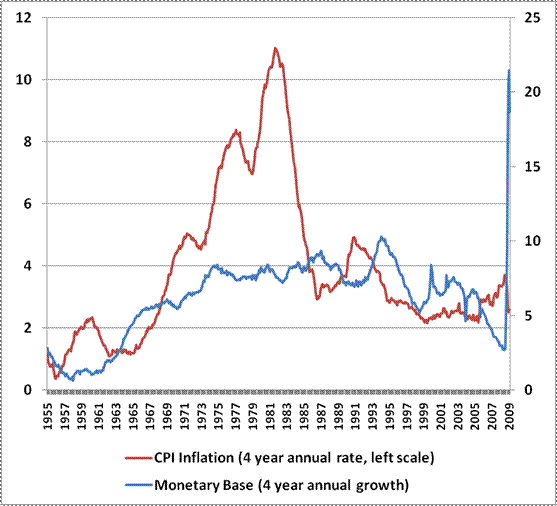
Hussman also added a note on inflation:

The reason we're not seeing inflation here and now is that despite a near doubling in the monetary base, we've seen a buildup in goods inventories combined with a surge in safe-haven demand for government liabilities. So investors have absorbed the increased supply of government liabilities without a collapse in their marginal utility. This will not persist indefinitely, so unfortunately, any nascent economic recovery in the next couple of years will be against the headwinds of both Alt-A mortgage defaults (coming to your neighborhood in 2010), and inflationary pressures as soon as safe haven demand for Treasuries eases back even moderately.


The graph above, of 4 year annual CPI growth versus 4 year annual growth in government spending, accompanied Hussman's column.

Tuesday, March 10, 2009

John Hussman's Latest: "Buckle Up"


In his latest market commentary ("Buckle Up") Dr. Hussman reiterates his call for the government to make bank bond holders take eat some losses:

The misguided policy response from Washington has focused almost exclusively on squandering public money and burdening our children with indebtedness in order to defend the bondholders of mismanaged financial institutions (blame Paulson and Geithner – I've got a lot of respect for our President, but he's been sold a load of garbage by banking insiders). Meanwhile, I suspect that the little tapes in Bernanke's head playing “we let the banks fail in the Great Depression” and “we let Lehman fail and look what happened” are so loud that he is making no distinction about the form of those failures. Simply letting an institution unravel is quite different from taking receivership, protecting the customers, keeping the institution intact, replacing management, properly taking the losses out of stockholder and bondholder capital, and issuing it back into private ownership at a later date. This is what it would mean for these banks to “fail.” Nobody is advocating an uncontrolled unraveling of major financial institutions or permanent nationalization as if we've suddenly become Venezuela.


[...]

The course of defending the bondholders of insolvent institutions is not sustainable. Do the math. The collateral behind private market debt is being marked down by easily 20-30%. That debt represents about 3.5 times GDP. That implies collateral losses on the order of 70-100% of GDP, which itself is $14 trillion. Unless Congress is actually willing to commit that amount of public funds to defend the bondholders of mismanaged financials so they can avoid any loss, this crisis simply cannot be addressed through bailouts. Bondholders have to take losses. Debt has to be restructured. There is no other option – but the markets are going to suffer interminably until our leaders figure that out.

[...]

Yes, some pension funds, insurance companies, mutual funds, and other investors who hold the corporate bonds of mismanaged financial institutions will take a haircut on those investments. As they should. But if we ignore the need to restructure debt obligations, we risk allowing this downturn to move aggressively into 2010.


The dot drawing of Hussman above comes from a Wall Street Journal article about him last week, "Outfoxing a Bear?". Hussman linked to this article in his market commentary.

Monday, February 23, 2009

Hussman Pivots


In his latest weekly commentary ("The Economy Needs Coordination, Not Money, From the Government"), Dr. Hussman seems to pivot a little on a couple of positions he took in his last market commentary (from which we excerpted in this post, John Hussman on "How to Climb out of a Global Financial Hole"). Last week, Hussman wrote this about Citigroup and some other large banks,

The government should continue to provide capital directly to large, diversified financial institutions which remain solvent but have some impairment to capital. Preferred stock is a reasonable form, though a high (possibly deferred) yield to the government is preferable to a low one (Bagehot's Rule[1]). Tight restrictions against using taxpayer capital for compensation and bonuses are certainly appropriate. These institutions include major banks like Citigroup, Bank of America, Wells Fargo, J.P. Morgan, and others, which appear to be experiencing pressure not because of insolvency, but because of uncertainty about potential future loan losses, and the ongoing availability of publicly provided capital.


Market action over the last week seems to have prompted a different view of Citi from Hussman today,

Take a look at Citibank's balance sheet as of the third quarter of 2008. The company had about $2 trillion in assets, versus about $132 billion in shareholder equity, for a gross leverage ratio of about 16-to-1. That's not a comfortable figure, because it indicates that a decline of about 6% in those assets would wipe out Citibank's equity and make the bank technically insolvent. Unfortunately, we saw credit default spreads screaming higher last week, while the bank's stock dropped below $2 a share, so evidently the market is deeply concerned about the possible immediacy of that outcome.


Instead of the government providing additional capital to Citi, now Hussman favors a sort of receivership,

But keep looking at the liability side of Citibank's balance sheet. There is over $360 billion in long-term debt to the company's bondholders, and another $200 billion in shorter term borrowings. None of that is customer money. That puts the total capital available to absorb losses at $132 + $360 + $200 = $692 billion, which is about 35% of the $2 trillion in assets carried by Citibank. That's a huge cushion for customers, who are unlikely to lose even if Citibank becomes insolvent. Should that occur, the proper response of government will not be to defend Citi's bondholders at taxpayer expense, but rather, to take Citi into receivership, wipe out the shareholders and most of the bondholders, and sell the assets along with the liabilities to customers to another institution.


On the broader point of dealing with foreclosures, Hussman still highlights the need for government coordination and the creation of PARs (proper appreciation rights) to compensate lenders for writing down the principal amounts of mortgages, but takes a slightly different tack on the issue of mortgage "cram-downs". Last week, Hussman wrote,

The most direct method of intervening is at the point of foreclosure through the courts. One way of doing this would be to give judges the ability to write down principal, and to assign the balance as a deferred “property appreciation right” (PAR) to the lender.


And this week, Hussman writes,

If you simply let bankruptcy judges push down principal values with no other recourse to lenders, you undermine the basic principles of contract law that underpin our economy. If you provide government funds to reduce the mortgage principal of some homeowners, with nothing for those who have played by the rules, you create huge inequities and incentives for good homeowners to go delinquent.


It may be that Hussman is being consistent here, i.e., that he's OK with allowing judges to reduce the principal on mortgages provided they compensate lenders with a PAR equivalent to amount the principle was reduced. Perhaps Dr. Hussman will clarify this next week. I suspect, though, that if the government facilitated a market for PARs (as Hussman recommends), most lenders would write down their mortgages in return for PARs voluntarily.

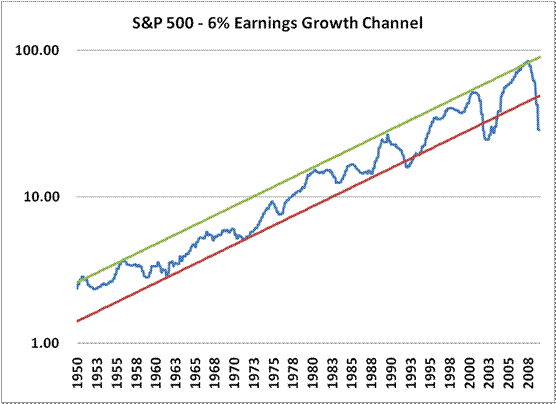
The chart above, which was included in Hussman's column, illustrates a point Hussman made about the steep recent decline in S&P earnings (earnings have historically grown 6% from one cyclical peak to the next cyclical peak).

Tuesday, February 17, 2009

John Hussman on "How To Climb Out of the Global Financial Hole"

From Dr. Hussman's market commentary today, "How To Climb Out of the Global Financial Hole":

•  Financials that are insolvent and are likely to survive only with large and sustained infusions of taxpayer funds should be allowed to fail in pre-packaged bankruptcies that wipe out both the shareholders and the bondholders of those institutions. Customers and depositors will not be hurt, and it won't cost taxpayers a penny. As Stiglitz notes, “you should not chase good money after bad.”


•  The government should continue to provide capital directly to large, diversified financial institutions which remain solvent but have some impairment to capital. Preferred stock is a reasonable form, though a high (possibly deferred) yield to the government is preferable to a low one (Bagehot's Rule[1]). Tight restrictions against using taxpayer capital for compensation and bonuses are certainly appropriate. These institutions include major banks like Citigroup, Bank of America, Wells Fargo, J.P. Morgan, and others, which appear to be experiencing pressure not because of insolvency, but because of uncertainty about potential future loan losses, and the ongoing availability of publicly provided capital.

•  Troubled assets should only be purchased if all of the pieces of a given issuance can be collected. The ability to aggregate all of the pieces is necessary because that's the only way the underlying mortgages can be restructured. If, for example, all of the pieces could be purchased at an average of 40 cents on the dollar (which is well above where many of these securities are marked), the underlying mortgages could be reduced by as much as 60%, making them solvent and likely to be repaid. The restructured loans might eventually even be re-sold into the market through the GSEs at no taxpayer expense.

•  The most direct method of intervening is at the point of foreclosure through the courts. One way of doing this would be to give judges the ability to write down principal, and to assign the balance as a deferred “property appreciation right” (PAR) to the lender. This would reduce foreclosure rates, preserve the value of the existing mortgage securities, and avoid concerns about fairness. A more ambitious government-sponsored program would be to make the PARs an obligation of homeowners to the Treasury administered through the IRS, asserting a claim on the price appreciation of the home or subsequent property owned by the homeowner. The foreclosure court would reduce principal, assign an offsetting PAR obligation to the homeowner, and assign the lender that same share in the Treasury's PAR Fund (basically a national pool of those PAR obligations). The PARs would then be marketable. Though they would undoubtedly sell at a discount to the face amount since not all the PARs will be repaid, they would be backed by a pool of real assets that are likely regain their value in the long-term, if not the near term. The Treasury could aggregate these claims and pay them out proportionately to the lenders, but would not even have to guarantee full payment – just enforce the claims by collecting and paying out.


The emphasis above is Hussman's. Hussman reiterates here a point he's made previously (e.g., "You Can't Rescue the Financial System If You Can't Read a Balance Sheet"), that forcing bondholders to take a haircut, or swap some of their debt for equity, would obviate the need for bailout funds from taxpayers in some cases. His advocacy of allowing bankruptcy judges to modify loans while awarding "property appreciation rights" (PARs) to lenders (his fourth bullet point above) raises a question though: if PARs existed now, would it be necessary for judges to intervene, i.e., wouldn't lenders have an incentive to write-down mortgages in return for PARs, particularly if such rights would be marketable, as Hussman envisions? Perhaps before allowing judges to re-write mortgages, the government ought to create a market for PARs and see if this helps expedite more voluntary restructuring of mortgage debt.

Another question Hussman's commentary raises relates to his point (in the third bullet point above) about the benefit of owning all the pieces of a securitized mortgage issue, i.e., that it would let the owner re-structure the underlying mortgages, making more of them viable and thus marketable. Why aren't more deep-pocketed institutional fixed income investors doing this already?

1"Lend freely at the penalty rate".

Saturday, December 13, 2008

John Hussman from May 2007

From one of Dr. Hussman's weekly market commentaries in May, 2007, five months before the end of the cyclical bull market that began at the end of 2002 ("How Much Do Interest Rates Affect the Fair Value of Stocks?"):

In recent months, I've used a wide variety of analytical methods (discounted cash flows, normalized earnings, price/peak earnings calculations, etc) to show that stocks are currently priced to deliver unusually poor long-term returns – stated simply, the U.S. stock market is more overvalued than at any point in history except during the late 1990's bubble.


It's worth reading the rest of that column, for Dr. Hussman's skeptical take on the Fed Model, and the conventional wisdom about the relationship between interest rates and stock valuations.

Monday, December 8, 2008

John Hussman's Latest Weekly Market Commentary

In his current market commentary, "Ambiguous Conditions Warrant Moderation", Dr. Hussman gives his opinion on the comparisons of today's economic environment to the Great Depression, finishing with a clever simile:

We continue to hear remarks that the current economic downturn is the worst since the Great Depression. While the prices of stocks and other financial assets have certainly suffered a great deal, by any reasonable measure of output and employment, this isn't even close to being the worst economic downturn since the Depression. Even after November's awful job report, and including all of the downward revisions, the U.S. economy would have to lose twice as many jobs as it has already lost even to be on par with the 1981-82 recession (measuring job losses as a percentage of the labor force).

While we do expect fourth-quarter GDP to come in at a loss of -4% to -6%, it is important to recognize that this is a quarterly change at an annual rate. The overall contraction in U.S. output will be somewhere about 1-1.5% in the fourth quarter. In the Great Depression, actual GDP dropped by 30%. Ben Bernanke was correct in remarks he made last week that there is “an order of magnitude” (10 fold) difference between the current downturn and the Great Depression. For the record, the worst overall drawdowns in GDP since the Depression – not just bad quarterly growth rates – were in 1954 (-2.65%), 1958 (-3.75%), 1975 (-3.10%), and 1982 (-2.87%).

This is not to minimize the prospects for a further economic downturn, but to say that this is “the worst economy since the Great Depression” is like blowing up a crate of dynamite on the Nevada Proving Grounds and saying it is the worst explosion since the detonation of the atomic bomb there. Even if the statement is accurate, the comparison is absurd.


Unlike Bill Gross and John Authers (see "Bill Gross on Stock Valuations"), Hussman does not believe corporate bonds are more attractive than equities at this point:

Corporate yields have increased significantly, but default rates tend to pick up in the later stages of recessions, and there isn't much historical evidence to suggest that corporate bonds reach their lows any earlier than stocks do. For that reason, corporate bonds are essentially equity-equivalents here, and the same considerations about quality apply as well here as they do for stocks. Generally speaking, corporate bonds are currently priced to deliver both lower long-term returns than stocks, but as a group, will probably have lower volatility than stocks as well. Our inclination to invest in corporates for the Total Return Fund will likely increase at about the same time as our willingness to hold stocks on an unhedged basis for Strategic Growth (which is not yet).

Monday, November 24, 2008

John Hussman Becomes a Guru

Dr. Hussman takes his place among the diverse group of value investors designated as gurus at GuruFocus.com.

Here is Dr. Hussman's latest market commentary: "The Cornerstone of Capitalism". Below are a few excerpts.

On the government's response to the financial crisis:

The two most important actions that government can take to address this crisis are: 1) continue to provide capital directly to the banks, rather than purchasing troubled assets, and 2) reduce the mortgage principal of distressed homeowners in return for a claim on future price appreciation.

[...]

...Treasury was absolutely correct to abandon the awful idea of buying up distressed assets directly from the banks. As I noted in September (9/29/08 – You Can't Rescue the Financial System if You Can't Read a Balance Sheet), if you buy the bad assets off the balance sheet at their market value, nothing changes on the liability side. The only way buying questionable assets would increase capital (particularly “Tier 1” capital, which is what gives depositors confidence) would be for the Treasury to overpay for those assets.


Secretary Paulson has repeatedly said that the Treasury abandoned the plan to buy distressed assets because “the facts changed.” The only fact that changed is that the Treasury realized that this was a really bad idea.

[...]

I don't believe that the U.S. economy needs any massive “stimulus” targeted toward consumers. The force of this economic downturn is coming from mortgage losses, and the interventions we require must be targeted at 1) bank capital and 2) mortgage principal reductions in return for property appreciation rights.

[...]

Boost bank capital and restructure the payment obligations of distressed mortgages, and credit, confidence and consumption will quickly be restored.


On investment returns:

Investment returns aren't “free money.” Over the long-term, they are compensation for providing scarce, useful resources – liquidity, information, and risk-bearing – to other market participants. No useful services are provided to the market by a speculator who follows the crowd and chases glamour stocks higher late in an extended bull market run.

[...]

In contrast, the market compensates investors – not over the short-term, but predictably over the long-term – for the willingness to bear risk when other investors are unwilling; for the willingness to provide liquidity by holding out bids (gradually and at depressed prices) to panicked holders stampeding to get out; and for improving the information content of market prices by reducing the pressure for undervalued stocks to become even more distorted in relation to their probable cash slows. Long-term returns in a market economy are always compensation for providing scarce, useful resources to other participants in that market. If the activity is not scarce, and is not useful to others, there is no reason to expect it to to be profitable.

Monday, October 27, 2008

"Risk Management and Hooke's Law"

Last week's Investor's Business Daily listed the Hussman Strategic Growth Fund as the best performing growth fund so far this year (with a year-to-date performance of -5%, if memory serves). Dr. Hussman was perhaps too modest to mention that in his weekly commentary, which is (as usual) worth reading, "Risk Management and Hooke's Law". In the excerpt below Hussman refers to Hooke's Law,

There's a general relationship in physics called Hooke's Law, which applies to springs: “as the extension, so the force.” My impression is that the stock market behaves much the same way. When investors are very skittish, the market may behave like a very loose rubber band, generating little tension even as it moves significantly away from fair value. But as risk aversion abates, the tension becomes much more like a stiff spring, and the potential to return forcefully toward normal valuations becomes enormous, particularly when the distance from fair value is large.

[Geek's Note: Adding up the cumulative tension described by Hooke's Law gives you a measure of the “potential energy” stored in the spring, which is proportional not to the distance the spring is pulled, but to the square of that distance. This observation has a nice analogy to finance, in terms of how investors should scale into a falling market. Taking the basic dividend discount model as an example, if the growth rate is 6% and the initial yield is 3%, it takes a 25% drop to increase long-term returns from 9% to 10%. From there it takes another 20% drop (40% cumulative) to increase long-term returns to 11%. From there, it takes a drop of 16.7% (50% cumulative) to increase long-term returns to 12%.]


For those who may not remember, Hooke's Law was named after the the physicist Robert Hooke, who was a contemporary of Isaac Newton. Hussman's mention of Hooke reminds me of a comment a friend of mine made years ago, when we were both students in a philosophy class on Baruch Spinoza. The class was mainly about Spinoza, but also covered the work of other rationalists of the same period, such as Gottfried Leibniz. Newton came up at one point during the class, because of a dispute Leibniz had with the Newtonians (Newton wouldn't correspond with Leibniz directly). My friend mentioned that Newton's famous quote, "If I have seen farther than others it is because I have stood on the shoulders of giants" was actually meant as a dig at Robert Hooke, who happened to be a hunchback. I don't know if that's true, but Hooke and Newton did have a bitter rivalry1.

Back to Hussman's commentary, the paragraph below is consistent with comments made by Jim Rogers on CNBC Europe last week, as we noted in a recent post ("Jim Rogers on CNBC Early This Morning"),

Given the enormous expansion of government liabilities we are observing worldwide, it is unlikely that we will observe a long-term absence of inflation once the recent drop in monetary velocity abates. “Monetary velocity” declines when investors hoard government liabilities as safe havens – this suppresses inflation pressures by supporting the value of government liabilities, including currency. But velocity can also shoot higher once credit fears subside. So one of the casualties of easing credit fears is likely to be weakness in the U.S. dollar, and a concurrent strengthening in commodities – particularly precious metals, which serve as a currency substitute. Given the pricing of precious metals shares here, it would not be unexpected to see the XAU roughly double within the next 12 months from these levels.


1Update: My friend offered me the following elaboration via e-mail,

Here are a couple of links, 'verifying' the claim. 'Course with the Internet, you never know...

http://everything2.com/index.pl?node_id=787876
http://boleo.wordpress.com/2008/02/11/standing-on-the-shoulders-of-giants/ (this is a long one, but traces the origins of the saying before Newton)

...but, I didn't doubt its veracity, because I heard it from a very reliable source: Dr. Jerry Lettvin, he of 'What the Frog's Eyes Tells the Frog's Brain' fame (a seminal paper that eventually led to the development of modern-day cognitive science studies).

He taught an honors seminar at Rutgers on Leibniz, which a friend of mine was taking at the time. We had tea at Jerry's house in Highland Park once. He is a fascinating character, to say the least:

http://en.wikipedia.org/wiki/Jerome_Lettvin

This'll round out your post-

Monday, September 29, 2008

"You Can't Rescue the Financial System If You Can't Read a Balance Sheet "

In his weekly market commentary published this morning ("You Can't Rescue the Financial System If You Can't Read a Balance Sheet"), John Hussman, Ph.D., of Hussman Funds opposed the Paulson rescue plan that was voted down by the House of Representatives earlier today. It's worth clicking on the link to read Hussman's lucid explanation of his position, but in summary, his objection to the Paulson plan is that if the government buys distressed assets at their market value, that won't do anything to boost financial institutions' assets, since the distressed assets should have been already written down to their market value. Hence,

The only way that buying the questionable assets will increase capital on the liability side of the balance sheet is if the Treasury overpays for them.


Of course, if the Treasury overpays for distressed assets, there's less chance it will eventually recoup its investment in them. Hussman's preferred solution would be for the government to infuse capital directly into firms as needed, in the form of a "super-bond" senior to all of a company's existing debt but subordinate to customer liabilities:

The “super-bond” would [...] be seen by customers as a legitimate cushion of protection. However, in the event of bankruptcy, it would have a senior claim in front of both stockholders and even senior bondholders. Do that, and you've actually got a mechanism to protect the financial system while at the same time protecting customers and taxpayers. Ideally, the super-bond accrues a relatively high rate of interest so that financials have an incentive to shift to private financing as soon as possible, but you would also defer the interest until the bank meets a minimal level of profitability to make sure that the financing doesn't strain the institution's liquidity.

But then, Congress didn't do this because nobody thinks in terms of balance sheets.


Hussman isn't the first to suggest direct government investment in financial firms as a way of recapitalizing them; John Paulson, of Paulson & Co. -- the man who made billions of dollars last year shorting sub-primes -- recommended something similar in a Wall Street Journal op/ed last week ("The Public Deserves a Better Deal"); both Hussman and Paulson point to Buffett's investment in Goldman Sachs last week and suggest the government should follow a similar tack in any rescue. Others (including the editors of the Financial Times, if memory serves) have advocated both approaches: buying distressed assets and direct, preferred investments to recapitalize key financial firms.

A proposal along the lines of the one I or University of San Diego Professor Frank Partnoy) suggested ("Why Not This?") might have been an easier sale. Since we proposed buying only mortgages, and not the securities derived from them, this sort of proposal would have been more difficult for populists to characterize as a bail out of Wall Street at the expense of Main Street. There might have also been less concern about the government overpaying for distressed assets, since houses and first mortgages are easier to value than complex securities such as CDOs. Now that the the House has rejected the plan for the government to buy distressed assets though, perhaps it will consider a plan along the lines of what John Hussman and John Paulson have suggested.