Showing posts with label The Credit Crisis. Show all posts

Wednesday, September 23, 2009

KSW Claws Back


Long time readers may recall that we noted that shares of KSW Mechanical Services (Nasdaq: KSW), Inc. plummeted last December when two projects comprising about 40% of its backlog were put on hold in the same week. On Monday, KSW announced that the larger of those two projects has been resumed.

Readers may also recall this post from March, where we noted that KSW's corporate counsel Jim Oliviero mentioned the company was competing for a World Trade Center project. Yesterday, the company announced it had been awarded this contract. The company predicted in its press release that its backlog would total $129 million as of the end of this quarter. Before the drop last December, the company's backlog totaled $139 million.

Saturday, September 19, 2009

Mohnish Pabrai: A Super Salesman, not a Super Investor

Mohnish Pabrai is clearly savvy at self-promotion (as I noted elsewhere last year) and a consummate salesman, judging by the hundreds of millions of dollars of assets he's gathered. I think it's clear by now though that he's not a great investor. If it's not, these notes on Pabrai's 2009 Chicago investor meeting, compiled by Miguel Barbosa of Simoleon Sense may be instructive. Reading them, you'll be reminded that Pabrai used to use shares of Berkshire Hathaway as a "placeholder for cash", which made absolutely no sense; that he ignored his own advice about avoiding retailers (not to mention his alleged preference for small caps) when he invested in Sears; and that he has belatedly realized that a highly-leveraged, subprime lender (Compucredit, on which Pabrai took a 72% loss1) might not do well during a credit crunch.

A couple of years ago, I sent a copy of Pabrai's book, The Dhando Investor2, to a friend of mine who works in the Southern California office of a firm that was initially established as the family office for a Gilded Age family, and now handles the finances for other wealthy families. At the time, I figured my friend's firm might be interested in looking at Pabrai as a candidate for its stable of outside investment managers, but now I think a better role for Pabrai would be as a salesman for a wealth management firm (though perhaps one with a lower minimum asset requirement than my friend's firm).

If I were Pabrai, I would quietly approach some leading wealth management/family office firms about them absorbing Pabrai's assets under management and bringing Pabrai on to gather assets for the firm from affluent Indian Americans. Pabrai could probably add more value to his wealthy clients as an excellent salesman than as an investor.

1Pabrai also doubled down on a subprime mortgage lender, Delta Financial Corporation, after the securitization market seized up in August of 2007. He held his stake until that company went bankrupt.

2Pabrai's brief book actually contains some interesting stories about entrepreneurship (Pabrai was an IT entrepreneur before becoming a hedge fund manager), but Pabrai himself ignored some of the lessons in those stories. For example, Pabrai wrote about the ethnic Indians whose businesses were expropriated by Idi Amin, and despite this, Pabrai invested in an oil company based in Hugo Chavez's Venezuela.

Thursday, September 10, 2009

An Interesting Investment Strategy from Goldman Sachs

I just found this by accident while searching for something else: US Hispanization: Long/short strategies. That PDF was dated October 23, 2007. Below are a few excerpts from it:

The Trend Continues... In November 2004, our report The Hispanization of the United States provided a context and investment framework to assess the growing influence of Hispanics in the US economy. Three years later, the theme retains its relevance, and we offer a long/short investment framework.

[...]

For domestically-focused investors and companies, gaining exposure to the rapidly growing US Hispanic population offers the best prospect for sales and earnings growth over the next three years.


See the graphic below, which comes from this PDF. Note the suggestions for Housing and Financials, and remember, this was published two months after the subprime crisis became obvious in August of 2007.

Does Goldman Sachs have two levels of clients -- one level that gets this advice, and a higher level that gets offered the opposite advice?

Tuesday, July 7, 2009

Blaming it on the Brooklyn College Guy


Who was responsible for bringing the global financial system to its knees? According to Princeton alumnus Michael Lewis, and MIT alumnus Jake DeSantis (one of the only current or former traders at AIG's Financial Products division willing to speak to Lewis on the record), it was Brooklyn College alumnus Joe Cassano (pictured above), a cop's son whose status insecurities caused him to yell a lot at his underlings over issues as trivial as who left the weights on the Smith machine1. So claims Lewis in his Vanity Fair article on the implosion of AIG's Financial Products division, "The Man Who Crashed the World" (Hat Tip: Real Clear Markets). Allowing a number of AIG F.P.'s traders to impugn Cassano anonymously was apparently the price Lewis had to pay for his access, but the article is worth reading anyway, as Lewis's Wall Street articles usually are.


1Given Lewis's familiarity with sports as well as finance, while reading the anecdote about the Smith machine, I wondered if Lewis would bring the Smith machine up later in the article as a metaphor for hedging risk, but no dice.

Saturday, May 30, 2009

Better Late than Never

In the Chronicle of Higher Education, Joseph Cronin and Howard Horton ask, "Will Higher Education Be the Next Bubble to Burst?" (Hat Tip: Dr. Paul Price). Readers of this blog may recall that we raised this question in a post on October 1st of last year, and later noted two subsequent Forbes articles on this question.

Saturday, May 2, 2009

An Astronomer with a Sense of Humor


A humorous letter to the editor in today's Financial Times, "Buy me a massive telescope or pay the consequences":

From Dr Charles Beichman

Sir, “Give me a billion dollars for my accelerator or I’ll kill your economy.” These words should strike terror into the hearts of bureaucrats everywhere. And the next time they hear them, those responsible for funding big science should immediately just hand over the money.

As your article (“Of couples and copulas,” April 25) on David Li[1] describes, the flood of theoretical physicists, aka the “quants”, coming into Wall Street after the cancellation of the SuperConducting Super Collider (SSC) created the financial weapons of mass destruction whose power to annihilate wealth is now obvious.

With the loss of trillions of dollars throughout the world economy, how much safer we all would have been if Congress had just paid the ransom over a decade ago and kept all those physicists safe in their laboratory at the Waxahachie, Texas, site of the SSC. So, please, listen carefully when I say that we have one or two major space telescopes that need funding. Otherwise I might consider moving to Wall Street.

Charles Beichman,
Executive Director,
Nasa ExoPlanet Science Institute,
California Institute Of Technology, US


The image above, of David Li's Gaussian copula function, comes from the Wired article by Felix Salmon linked to in the footnote below.

[1]Creator of the Gaussian copula default function ("the formula that killed Wall Street").

Monday, April 27, 2009

John Hussman's Latest: "Money Doesn't Grow on Trees"

From Dr. Hussman's latest market commentary, "Money Doesn't Grow on Trees":

On the BofA/Merrill Lynch deal:

[I]nstead of Merrill Lynch's bondholders taking a loss on their bonds, or swapping their debt for BofA equity, those bondholders will now be made whole for all of the losses that Merrill incurred, with 100% principal and interest, right alongside of the bondholders of BofA that are being protected. That's what these bureaucrats want during their stint in government service, that's how they advise our elected officials, and then their revolving door takes them right back to Wall Street.


On what it would take for the banks to earn their way out of their losses:


[T]he earnings to recover the losses have to come from somewhere, which implies a redistribution away from where they were going before. Really, money doesn't grow on trees. We've got an economy running with outstanding debt of about 350% of GDP. Even a moderate percentage of that as loan losses will represent a significant share of GDP. To reallocate enough funds to fill that hole, we would have to keep deposit rates near zero, and corporate lending rates high, so that financial institutions would earn a persistently wide spread, or “net interest margin.” Over the short-term, that's what's been happening, so ironically, banks are more “profitable” today than they probably will ever be. Unfortunately, that “profitability” is an artifact of a) unsustainably wide net interest margins, and b) a failure to adequately book losses, at the encouragement of government bureaucrats.

[...]

In order for U.S. financial institutions to earn their way out of the losses, they will have to accrue and retain an amount on the order of 25% to 35% of GDP. From where will they reallocate that amount?

[...]

If banks were able to sustainably charge high interest rates on loans and pay low interest rates on deposits, the earnings of the banks would come at a cost to what would otherwise have been retained: corporate earnings and private savings. Essentially, savers will earn less, and corporate borrowers will pay more. To accrue 25-35% of GDP to cover the debt losses (which is a mainstream estimate, not a worst-case by any means), you would have to persistently depress non-financial corporate profits and personal savings by about 25% for well over a decade.


As Dr. Hussman goes on to reemphasize, this is a high price to pay to provide 100% protection to the bondholders of poorly-run financial institutions.

Saturday, April 18, 2009

"No Easy Workout"


That headline appeared above a photo of gym-goers working out on treadmills and stair masters at the soon-to-be foreclosed on Fayetteville Athletic Club, in a front page article about distressed debt in the business section of yesterday's New York Times. Apparently the business section's online editors don't have the same sense of humor, since the online version of the article eschews the clever pun of that headline and photo. Instead, the online version leads with this headline, "After the Bank Failure Comes the Debt Collector", and the photo above, of Fayetteville Athletic Club owners Robert and Katherine Shoulders.

The article notes that the Shoulderses borrowed $10 million from a local bank to renovate and expand their health club, and when that bank failed, they stopped paying their interest payments. Then Rick Williamson, "a Chicago banker turned junk-loan buyer", swooped in and bought the Shoulderses' loan at an FDIC auction for 34 cents on the dollar, and sued to foreclose on their property. One question raised, but not answered, by the article is why the Shoulderses didn't bid on their own loan at the FDIC auction (or have a friend do so). According to the article, the Shoulderses were willing to pay the FDIC $6 million upfront to forgive their loan -- so why not bid $4 or $5 million at the auction for their own loan (which Williamson bought for $3.4 million)? Williamson might have backed out then, and the Shoulderses wouldn't today be in danger of losing their business.

Also mentioned in the article was Andy Beal, the self-made billionaire and buyer of distressed debt who was the subject of a previous post here ("A Different Kind of Banker"):

The single biggest buyer at these [FDIC] auctions has been Andrew Beal, a banking billionaire from Texas who made his fortune buying distressed debt during the savings and loan crisis.

By the end of February, Mr. Beal had paid more than $200 million to buy $438 million worth of loans, according to agency records. Some of the loans came from the failed Arkansas bank.

Mr. Beal is hardly averse to risk. He is famous for trying (and failing) to build his own space satellite launch company, and for luring some of the world’s best poker players to a series of games, with him as a participant, and betting pots worth $2 million. Mr. Beal, in a telephone interview, said he went to great lengths not to push people out of their businesses, but at times he had no choice.

“Borrowers force us into litigation,” he said. “They don’t want to perform on their loan, they won’t talk to our workout people. What are we supposed to do, send them a vase of roses?”

Tuesday, April 7, 2009

"Fighting Recklessness with Recklessness"

That's the title of John Hussman's latest market commentary. Excerpt:

Look. You can play hot potato with the toxic assets all day long, and only outcome will be that the public will suffer the losses that would otherwise have been properly taken by the banks' own bondholders. You can tinker with the accounting rules all you want, and it won't make the banks solvent. It may improve “reported” earnings for a spell, but as investors who care about the stream of future cash flows that will actually be delivered to us over time, it is clear that modifying the accounting rules doesn't create value. It simply increases the likelihood that financial institutions will quietly go insolvent. I recognize that the accounting changes may reduce the immediate need for regulatory action, since banks will be able to pad their Tier 1 capital with false hope. But we have done nothing to abate foreclosures, and we are just about to begin a huge reset cycle for Alt-A's and option-ARMs. As the underlying mortgages go into foreclosure, it will ultimately become impossible to argue that the toxic assets would be worth much even in an “orderly transaction.”

Meanwhile, in a bizarre convolution of reality reminiscent of Alice in Wonderland, the Financial Times reported last week: “US banks that have received government aid, including Citigroup, Goldman Sachs, Morgan Stanley and JPMorgan Chase, are considering buying toxic assets to be sold by rivals under the Treasury's $1,000bn plan to revive the financial system.” And why not? They can put up a few percent of their own money, and swap each other's toxic assets financed by a bewildered public suddenly bearing more than 90% of the downside risk. The “investors” in this happy “public-private partnership” keep half the upside while ordinary Americans take the downside off of their hands. Some partnership.


With regard to the economy, there is quite a bit of optimism that the recent market advance represents a forward-looking call that the economy will recover in the second half of the year. Indeed, some analysts have noted that year-over-year consumer spending has only declined very slightly, hailing this as evidence that economic concerns are overblown. The difficulty is that consumer spending has never declined on a year-over-year basis, except in this downturn, so that slight decline is actually the worst showing for consumer spending in the available data. Likewise, capacity utilization has plunged to levels seen only in 1974 and 1982, both which were accompanied by far deeper valuation extremes than at present.

Monday, April 6, 2009

A Different Kind of Banker


From Forbes, "The Banker Who Said No" (Hat Tip: Carpe Diem):

While the nation's lenders ran amok during the boom, Andy Beal hoarded his money. Now he's cleaning up--with scant help from Uncle Sam.

[...]

Andy Beal, a 56-year-old, poker-playing college dropout, is a one-man toxic-asset eater--without a shred of government assistance. Beal plays his cards patiently. For three long years, from 2004 to 2007, he virtually stopped making or buying loans. While the credit markets were roaring and lenders were raking in billions, Beal shrank his bank's assets because he thought the loans were going to blow up. He cut his staff in half and killed time playing backgammon or racing cars. He took long lunches with friends, carping to them about "stupid loans." His odd behavior puzzled regulators, credit agencies and even his own board. They wondered why he was seemingly shutting the bank down, resisting the huge profits the nation's big banks were making. One director asked him: "Are we a dinosaur?"

[...]

Now, while many of those banks struggle to dig out from under a mountain of bad debt, Beal is acquiring assets. He is buying bonds backed by commercial planes, IOUs to power plants in the South, a mortgage on an office building in Ohio, debt backed by a Houston refinery and home loans from Alaska to Florida. In the last 15 months Beal has put $5 billion to work, tripling Beal Bank's assets to $7 billion, while such banks as Citigroup and Morgan Stanley shrink and gobble up billions in taxpayer bailouts.

Beal has barely got a dime from the feds. A self-described "libertarian kind of guy," Beal believes the government helped create the credit crisis. Now he finds it "crazy" that bankers who acted irresponsibly are getting money and he's not. But he wants to exploit their recklessness to amass his own fortune. "This is the opportunity of my lifetime," says Beal. "We are going to be a $30 billion bank without any help from the government." (A slight overstatement: He is quick to say he relies on federal deposit insurance.) Not much next to the trillion-dollar balance sheets of the nation's troubled banks, but the lesson here might be revealed in the fact that this billionaire is not playing with other people's money--he owns 100% of the bank and is acting accordingly.


You should read the whole thing, but here's one more brief quote from it:

In the last 15 years Beal says he has bought only one stock. If he ever thinks of investing in hedge funds or private equity, he says, "Just shoot me."


If you read the rest of article, you'll understand why Beal limits himself to buying distressed debt: he has access to more information than he would investing in a publicly-traded stock, he's built his own methodology, and he's good at it. He seems to be better at it than most of the hedge fund managers who invest in this asset class. The article notes that Beal got his start buying distressed debt during the last credit crisis.

The photo above, of the headquarters of Beal Bank, comes from the company's website.

Thursday, April 2, 2009

The Latest Warning from China about the U.S. Dollar and Debt

From an op/ed column by Professor Yu Qiao of the School of Public Policy and Management, Tsinghua University, Beijing, in the Financial Times this week ("Asia is the victim if the bond bubble bursts"):

Most of Mr Obama’s stimulus spending is devoted to social programmes rather than growth promotion, which may exacerbate America’s over-consumption problem and delay sustainable recovery. On top of this, the unprecedented fiscal stimulus, with the Federal Reserve’s move to inject money into credit markets, contains self-destructive seeds. The US risks ending the dollar’s role as the reserve currency, especially considering there is already $10,000bn (€7,535bn, £7,009bn) in US Treasury debt, and much more in liabilities from the costs of social security, healthcare and financial institution bail-outs.

The provision of stable, reliable and viable dollars may be subordinated to short-term US interests, posing a risk to global monetary stability. In the long term, America may seek to resolve its economic mess by devaluing the dollar at best and a default at worst. This is depicted in a Chinese proverb: “Drinking poisonous liquid to quench thirst”.


Professor Yu proposes an interesting alternative in his op/ed: essentially, for China and other Asian holders of our debt to work with the U.S. government to convert some of these holdings into preferred minority stakes in equities and infrastructure projects, since "equity claims on sound corporations and infrastructure projects are at less risk from a currency default".

Tuesday, March 31, 2009

"My Manhattan Project"


In New York Magazine, Michael Osinsky, the creator of a software program that facilitated mortgage securitization, looks back on his career, "My Manhattan Project: How I helped build the bomb that blew up Wall Street." (Hat Tip: Real Clear Markets). An interesting read, though the title overstates the case. This excerpt from the piece is closer to the mark:

The packaging of heterogeneous home mortgages into uniform securities that can be accurately priced and exchanged has been singled out by many critics as one of the root causes of the mess we’re in. I don’t completely disagree. But in my view, and of course I’m inescapably biased, there’s nothing inherently flawed about securitization. Done correctly and conservatively, it increases the efficiency with which banks can loan money and tailor risks to the needs of investors. Once upon a time, this seemed like a very good idea, and it might well again, provided banks don’t resume writing mortgages to people who can’t afford them.


Osinksy is right that there's nothing inherently wrong with securitization, and critics of the packaging of heterogeneous mortgages are right too. A security created from a pool of homogeneous mortgages -- say, $200k 30 year fixed rate mortgages with loan-to-value ratios of 80% and borrower credit scores of 720+ -- wouldn't be inherently flawed. It would also be a lot easier for investors to price.

The image above is from the New York Magazine article.

South Park's Take on the Financial Crisis

Hat tip to the Atlantic's Business Channel. This is pretty funny -- pay close attention to the choices on the chart at the end.

Monday, March 30, 2009

Hussman Ties It All Together

In his latest market commentary ("On the Urgency of Restructuring Bank and Mortgage Debt, and of Abandoning Toxic Asset Purchases"), Dr. Hussman lucidly recaps his previous objections to the government's responses to the financial crisis and offers alternative solutions. On the issue of credit default swaps, Hussman writes that the government ought to,

[L]egislate a restriction on the use of credit default swaps (essentially insurance contracts against the failure of a company's bonds), requiring that such swaps may be used for bona-fide hedging purposes only. That is, a credit default swap could not be entered for purely speculative purposes, but only to offset the default risk of the same or similar bonds held by the investor.


This is similar to George Soros's recent comments on credit default swaps (e.g., in this Wall Street Journal op/ed last week, "One Way to Stop Bear Raids"), and it's consistent with the long-standing doctrine in the insurance business that only those with an "insurable interest" (i.e., something to lose if something bad happens to the insured) are allowed to take out insurance policies1. This reduces the chance that a policy holder will try to deliberately damage the insured in order to collect on the insurance policy.

Hussman covers a lot more ground in this week's commentary, and his essay is worth reading in full.

1In the early days of the insurance business, this doctrine wasn't in force, and it was possible to, for example, take out a life insurance policy on a complete stranger, despite the perverse incentives that would create.

Friday, March 27, 2009

Lula: "White People with Blue Eyes" Caused Financial Crisis


From today's Financial Times ("Brazil president blames white people for crisis"):

Brazil's President Luiz Inácio Lula da Silva yesterday blamed the global economic crisis on "white people with blue eyes" and said it was wrong that black and indigenous people should pay for white people's mistakes, writes Jonathan Wheatley .

Speaking in Brasília at a joint press conference with Gordon Brown, the UK prime minister, Mr Lula da Silva told reporters: "This crisis was caused by the irrational behaviour of white people with blue eyes, who before the crisis appeared to know everything and now demonstrate that they know nothing."

He added: "I do not know any black or indigenous bankers so I can only say [it is wrong] that this part of mankind which is victimised more than any other should pay for the crisis."


Lula ought to know about the victimization of black and indigenous people. After all, Brazil was the last country in the Western Hemisphere to abolish black slavery, and as recently as five years ago, Brazil acknowledged that tens of thousands of its indigenous citizens were working as slave laborers. It's interesting that Lula says he doesn't know of any black or indigenous bankers though. Perhaps all the bankers in Brazil are white, but this isn't the case in the United States. We've had African Americans at the highest levels of the financial industry -- for example, Stan O'Neal as CEO of Merrill Lynch, and Don Parsons as a director (and soon to be chairman) of Citigroup. We've also had people of all races and backgrounds involved in originating toxic mortgages -- including Brazilians. In fact, two years ago, the Wall Street Journal reported on a "mostly Brazilian ring that allegedly conspired to defraud people by persuading them to buy homes they couldn't afford" ("How the Subprime Mess Hit Poor Immigrant Groups"). Here's an excerpt from that article:

SOUTH SAN FRANCISCO, Calif. -- Naira Costa, a 27-year-old housekeeper, met her husband at Message of Peace, an evangelical church that is a spiritual and social haven for Brazilians in the Bay Area. When the couple considered buying a house a few years ago, the church's head deacon, Soario Santos, ministered to that need, too.

Mr. Santos, a fellow Brazilian, served the Pentecostal church on nights and weekends. During the day, he worked as a loan officer at a mortgage brokerage owned by a Brazilian immigrant. Mr. Santos and other church officers also working at the same real-estate business routinely approached churchgoers to encourage them to buy homes.

Weak credit and low wages weren't barriers, Ms. Costa recalls. "He told us that a house easily would appreciate $100,000 in a year," enabling the owner to refinance, says Ms. Costa. "We trusted him implicitly. Everyone at the church was buying houses from him."

Today, Ms. Costa and other former Message of Peace parishioners claim that Mr. Santos was a key part of a mostly Brazilian ring that allegedly conspired to defraud people by persuading them to buy homes they couldn't afford. Ms. Costa, the housekeeper, secured a $713,000 sub-prime mortgage. In another instance, a Brazilian baby sitter borrowed $495,000. Now, the home buyers are beset by foreclosures and additional stains on their already-tainted credit.


The graphic above, from a Knight-Ridder article on modern slavery in Brazil, comes from a website called Mongabay.com

Tuesday, March 24, 2009

John Hussman's Latest Market Commentary


In his market commentary yesterday ("Fed and Treasury - Putting off Hard Choices with Easy Money (and Probable Chaos)"), Dr. Hussman reiterated his call for the government to require bond holders in financial institutions to assume some losses in order to recapitalize those firms:

Make no mistake - we are selling off our future and the future of our children to prevent the bondholders of U.S. financial corporations from taking losses. We are using public funds to protect the bondholders of some of the most mismanaged companies in the history of capitalism, instead of allowing them to take losses that should have been their own. All our policy makers have done to date has been to squander public funds to protect the full interests of corporate bondholders. Even Bear Stearns' bondholders can expect to get 100% of their money back, thanks to the generosity of Bernanke, Geithner and other bureaucrats eager to hand out the money of ordinary Americans.


Though I believe that the consequences (via credit default swaps and the like) are overstated of letting bondholders take a haircut, and will ultimately be no worse than having the public take the losses, the fact is that we don't even need the bonds of major financial institutions to go into default. What we do need to do is offer those bondholders a choice:


1) The U.S. government takes receivership of the financial institution, changes the management, wipes out the stockholders and a chunk of the bondholders claims entirely, continues the operation of the institution in receivership, eventually reissues the company to private ownership, and leaves the bondholders with the residual. This is not “nationalization,” but receivership – a form of “pre-packaged bankruptcy” that protects the customers and allows the institution to continue to operate, followed by re-privatization. As I've previously noted, this would fully protect all of the customers and depositors at no probable expense to the public. Alternatively;


2) The bondholders voluntarily agree to move a portion of their claims lower down in the capital structure, swapping debt for equity (preferred or common), allowing the bank to have a larger cushion of Tier-1 capital, avoiding insolvency, and hopefully allowing the bank to recover by its own bootstraps, preferably assisted by debt restructuring on the borrower side (via property appreciation rights and the like). Similar debt/equity swaps would be an appropriate strategy toward failing U.S. automakers as well.


Hussman also added a note on inflation:

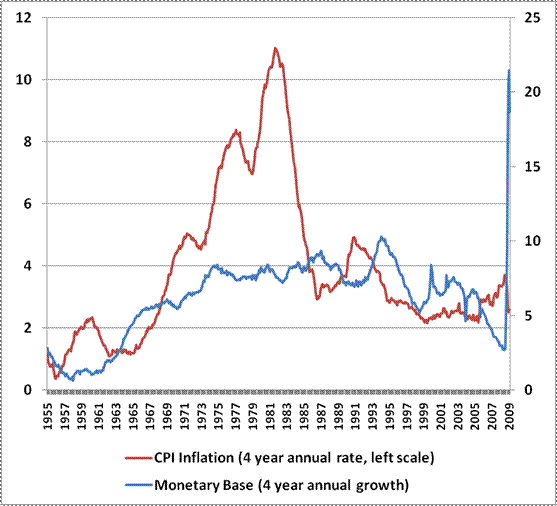
The reason we're not seeing inflation here and now is that despite a near doubling in the monetary base, we've seen a buildup in goods inventories combined with a surge in safe-haven demand for government liabilities. So investors have absorbed the increased supply of government liabilities without a collapse in their marginal utility. This will not persist indefinitely, so unfortunately, any nascent economic recovery in the next couple of years will be against the headwinds of both Alt-A mortgage defaults (coming to your neighborhood in 2010), and inflationary pressures as soon as safe haven demand for Treasuries eases back even moderately.


The graph above, of 4 year annual CPI growth versus 4 year annual growth in government spending, accompanied Hussman's column.

Sunday, March 22, 2009

Son of TARP

The Wall Street Journal explains the Obama Administration's new plan to buy bad assets off of the books of banks ("U.S. Sets Plan for Toxic Assets"). Economist and New York Times columnist Paul Krugman criticizes it ("Despair of Financial Policy"), and criticizes it again ("More on the bank plan"); economist Brad DeLong defends it ("The Geithner Plan FAQ" -- Hat Tip: Matt Yglesias), and Krugman responds to Brad DeLong's defense ("Brad DeLong's Defense of Geithner").

Since this new plan is, essentially, a return to the original, rejected, tack of the TARP plan last fall, it's also worth revisiting John Hussman's objections to the original TARP plan, ("You can't rescue the financial system if you can't read a balance sheet"). I suspect Dr. Hussman will reiterate some of those objections in his market commentary this week.

Thursday, March 19, 2009

Buffett's Turn to Face Some Heat


In a recent post ("More Obama Supporters Concerned by the President's Recent Actions") we noted that Warren Buffett and Jim Cramer had made essentially the same criticism of Obama's recent handling of the economy: in an economic emergency, the president's primary focus ought to be dealing with that emergency, not trying to enact other policy priorities. Last week, Jim Cramer and his network, CNBC, became the targets of liberal comedian Jon Stewart. Stewart's criticisms of Cramer, some of which had merit, related mainly to Cramer's actions last year and earlier (e.g., Cramer's comments regarding Bear Stearns prior to that firm's collapse). Why bring that up now? As I speculated elsewhere recently (for example, in a comment on Dr. Mark Perry's Carpe Diem blog), Cramer seemed to be targeted because of his recent criticisms of President Obama -- particularly since he made an easier target than some other Obama supporters who recently criticized the President, e.g., Warren Buffett.

Yesterday, apparently, was Buffett's turn. An article in the business section of Wednesday's New York Times ("Buffett Is Unusually Silent on Rating Agencies") criticized Buffett for not using his influence (since he owns 20% of the company via Berkshire Hathaway) to get Moody's to clean up the way it assigns credit ratings. Now, this is a legitimate criticism of Buffett; in fact, it's one I've made myself1. But the timing of it seems a little odd, if you don't take into account Buffett's recent criticism of Obama. After all, Berkshire Hathaway has been a major holder of Moody's for years, and the role Moody's and the rest of the ratings oligopoly played in the credit crisis has been common knowledge since at least 2007. Can it be a coincidence that Buffett is getting criticized for this now, a week after he expressed concerns about Obama's handling of the economy on CNBC?

The illustration of Buffett above was credited to Minh Uong, and accompanied the New York Times article.

1For example, on June 12th last year, on GuruFocus I wrote,

Before we begin the ritualistic praise of Buffett here, let's remember that a company in which he was the largest shareholder through BRK, Moody's, facilitated these excesses by slapping triple-A ratings on so many of those CDOs. When you own ~19% of a company, you have a lot of access to what's going on there, if you want it. It's too bad that Buffett didn't exercise more oversight of Moody's during the credit boom.

Wednesday, March 11, 2009

Armando Falcon, Jr.: An Enemy of the People?


Armando Falcon, Jr. (pictured above) was the director of the Office of Federal Housing Enterprise Oversight (OFHEO) who brought to light problems at Fannie Mae and Freddie Mac several years ago. For his service as a diligent regulator, he received something less than gratitude from certain Members of Congress, as the video below (which got a lot of hits on YouTube last fall) shows1. For some reason, the connection between that and the Ibsen play "An Enemy of the People" (which I last read when it was assigned in one of my high school English classes) just came to me yesterday. For those who aren't familiar with the play, here is the summary of it from Wikipedia:

Dr. Thomas Stockmann is the popular citizen of a small coastal town in Norway. The town has recently invested a large amount of public and private money towards the development of baths, a project led by Dr. Stockmann and his brother, the Mayor. The town is expecting a surge in tourism and prosperity from the new baths, said to be of great medicinal value, and as such, the baths are the pride of the town. However, as the baths are starting to succeed, Dr. Stockmann discovers that waste products from the town's tannery are contaminating the baths, causing serious illness among the tourists. He expects this important discovery to be his greatest achievement, and promptly sends a detailed report to the Mayor, which includes a proposed solution, which would come at a considerable cost to the town.

But to his surprise, Stockmann finds it difficult to get through to the authorities. They seem unable to appreciate the seriousness of the issue and unwilling to publicly acknowledge and address the problem because it could mean financial ruin for the town. As the conflict ensues, the Mayor warns his brother that he should "acquiesce in subordinating himself to the community." Stockmann refuses to accept this, and holds a town meeting at Captain Horster's house in order to convince the people to close the baths.

The townspeople - eagerly awaiting the prosperity that the baths are believed will bring - refuse to accept Stockmann's claims, as his friends and allies, who had explicitly given support for his campaign, turn against him en masse. He is taunted and denounced as a lunatic, an "Enemy of the People." In a scathing rebuke of both the Victorian notion of community and the principles of democracy, Dr. Stockmann proclaims that in matters of right and wrong, the individual is superior to the multitude, which is easily led by self-advancing demagogues. Stockmann sums up Ibsen's denunciation of the masses, with the memorable quote "...the strongest man in the world is the man who stands most alone."


And here is that video1 showing how Falcon's warnings were resented by come Congressional Reps:


1The creators of this video overstate their case slightly when they claim that Democrats opposed tighter regulation of the GSEs while Republicans advocated tighter regulation. Falcon mentioned to Real Clear Politics that one Democrat, Rep. Maurice Hinchey of New York, was supportive of his efforts. Also, although Republicans in Congress and the Bush Administration advocated stronger regulation of the GSEs, President Bush shared the zeal of most of the Democrats for encouraging the extension of credit to marginal borrowers, in order to increase home ownership levels, particularly among minorities.

The photo of Falcon above comes from this New York Times article, and is credited to Chris Kleponis/Bloomberg News.

Tuesday, March 10, 2009

John Hussman's Latest: "Buckle Up"


In his latest market commentary ("Buckle Up") Dr. Hussman reiterates his call for the government to make bank bond holders take eat some losses:

The misguided policy response from Washington has focused almost exclusively on squandering public money and burdening our children with indebtedness in order to defend the bondholders of mismanaged financial institutions (blame Paulson and Geithner – I've got a lot of respect for our President, but he's been sold a load of garbage by banking insiders). Meanwhile, I suspect that the little tapes in Bernanke's head playing “we let the banks fail in the Great Depression” and “we let Lehman fail and look what happened” are so loud that he is making no distinction about the form of those failures. Simply letting an institution unravel is quite different from taking receivership, protecting the customers, keeping the institution intact, replacing management, properly taking the losses out of stockholder and bondholder capital, and issuing it back into private ownership at a later date. This is what it would mean for these banks to “fail.” Nobody is advocating an uncontrolled unraveling of major financial institutions or permanent nationalization as if we've suddenly become Venezuela.


[...]

The course of defending the bondholders of insolvent institutions is not sustainable. Do the math. The collateral behind private market debt is being marked down by easily 20-30%. That debt represents about 3.5 times GDP. That implies collateral losses on the order of 70-100% of GDP, which itself is $14 trillion. Unless Congress is actually willing to commit that amount of public funds to defend the bondholders of mismanaged financials so they can avoid any loss, this crisis simply cannot be addressed through bailouts. Bondholders have to take losses. Debt has to be restructured. There is no other option – but the markets are going to suffer interminably until our leaders figure that out.

[...]

Yes, some pension funds, insurance companies, mutual funds, and other investors who hold the corporate bonds of mismanaged financial institutions will take a haircut on those investments. As they should. But if we ignore the need to restructure debt obligations, we risk allowing this downturn to move aggressively into 2010.


The dot drawing of Hussman above comes from a Wall Street Journal article about him last week, "Outfoxing a Bear?". Hussman linked to this article in his market commentary.