Showing posts with label The real estate bust. Show all posts

Friday, January 15, 2010

Scene from the real estate bust


I had a late breakfast today with my sister at the place above, which is located in a working class town nearby. $11.50 for two orders of scrambled eggs with diced tomatoes and onion, one order of Spanish sausage, a cheese-filled pastry, and two cafés con leche. That photo was snapped at about 10:30am today, right after we left. Those are a couple of migrant day workers walking in. Chances are, they won't get any work today. Contractors usually pick up their illegal laborers earlier in the morning.

Nearby, there were a couple of pairs of day laborers lingering, waiting for work. At the height of the real estate bubble, there would be dozens.

Thursday, September 10, 2009

An Interesting Investment Strategy from Goldman Sachs

I just found this by accident while searching for something else: US Hispanization: Long/short strategies. That PDF was dated October 23, 2007. Below are a few excerpts from it:

The Trend Continues... In November 2004, our report The Hispanization of the United States provided a context and investment framework to assess the growing influence of Hispanics in the US economy. Three years later, the theme retains its relevance, and we offer a long/short investment framework.

[...]

For domestically-focused investors and companies, gaining exposure to the rapidly growing US Hispanic population offers the best prospect for sales and earnings growth over the next three years.


See the graphic below, which comes from this PDF. Note the suggestions for Housing and Financials, and remember, this was published two months after the subprime crisis became obvious in August of 2007.

Does Goldman Sachs have two levels of clients -- one level that gets this advice, and a higher level that gets offered the opposite advice?

Monday, February 23, 2009

Hussman Pivots


In his latest weekly commentary ("The Economy Needs Coordination, Not Money, From the Government"), Dr. Hussman seems to pivot a little on a couple of positions he took in his last market commentary (from which we excerpted in this post, John Hussman on "How to Climb out of a Global Financial Hole"). Last week, Hussman wrote this about Citigroup and some other large banks,

The government should continue to provide capital directly to large, diversified financial institutions which remain solvent but have some impairment to capital. Preferred stock is a reasonable form, though a high (possibly deferred) yield to the government is preferable to a low one (Bagehot's Rule[1]). Tight restrictions against using taxpayer capital for compensation and bonuses are certainly appropriate. These institutions include major banks like Citigroup, Bank of America, Wells Fargo, J.P. Morgan, and others, which appear to be experiencing pressure not because of insolvency, but because of uncertainty about potential future loan losses, and the ongoing availability of publicly provided capital.


Market action over the last week seems to have prompted a different view of Citi from Hussman today,

Take a look at Citibank's balance sheet as of the third quarter of 2008. The company had about $2 trillion in assets, versus about $132 billion in shareholder equity, for a gross leverage ratio of about 16-to-1. That's not a comfortable figure, because it indicates that a decline of about 6% in those assets would wipe out Citibank's equity and make the bank technically insolvent. Unfortunately, we saw credit default spreads screaming higher last week, while the bank's stock dropped below $2 a share, so evidently the market is deeply concerned about the possible immediacy of that outcome.


Instead of the government providing additional capital to Citi, now Hussman favors a sort of receivership,

But keep looking at the liability side of Citibank's balance sheet. There is over $360 billion in long-term debt to the company's bondholders, and another $200 billion in shorter term borrowings. None of that is customer money. That puts the total capital available to absorb losses at $132 + $360 + $200 = $692 billion, which is about 35% of the $2 trillion in assets carried by Citibank. That's a huge cushion for customers, who are unlikely to lose even if Citibank becomes insolvent. Should that occur, the proper response of government will not be to defend Citi's bondholders at taxpayer expense, but rather, to take Citi into receivership, wipe out the shareholders and most of the bondholders, and sell the assets along with the liabilities to customers to another institution.


On the broader point of dealing with foreclosures, Hussman still highlights the need for government coordination and the creation of PARs (proper appreciation rights) to compensate lenders for writing down the principal amounts of mortgages, but takes a slightly different tack on the issue of mortgage "cram-downs". Last week, Hussman wrote,

The most direct method of intervening is at the point of foreclosure through the courts. One way of doing this would be to give judges the ability to write down principal, and to assign the balance as a deferred “property appreciation right” (PAR) to the lender.


And this week, Hussman writes,

If you simply let bankruptcy judges push down principal values with no other recourse to lenders, you undermine the basic principles of contract law that underpin our economy. If you provide government funds to reduce the mortgage principal of some homeowners, with nothing for those who have played by the rules, you create huge inequities and incentives for good homeowners to go delinquent.


It may be that Hussman is being consistent here, i.e., that he's OK with allowing judges to reduce the principal on mortgages provided they compensate lenders with a PAR equivalent to amount the principle was reduced. Perhaps Dr. Hussman will clarify this next week. I suspect, though, that if the government facilitated a market for PARs (as Hussman recommends), most lenders would write down their mortgages in return for PARs voluntarily.

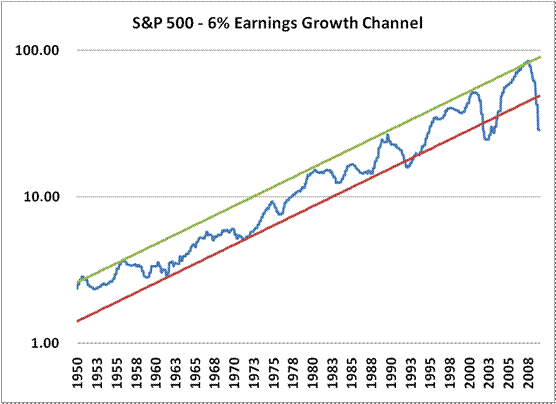
The chart above, which was included in Hussman's column, illustrates a point Hussman made about the steep recent decline in S&P earnings (earnings have historically grown 6% from one cyclical peak to the next cyclical peak).

Friday, December 12, 2008

Profiting from the Credit Crisis


Back in August, we mentioned two groups of entrepreneurs that were profiting from the credit crisis ("Profiting from the Credit Crunch/Real Estate Bust"). Yesterday, the Financial Times published an article about another such entrepreneur: Barry Silbert, the founder of SecondMarket. According to the article ("SecondMarket enters new territory"), Silbert started SecondMarket in 2004 to provide a marketplace for trading restricted securities; in the first quarter of 2009, Silbert plans to create an online marketplace for illiquid mortgage-backed securities and CDOs. From the article:

Inspired by books about Amazon.com, Ebay and Goldman Sachs, Mr Silbert says the SecondMarket platform will, for example, allow valuation experts, research providers and others to offer their services and get ranked by users.

"We are incorporating the best of current technology," says Mr Silbert. "We are inspired by the ideas behind the wisdom of crowds, and want to be inclusive rather than exclusive."

SecondMarket is a broker-dealer, getting paid a transaction fee on deals that get done, but not taking any positions itself. With many Wall Street players strapped for cash, no other serious venture aimed at targeting illiquid markets has emerged.


This story about SecondMarket reminds me about the old cliché (apparently untrue, according to this essay by U Penn Chinese professor Victor Mair) that the Chinese word for "opportunity" is comprised of characters meaning "danger" and "opportunity". The characters shown above, from Professor Mair's essay, are the ones that comprise the Chinese word for "crisis", "wēi" and "jī". For Professor Mair's explanation of why "wēi" can be translated as "danger" but "jī" shouldn't be translated as "opportunity", see his essay.

Wednesday, September 3, 2008

Unskilled Immigration and Economic Statistics

Robert Samuelson ("The Real Economic Report Card") brings up a point that ought to be obvious but isn't made more often: unskilled immigration makes economic statistics such as poverty levels and the number of those without health insurance worse. It seems like common sense that if you import more poor people whose likely jobs (landscaper, busboy, non-union construction worker) usually don't include health insurance, you will end up with more poor, uninsured people in the country than you would otherwise. Perhaps the reason this point isn't made more often is that immigration is one area where there currently is no significant policy difference between the major party presidential candidates.

It makes some sense, from a political perspective (if not from an economic perspective), for Democrats to be in favor of increasing unskilled immigration. If unskilled immigrants become citizens, they are more likely to be net recipients of government benefits, and thus more likely to vote for the party that favors more progressive taxation and more generous spending on social services. Unskilled immigration makes less sense politically for Republicans, but it makes economic sense for certain Republican constituencies, e.g., the small business owners who hire the busboys, landscapers, etc. From the perspective of these small employers, the GOP offers the best of both worlds: support for cheap labor and support for pro-business policies such as lower taxes. Of course, over the longer term, it's hard to see how an embrace of unskilled immigration won't consign the GOP to permanent minority status, unless somehow these immigrants are never given a chance at citizenship, which seems unlikely.

The real estate bust, by drying up the demand for residential construction laborers, seems to have put this issue on the back burner for now, which helps John McCain, since his stance on immigration is one of the areas where he is against his base.