Showing posts with label Secular Bull Market in Commodities. Show all posts

Thursday, November 12, 2009

Alloy Steel expands into Indonesia


Special message from our sponsor to visitors from iHub:

If you don't want everything in your portfolio tanking at the same time during the next market correction, you may want to consider adding some selective shorting (or put buying). See Short Screen to screen for companies predicted to go bankrupt by their Altman Z-scores.

You may remember that the Altman scores accurately predicted both AYSI's survival and VBDG's demise


Alloy Steel International (OTC BB: AYSI.OB) filed this 8-K today:

Quantum Leap for New Super Alloy

High demand for new Super Alloy Arcoplate products has prompted Alloy Steel International to expand their operations into Indonesia by the appointment of a company to carry out functions on its behalf and under its direction.

The first overseas engineering office, based in Jakarta, will house both marketing staff and engineering professionals.

The Indonesian capital was chosen as the hub of operations due to its proximity to the expanding South-east Asian market, the lower manufacturing costs and the availability of highly qualified technical staff.

Possible sites for the manufacturing facility are undergoing analysis regarding capital costs of construction and fit out.

The Arcoplate Super Alloy, released in July this year, can be manufactured thinner thus lighter and more durable than older white iron type products. A one inch Arcoplate Super Alloy plate can replace white iron products up to six inches thick. Successful laboratory tests and field trials have shown cost and energy savings by reducing friction, greater ease of handling, and less production shutdown time for plate replacements.

Mining clientele have indicated they will specify Arcoplate in their plant expansions, upgrades and in new mining and mineral processing applications worldwide. The new thicker sizes are in heavy demand worldwide.

The new Indonesian branch of Alloy Steel International will cater for clients extending their mining operations into Indonesia and will allow for further expansion into the Chinese, Indian and Mongolian markets.

Alloy Steel International Chairman, Mr Gene Kostecki, estimates that once the company has the facility to service the Indonesian market from a local base, demand for Arcoplate in Indonesia could exceed $10 million per annum.


There was some question on Alloy Steel's i-Hub message board about whether this is a licensing deal or not. I suspect it isn't, but I sent an e-mail to the CEO asking if he could clarify. If I hear back from him, I'll update this post accordingly.

Update: Alloy Steel International's CEO Gene Kostecki responded via e-mail saying that this was not a licensing deal. He said the company was avoiding those out of concerns about protecting its intellectual property, which he said was the company's highest priority. He said that this expansion would enable AYSI to take advantage of Indonesia's lower labor costs and proximity to markets in China and India. If I get his permission to do so, I will quote his e-mail verbatim here, but those were the key points.

Second Update: I have his permission, so here's his e-mail:

Dear David:

We are all very excited with our expansion program into South East Asia as it will give the company a great stepping stone into the entire ASEAN Market which is one of the fastest growing economies in the world.

The new government in Indonesia is fast tracking all economic development and investment in Indonesia. With Indonesia’s low labour costs and proximity to China and India it will place the company in a very competitive position to capitalize on Asian markets in this part of the world without sacrificing quality and margins, yet still being price competitive against low end products that portray themselves as wear plate.

David, we do not see the need to enter into any licensing agreements with any third party as this could potentially compromise our position in protecting our intellectual property rights in this part of the world. Protecting our intellectual property rights is the company's top priority.

Sincerely,

Gene Kostecki

Wednesday, October 21, 2009

Response from Alloy Steel International's CEO


In response to the list of questions I submitted to him last week, I got an e-mail from Alloy Steel CEO Gene Kostecki a couple of hours ago. I didn't hear back from him when I asked him if I could share the text of his e-mail on this blog (bear in mind Perth time is twelve hours ahead, so he may have signed off for the night by then), so I won't quote it here verbatim. But this is the gist of it: Gene apologized for not answering the questions by today; he noted that he's been busy drawing up plans for the new mill program, and that CFO Alan Winduss has been busy working on the reports given the recent conclusion of the company's fourth quarter and fiscal year. Gene said that the company planned to issue an interim report that would answer many of the shareholder questions I submitted to him, and that they would be happy to address any questions it didn't answer.

Wednesday, October 7, 2009

Questions for the CEO of Alloy Steel International?


On the off chance any of you have a question for the Hank Reardon of wear plates, leave it in the comment thread below. Mr. Kostecki has apparently indicated through an intermediary a willingness to chat with me.

Wednesday, September 16, 2009

China's New, Self-Propelled Economy

A few months ago, we mentioned James Kynge's 'China Continental' thesis. In that post, we excerpted an essay Kynge had written in the Financial Times explicating his thesis for China's continuing growth in the wake of declining exports. This was the excerpt we quoted from Kynge's essay:

China is going continental. Just as the US during the 19th century underwent a transition from export-oriented growth to a greater reliance on inner dynamism, so China is looking inwards for the engine to drive its economy.

In China’s case it is still early days, but evidence suggests the conventional view of an export-dependent, river delta-driven economy no longer matches the reality. The argument here is not that trade has somehow become unimportant to China, but rather that the energy generating the world’s fastest economic growth rate this year is increasingly coming from within.

A series of indicators reveals the shift to “China Continental” – the transition of the world’s most populous country into an increasingly self-propelling economic force.


A couple of items that appeared earlier this week in the Financial Times suggest that Kynge's thesis may have been correct. This item from Monday's Lex column, "China's Stimulus" is one, and Martin Wolf's column from Monday's FT, "Wheel of fortune turns as China outdoes west", is another. Here are a couple of brief excerpts from both.

Lex:

There is no precise breakdown of stimulus spending by geography. But $366bn falls under the heading of infrastructure and post-quake recovery; another $113bn under public housing and rural development. Only a small slice – $54bn to stimulate “technological innovation” – seems to explicitly favour developed regions. Output in 12 western provinces grew an average 8 per cent in the first half – a whole percentage point better than 11 provinces in the east.

This structural shift was evident in first-half figures from ICBC, China’s largest commercial lender. Its year-on-year percentage increase in operating income in the Yangtze and Pearl river deltas fell, but rose in central and western regions. In short, China would rather finance roads in Chengdu than sweatshops in Guangdong. Many private, export-led companies in coastal areas, lacking collateral in the form of land or government relationships, are still struggling for funds. Trade data on Friday showed exports and imports falling for the 10th month, year-on-year. Weak external demand is not the only cause; this is an unabashed internalisation of growth.


Martin Wolf:

China has emerged as the most significant winner from the financial and economic crisis. At the end of 2008, many questioned whether China would achieve its growth target of 8 per cent in 2009. Who now dares to do so?

Cushioned by its more than $2,100bn (€1,440bn, £1,260bn) of foreign currency reserves, huge trade and current account surpluses and a robust fiscal position, Beijing has been able to deploy all its levers over the financial system and the economy.

[...]

Three immediate questions arise. How has China responded to the crisis? Is its resurgent growth sustainable? How far will its recovery help the world economy?

The answer to the first question is: astonishingly. According to data reported at the end of last week, industrial output expanded 12.3 per cent in the 12 months to August, up from a 10.8 per cent increase in July. This is the fastest growth for a year.

[...]

Is this growth surge sustainable? In a word, yes. Inevitably, the torrid growth of bank credit and money is spilling over into asset prices, particularly equities. But there is little danger of excessive inflation in an economy with an appreciating currency, fully embedded in a world economy still threatened more by deflation than by inflation, at least in the near term. Moreover, the government is solvent. As premier Wen Jiabao noted in Dalian, "we . . . kept budget deficit and government debt at around 3 per cent and 20 per cent of the GDP respectively". Should bad loans increase, China is well able to recapitalise its financial system.


This is good news, of course, for companies selling raw materials to China, for vendors to those companies (e.g., Alloy Steel International), and, more broadly, for countries such as Australia and Brazil that export significant amounts of raw materials to China.

Friday, July 3, 2009

Reconsidering the Role of Speculation in Commodities Markets

In a post last week ("Matt Taibbi versus Goldman Sachs"), I wrote,

Taibbi takes the hedge fund manager [Michael] Masters at his word re: the commodities spike last year. Goldman is an enormous player in commodities, but one problem with blaming the commodity spike on paper speculation, or on firms such as Goldman getting pension funds to pour money into commodity index funds, is that the prices of commodities that aren't traded on futures markets or included in commodity indexes (for example, certain metals) spiked as well.


News this week lends some support to Masters's claim. From the Financial Times ("‘Rogue broker’ blamed for oil spike"):

The startling spike in oil prices to their highest level this year on Tuesday was caused by a rogue broker who placed a massive bet in the Brent oil market, triggering almost $10m (€7m) of losses for his company.

PVM Oil Associates, the world’s largest over-the-counter oil brokerage, said on Thursday it had been the “victim of unauthorised trading”. The privately owned company said that as a result of the unauthorised trades it had been forced to close substantial volumes of futures contracts at a loss.

[...]

Oil traders in London and New York said the “unauthorised trading” explained the exceptional spike in business activity and prices in the early hours of Tuesday that some initially thought must have been caused by a geopolitical event. “Trading volumes rose overnight and prices jumped more than $2 a barrel without apparent justification,” a senior oil trader in New York said.

Prices rose in one hour from $71 to $73.5, the highest level for the year, according to Reuters data. In total, futures contracts for more than 16m barrels of oil changed hands in that hour – equivalent to double the daily production of Saudi Arabia, the world’s largest oil producer, and far more than the traditional 500,000 barrels for that time of the day.

Traders said the broker implicated had allegedly accounted for at least half of the unusual activity, with the rest the result of others chasing the rally. Oil prices on Thursday fell to $66.5 a barrel, down almost 10 per cent from Tuesday’s peak.

The Financial Times has identified the PVM broker as Steve Perkins. PVM declined to comment and Mr Perkins could not be reached. Fellow traders said Mr Perkins was considered an experienced broker, well-regarded in the market.

This is the second episode of rogue trading in the oil market this year. In May, an oil trader at Morgan Stanley was banned by the City watchdog after he hid from his bosses potential losses on trades made under the influence of alcohol.

The incidents come as regulators are considering tougher oversight of the commodities markets after policymakers complained that speculators fuelled last year’s surge in oil and agriculture prices.

The involvement of PVM is ironic considering the company’s head, David Hufton, has been an outspoken critic of speculators in the oil market, calling some of the exchanges “electronic oil casinos”. In 2006, he said that “if futures exchanges did not exist, oil prices would be a lot lower”.

Saturday, June 6, 2009

James Kynge's Thesis: "China Continental"; John Authers's Follow Up

James Kynge laid out his thesis for China's continuing growth in the wake of declining exports in a recent Financial Times column, "China Continental". Excerpt:

China is going continental. Just as the US during the 19th century underwent a transition from export-oriented growth to a greater reliance on inner dynamism, so China is looking inwards for the engine to drive its economy.

In China’s case it is still early days, but evidence suggests the conventional view of an export-dependent, river delta-driven economy no longer matches the reality. The argument here is not that trade has somehow become unimportant to China, but rather that the energy generating the world’s fastest economic growth rate this year is increasingly coming from within.

A series of indicators reveals the shift to “China Continental” – the transition of the world’s most populous country into an increasingly self-propelling economic force.


Kynge lists a few different specific metrics to back up his case, including increases in China's retail sales and domestic cargo traffic, and survey results on consumer spending intentions, before addressing China skeptics in his conclusion:

Sceptics argue that China’s performance this year has come through huge but ultimately unsustainable government intervention. Such spending, they say, will boost growth for a time but achieve little but industrial overcapacity in the longer run. These arguments are not without merit, but they miss a newer, more interesting prospect; that Chinese growth is increasingly self-generating and continentally driven.


Recent moves in the commodity markets support Kynge's thesis, as John Authers noted in his Financial Times column today ("China's health gives rise to fresh growth theory"):

Industrial commodities, that benefit most from economic growth, have surged, with lead and copper up more than 50 per cent in three months. Gold, an inflation hedge, has barely gained.


Authers went on to summarize the debate about China's economy (both sides of which have been fleshed out by Kynge and Zeihan, respectively):

As a whole, even before yesterday's strong headline to the US jobless report, world markets were plainly working on the assumption that China has saved the world from Depression. Is the market right to do so?

There are two camps. The optimistic side, laid out by James Kynge in the Financial Times last week, is "China Continental"; like the US in the late 19th century, China can turn itself into a great economic power, by building links to its interior and unleashing its buying power.

The pessimistic side suggests China has poured money into the public sector, and will merely form excess capacity. The huge demand for industrial metals may be artificial.

Electricity generation is down year-on-year. Supply managers surveys show new export orders are barely expanding. So maybe China is caricaturing the US in the 1930s, and paying some people to dig holes and others to fill them in.

If so, the gains could soon be in for another ugly recoupling. Either way, nothing just now is more important than the health of the Chinese economy.

Wednesday, March 11, 2009

Matt Simmons on the Outlook for Oil and Natural Gas Prices


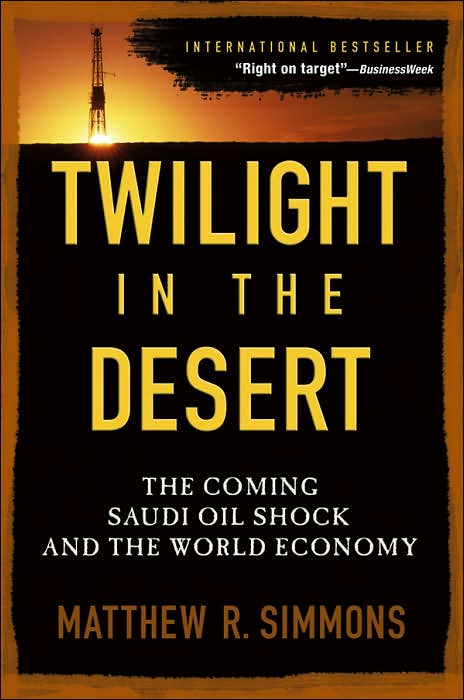
Hat tip to Aaron Edelheit for this PDF of Matt Simmons's PowerPoint presentation to the Commercial Club of Boston last month: "The Oil and Gas System is Sick". I hope it won't ruin any surprise if I tell you that Simmons, the author of the book Twilight in the Desert, thinks oil and natural gas prices are heading much higher. I happen to agree, but I'd feel surer if Simmons offered a compelling explanation for the massive correction in oil and natural gas prices last fall. On p.33 of the PDF he lists three common explanations,

–Speculators left the game that created spike
–Unraveling economy killed off demand
–Gluts are now endemic:
~Tank farms brimming with oil
~Super-tankers now floating oil gluts


■But, none of these “facts” were true.
■Only clear fact: “Crude oil fell 74% in 12 weeks” (September 22nd–December 22nd).


And then on P.34 Simmons offers this,

Are We Missing “The Black Swan?”

■Credit default swap index soared as crude oil plunged.
■Credit freeze began when oil collapsed.
■This had to hurt traders’ ability to own oil contracts.
■If any traders ever had to liquidate contracts, this would cause oil prices to temporarily fall.
■Glencore(aka Marc Rich & Co AG) Energy Trading credit default swaps illustrate the squeeze.


Which seems to contradict his point on the previous slide that the collapse wasn't the result of speculators leaving the game. Perhaps Simmons explicated this during a Q&A.

The image above, of the cover of Simmons's book, comes from Barnes & Noble's website.

Thursday, February 19, 2009

Alloy Steel Update


Ugly tape for Alloy Steel International (OTC BB: AYSI.OB) on a down day. Looks like a flat-lining EKG. No company-specific news today, but there have been some tentatively positive indicators related to the metals sector recently1. Picked up a few more shares today at .29.


1E.g.,

- Temasek, the $134 billion Singaporean sovereign wealth fund, recently hired Chip Goodyear, former CEO of blue chip miner BHP Billiton, as its new chief (Wall Street Journal: Temasek Shakes Up Its Top Ranks -- Ho Ching Out, 'Chip' Goodyear In at Singapore Fund; a Commodity Push?)

- China bought a stake in (over-levered) blue chip miner Rio Tinto (BBC: China takes a stake in Rio Tinto)

- The Baltic Dry Index was up 147% year-to-date as of February 17th (Bloomberg: "Shipping Index Surge Signals Commodity Currency Gains"). It's up about 166% as of today (but still down steeply from its 2008 highs).

On the other hand, the continuing global recession is obviously bearish, and as reader Sivaram noted in a recent comment thread ("Mohnish, How Are You Feeling"), Mohnish Pabrai mentioned in his annual investor letter that he has turned bullish on the commodity sector, which, given his recent track record, could be considered a bearish indicator.

Friday, February 13, 2009

Alloy Steel's Q1


Alloy Steel International (AYSI.OB) filed its 10-Q today for its fiscal Q1 (the fourth calendar quarter of 2008). The company essentially broke even on sharply lower sales on a year-over-year basis. From the 10-Q:

Alloy Steel had sales of $1,845,504 for the three months ended December 31, 2008, compared to $3,180,339 for the three months ended December 31, 2007. These sales consist solely of the sale of our Arcoplate product. Substantially all of our sales during the periods were denominated in Australian dollars. Sales were converted into U.S. dollars at the conversion rate of $0.67306 for the three months ended December 31, 2008 and $0.8905 for the three months ended December 31, 2007 representing the average foreign exchange rate for the respective periods.

The decrease in sales for the period is representative of the general downturn being experienced in the world economy. During the quarter, the Company's orders declined as demand for our product reduced with various mining companies announcing that new mining projects were being delayed and/or existing mining projects were being wound back until demand for commodities again increased.


This was worse than my optimistic guestimate of 1 cent per share in earnings, but not wholly unexpected, given the global economic downturn, and particularly, the downturn in the metals sector. On the plus side, the company managed to stay in the black during a difficult quarter. Back to the 10-Q:

The Company has continued to promote its product in the market place as a superior option for maintenance, as well as seeking entry into other markets which were previously limited by the Company's ability to meet the demand existing prior to the economic downturn. The Company is confident of being able to present its product well in these new markets, and anticipates additional orders will be generated from these new locations.


One of those new locations referred to above is North America, as the 10-Q notes that the company has incorporated two North American subsidiaries to handle business in this region. It would be encouraging to see the company generate some sales from companies involved in infrastructure/excavation, since those companies' bulldozer blades and truck beds are subject to wear as well.

I picked up a few more shares of AYSI earlier this week at .361.

The photo above, from Alloy Steel's website, is of an Arcoplate fan liner of the sort used in cement plants and coal-fired power plants, according to the site. I don't believe this application has been a significant source of sales for Alloy Steel yet, but perhaps this is an area its new salesmen can pursue.

Tuesday, February 10, 2009

Coming Soon

The titles of a few posts I have on deck, but haven't finished yet:

- TBT or not TBT

- More on Mohnish

- Some Bullish and Bearish Indicators on Commodities

- Penny Ante Arbitrage

Thursday, January 22, 2009

This Week's Other Big News from the Mideast


From the Lex Column in yesterday's Financial Times ("Holy Hydrocarbons"):

An old joke in Israel says that Moses turned left when he should have turned right during his desert wanderings. After all, he had the rotten luck of finding almost the only country in the Middle East virtually bereft of oil and gas.

In a piece of news this weekend overshadowed by the ceasefire agreement in Gaza - but with perhaps equally important security implications - a major natural gas find was announced 90km off the coast of northern Israel. Nobel Energy of the US, which owns a 36 per cent interest, called it the biggest in the company's history, saying the lower bound of the reserve may be 3,000bn cubic feet.

As sweet as such a discovery is for a small country whose right to exist is denied by most of the leading owners of the global energy reserves, it is a bitter pill for the BG Group and the Palestinian Authority. BG owned a major stake in the field and, reportedly against the objections of its country manager, allowed its rights to lapse without compensation three years ago. Instead, it focused on its holdings in Egypt and off the shore of the Gaza Strip, where it invested amid optimism over the peace process.

Even after Hamas won an election in 2006 and took control of Gaza in 2007, BG's negotiations over selling gas from GAza to Israel, which seeks to plug a looming supply gap, continued. Hamas opposed the deal as an "act of theft", both because Israel was the buyer and because the proceeds would have gone to the Palestinian Authority. Negotiations broke down over price in late 2007.

Along with its disastrous December rocket barrage, this is another Palestinian own-goal. Noble's new discover could supply Israel for decades. BG, meanwhile, is left supplying gas-rich Egypt, a much less lucrative prospect. Perhaps Moses had a sense of direction after all.


This brings to mind the late Israeli foreign minister Abba Eban's quip1 that the Arabs of Palestine "never missed an opportunity to miss an opportunity".

The photo of the natural gas rig above is from Noble Energy's website.

1That line has been quoted frequently recently, including in this Economist leader from a couple of weeks ago, "The Hundred Years' War".

Tuesday, January 20, 2009

U.S. Energy Corp. Update


A few quick updates:

- U.S. Energy Corp. (Nasdaq: USEG) filed an 8-k and issued a press release today announcing that it had retired its $16.8 million construction loan on its Remington Village real estate project. Since it was unable to get longer-term financing in the current credit environment without paying onerous fees, since it had close to $70 million in low-yielding Treasuries, USEG management figured it was better off using some of that cash to payoff the loan. The press release also added some details about the status of the Remington Village project:

``Remington Village is an excellent asset in an economically sound area that is currently generating in excess of $200,000 per month in revenue and is expected to generate $248,000 in monthly revenues upon stabilization at 95% occupancy,'' [said USEG CEO Keith Larsen]

The project was completed ahead of schedule in early December, 2008 approximately $1.1 million under budget, and is currently 88% occupied. The Remington Village complex consists of nine 24-plexes with a mix of one, two, and three bedroom units, as well as a clubhouse and leasing office.

The Gillette, Wyoming region continues to experience solid growth following record state coal production in 2008, and attracting new residents through a number of infrastructure projects currently under development including a $40 million recreation center, an $80 million hospital renovation, a $1.4 billion mine mouth-feed coal-fired power plant and a soon to be constructed $120 million coal dewatering facility north of Gillette.


- Last week, USEG announced that it had received a scheduled $1 million milestone payment from Thomson Creek as part of the option agreement Thomson Creek signed with USEG in August to pursue development of the Lucky Jack Molybdenum project.

- Earlier this month, USEG announced that it had signed an oil & gas participation agreement with a private company to acquire a 50% working interest in a prospect in Northeastern Wyoming. In this release, USEG's CEO stated that his company's goal was to increase its production from its current level of 1,700 million cubic feet equivalent per day (MCFE/D) to 7,000 MCFE/D by the end of 2009.

The photo above, of the company's Remington Village real estate development, is from the company's website

Friday, January 2, 2009

Vaalco Energy Update


Vaalco Energy (NYSE: EGY) ended the week up over 20%, after releasing an update on its drilling program. From the release:

HOUSTON, Dec. 31 /PRNewswire-FirstCall/ -- VAALCO Energy, Inc. (NYSE: EGY - News) today provided an update on the new development well being drilled in the Ebouri field and the new appraisal well (North Ebouri) being drilled in the Etame block. VAALCO commenced drilling these wells in November with the jack-up rigs Adriatic 6 and Pride Cabinda, respectively, as previously announced.

For the development well in the Ebouri field, VAALCO announced that it has drilled one pilot hole to the south of the original Ebouri discovery and a second pilot hole to the northeast of the original discovery. Both of these pilot holes were successful in delineating additional Gamba sandstone reservoir above the oil water contact, thereby increasing the acreage and reserves of the Ebouri field. VAALCO is currently completing the development well horizontally on the same orientation as the second pilot hole. First oil production from this well is expected in January 2009.

The Company also announced that it drilled the North Ebouri appraisal well in the Etame block approximately 1.5 miles to the northeast of the Ebouri platform and found 21 feet of oil column, further expanding the Ebouri field. VAALCO is now planning a sidetrack to optimize the location for a potential second horizontal development well. In addition, the Company is planning two exploration wells (North Etame and South East Etame) on newly mapped structures. The wells will be drilled back to back using Pride Cabinda.

VAALCO continues to expect production at a rate sufficient to bring total production from the Etame license area to approximately 25,000 barrels of oil per day (bopd). The Etame license production areas currently produce approximately 20,000 bopd, of which VAALCO has a 28.1% working interest.

"Results from the Ebouri development drilling have exceeded expectations, and we are pleased with the initial results from our drilling program in the Etame block, with more wells to come," said Robert L. Gerry, III, Chairman and CEO of VAALCO. "We have substantially enlarged the productive acreage of the Ebouri field, thereby greatly enhancing the recoverable reserves. We look forward to continued success with our exploration program."


Last time EGY rose over $7, I sold 5% of my position and used those funds to buy more AYSI.OB. I may sell a little more at these prices, but I plan on holding most of my EGY for the long term, as I'm bullish on oil over the next five years, and I'm bullish on Vaalco's ability to increase its reserves through its drilling program. The image above, which shows Vaalco's Ebouri field, is from the company's website.

Wednesday, December 24, 2008

Alloy Steel's Annual Report


Alloy Steel International (OTC BB: AYSI.OB) filed its 10KSB annual report today.

A few notes on it:

- Fiscal 2008 net income was $0.15 per share1, versus $0.08 in 2007, an 87.5% year-over-year increase.

- The company's second mill is completed, and the company expects it to go into commercial production in February.

- The company plans to hire two more manufacturing employees in 2009.

- The company is now looking into the possibility of licensing production of its Arcoplate wear plates in other countries2.

- The balance sheet shows finished goods valued at $765,446. If this represents sales that will be recognized in the next quarter (as was the case with the finished goods that were listed on the 3Q08 10K), and if the company's gross margins remain stable, this could represent approximately $1.4 million in 1Q09 sales.

A more general comment, about the prospects of a "picks & shovels" business such as Alloy Steel's during a steep correction in the prices of mined commodities follows. In a recent article in the Financial Times ("Engineers feel impact of cancelled projects"), the reporter asked the CEO of the British conveyor belt manufacturer Fenner about the impact of the decline in commodity prices. This was the CEO's response:

“Conveyer belts carry materials based on volume and tonnage. If you are producing a commodity, we are driven by volume, not its price,” says Mark Abrahams, chief executive of Fenner.


Of course, if the price of a commodity drops far enough, i.e., below its cost of production, production volume will plummet, but above that price point, a picks & shovels business such as Fenner or Alloy Steel International ought to be less sensitive to fluctuations in price of the underlying commodity.

The photo above, of a truck bed lined with Alloy Steel's wear plate, comes from the Investors Hub page for Alloy Steel.

1This is quite close to a commenter's recent estimate of $0.148, based on the revenue figures in Alloy Steel's last 8K.

2This is a departure from the company's previous position on licensing that we noted in an earlier post ("Answers from Alloy Steel's CFO").

Tuesday, December 16, 2008

"Why Gasoline is Still King"


Another interesting article from the American re fossil fuels, this one by Ralph Bennett: "Why Gasoline is Still King: Electric roadsters are the darlings of the press, but it is likely that gasoline will continue to dominate personal transportation." Bennett's short answer comes down to the energy density of gasoline. Below is a relevant excerpt:

We may expatiate on the latest developments in electric cars and the delicious prospects of hydrogen fuel cells and various biofuels made with everything from switch grass to garbage; we may earnestly speculate about flywheels and compressed air and various gases, natural and unnatural—but we go with gasoline.

A gallon of gas weighs about 6.3 pounds and produces roughly 35 kilowatt hours of energy. That’s enough to burn a 100-watt light bulb continuously for more than two weeks. A lead-acid battery could do the same thing without needing a recharge—if it were the size of a desk and weighed a ton. Energy density is the point. We just haven’t come up with a fuel or a device that will safely and economically offer the same calorific value in such a small space as an automobile’s gasoline tank. Compressed natural gas (CNG) and liquefied natural gas (LNG) intrigue us, but the problems of storing them (or hydrogen) in a car in sufficient quantity to approach gasoline’s range and performance continues to be a sticking point. We always come back to density.


The photo above, from the article, is of the Tesla Roadster

Monday, December 15, 2008

Why We Will Be Using Fossil Fuels for Decades to Come

From Vaclav Smil's essay in the American, "Moore's Curse and the Great Energy Delusion":

“Energy transitions” encompass the time that elapses between an introduction of a new primary energy source oil, nuclear electricity, wind captured by large turbines) and its rise to claiming a substantial share (20 percent to 30 percent) of the overall market, or even to becoming the single largest contributor or an absolute leader (with more than 50 percent) in national or global energy supply. The term also refers to gradual diffusion of new prime movers, devices that replaced animal and human muscles by converting primary energies into mechanical power that is used to rotate massive turbogenerators producing electricity or to propel fleets of vehicles, ships, and airplanes. There is one thing all energy transitions have in common: they are prolonged affairs that take decades to accomplish, and the greater the scale of prevailing uses and conversions the longer the substitutions will take. The second part of this statement seems to be a truism but it is ignored as often as the first part: otherwise we would not have all those unrealized predicted milestones for new energy so.

[...]

The scale of transition needed for electricity generation is perhaps best illustrated by deconstructing Al Gore’s July 2008 proposal to “re-power” America: “Today I challenge our nation to commit to producing 100 percent of our electricity from renewable energy and truly clean carbon-free sources within 10 years. This goal is achievable, affordable, and transformative.”

Let’s see. In 2007 the country had about 870 gigawatts (GW) of electricity-generating capacity in fossil-fueled and nuclear stations, the two nonrenewable forms of generation that Gore wants to replace in their entirety. On average,these thermal power stations are at work about 50 percent of the time and hence they generated about 3.8 PWh (that is, 3.8 x 10¹⁵ watt-hours) of electricity in 2007. In contrast, wind turbines work on average only about 23 percent of the time, which means that even with all the requisite new high-voltage interconnections, slightly more than two units of wind-generating capacity would be needed to replace a unit in coal, gas, oil, and nuclear plants. And even if such an enormous capacity addition—in excess of 1,000 GW—could be accomplished in a single decade (since the year 2000, actual additions in all plants have averaged less than 30 GW/year!), the financial cost would be enormous: it would mean writing off the entire fossil-fuel and nuclear generation industry, an enterprise whose power plants alone have a replacement value of at least $1.5 trillion (assuming at least $1,700/installed kW), and spending at least $2.5 trillion to build the new capacity.

But because those new plants would have to be in areas that are not currently linked with high-voltage (HV)transmission lines to major consumption centers (wind from the Great Plains to the East and West coasts,photovoltaic solar from the Southwest to the rest of the country), that proposal would also require a rewiring of the country. Limited transmission capacity to move electricity eastward and westward from what is to be the new power center in the Southwest, Texas, and the Midwest is already delaying new wind projects even as wind generates less than 1 percent of all electricity. The United States has about 165,000 miles of HV lines, and at least 40,000 additional miles of new high-capacity lines would be needed to rewire the nation, at a cost of close to $100 billion. And the costs are bound to escalate, because the regulatory approval process required before beginning a new line construction can take many years. To think that the United States can install in 10 years wind and solar generating capacity equivalent to that of thermal power plants that took nearly 60 years to construct is delusional.

Thursday, December 11, 2008

Alloy Steel Breaks Radio Silence


Alloy Steel International (OTC BB: AYSI.OB) belatedly filed an 8-k announcing its preliminary full year sales and pre-tax profit (the company's fiscal year ended on September 30th):

PRELIMINARY FULL YEAR PROFIT ADVICE
FOR THE YEAR ENDED SEPTEMBER 30, 2008

The Company advises that its unaudited profit before income tax expense for the financial year ended September 30, 2008 is $3,670,000. This is an increase of $1,710,000 over the profit before income tax expense achieved for the year ended September 30, 2007.

This profit has been achieved on sales of $13,500,000, which is an increase in sales of $4,800,000 over the previous year.

While these figures are still subject to final sign off by the Company's Auditors, the Directors do not believe there will be any significant changes to these figures.

The Company is very cognizant of the possible effects of the economic downturn on the world mining market but believes that, with its positioning in the market place, it will not be adversely affected by the possible change in market conditions.


The last sentence above is encouraging.

After subtracting the sales and pre-tax profits from the first three quarters of this year from these preliminary year-end numbers, we end up with 4Q sales of $3,572,000 and 4Q pre-tax earnings of $1,014,000. My estimate was too high on the profit side and a little low on the revenue side: I estimated the firm would generate about $1.3 million in profits on about $3 million in sales in the quarter. After tax profits might end up being ~$700k for the quarter, but that would still be a significant sequential increase from last quarter's profit of $230k.

I got another limit buy order for Alloy Steel filled at $0.451 yesterday; I have another GTC order open at close to that price, but given this 8-k, I doubt I'll get it filled today.

The image above, which shows how Alloy Steel's Arcoplate wear plates minimize hang up, is from the company's website.

Wednesday, December 10, 2008

Juxtaposition in the Financial Times

There was an interesting juxtaposition in today's Financial Times. Page seven contained an article on commodities with the bearish headline, "So long, super-cycle". The article itself was more balanced than that headline, and included a couple of "to be sure" paragraphs, summarizing the view that the current commodity correction is a cyclical one within an intact secular bull market. The main focus of the article though was on the bearish view, including that of the World Bank, that the commodities boom is over. This article was juxtaposed by these two articles on page six, warning of falling supply of agricultural commodities:

"Crop Crunch: Brazil Farmers lose debt battle", which noted that,

Credit for fertiliser and other inputs has dried up. Soya production in the [Brazilian] state [of Mato Grosso] is likely to fall by 10 per cent this year, farmers say. Next year, it could fall by two-thirds.

and,

"Sharp drop in Argentine wheat output forecast", which noted that,

"Wheat output from Argent­ina, the world’s number four exporter, is set to fall by more than 37 per cent in 2008-09..."

Friday, November 21, 2008

An Unprecedented Investment in Food Security


Yesterday, the Financial Times reported that South Korea's Daewoo Logistics had leased half the arable land on Madagascar ("Daewoo to cultivate Madagascar land for free"). From the article:

Daewoo Logistics of South Korea said it expected to pay nothing to farm maize and palm oil in an area of Madagascar half the size of Belgium, increasing concerns about the largest farmland investment of this kind.

The Indian Ocean island will simply gain employment opportunities from Daewoo’s 99-year lease of 1.3m hectares, officials at the company said. They emphasised that the aim of the investment was to boost Seoul’s food security.

“We want to plant corn there to ensure our food security. Food can be a weapon in this world,” said Hong Jong-wan, a manager at Daewoo. “We can either export the harvests to other countries or ship them back to Korea in case of a food crisis.”


The editors of the paper criticized the terms of the deal as "neocolonial" in a related editorial, "Food security deal should not stand".

Hopefully, someone from the precision agriculture company Hemisphere GPS (TSX: HEM.TO) has arranged a sales call with Daewoo.

The graphic above is from the FT article.

Friday, November 14, 2008

Alloy Steel Update


Last month, the CEO of Alloy Steel International, Inc. (OTC BB: AYSI.OB) gave us a brief update on the company and mentioned they were planning to issue a release after they finished their accounting for the quarter ("E-Mail from the CEO of Alloy Steel International, Inc."). Having not seen any update, I followed up with the company again yesterday, to ask if they were planning to file an 8-k or issue a press release before they filed their 10-k at the end of the year. Today I got the following response from the company's CFO, Alan Windus,

The auditors are currently reviewing end of year figures; we should be in a position to lodge a preliminary profit advice late next week.


Alloy Steel shares closed at 72 cents per share today, trading at less than 5x the company's earnings over the trailing twelve months. I have a limit order in to buy a few more shares at a slightly lower price. I don't have a lot of visibility on this one in the near term. The recent strengthening of the U.S. dollar versus the Australian dollar should negatively impact earnings as reported in U.S. dollars, and the global economic slowdown is of course impacting the company's customers in the mining industry. On the plus side, Alloy Steel sells a product that can increase efficiency and reduce costs, and increased efficiency and reduced costs should continue to be a compelling proposition for mining companies. Plus, Alloy Steel is starting from such a small base and has such limited exposure outside of Australia, that it might still be able to grow its business during a slowdown. We'll see. Longer term, if the company makes it through this period, I am bullish about its prospects.

The photo above, of a truck bed outfitted with Alloy Steel's Arcoplate wear plates, is from the company's website.