In response to the list of questions I submitted to him last week, I got an e-mail from Alloy Steel CEO Gene Kostecki a couple of hours ago. I didn't hear back from him when I asked him if I could share the text of his e-mail on this blog (bear in mind Perth time is twelve hours ahead, so he may have signed off for the night by then), so I won't quote it here verbatim. But this is the gist of it: Gene apologized for not answering the questions by today; he noted that he's been busy drawing up plans for the new mill program, and that CFO Alan Winduss has been busy working on the reports given the recent conclusion of the company's fourth quarter and fiscal year. Gene said that the company planned to issue an interim report that would answer many of the shareholder questions I submitted to him, and that they would be happy to address any questions it didn't answer.
Showing posts with label The Commodity Correction. Show all posts
Showing posts with label The Commodity Correction. Show all posts
Wednesday, October 21, 2009
Response from Alloy Steel International's CEO
In response to the list of questions I submitted to him last week, I got an e-mail from Alloy Steel CEO Gene Kostecki a couple of hours ago. I didn't hear back from him when I asked him if I could share the text of his e-mail on this blog (bear in mind Perth time is twelve hours ahead, so he may have signed off for the night by then), so I won't quote it here verbatim. But this is the gist of it: Gene apologized for not answering the questions by today; he noted that he's been busy drawing up plans for the new mill program, and that CFO Alan Winduss has been busy working on the reports given the recent conclusion of the company's fourth quarter and fiscal year. Gene said that the company planned to issue an interim report that would answer many of the shareholder questions I submitted to him, and that they would be happy to address any questions it didn't answer.


Friday, October 16, 2009
First Results in from USEG's Bakken Deal
U.S. Energy Corp.'s partner Brigham Exploration reports:
AUSTIN, TX--(Marketwire - 10/16/09) - Brigham Exploration Company (NASDAQ:BEXP - News) announced that its operated Brad Olson 9-16 #1H produced approximately 2,112 barrels of oil equivalent per day from the Bakken formation during an early 24 hour flow back period.
[...]
Brigham maintains an approximate 33% working interest and 26% net revenue interest in the Brad Olson 9-16 #1H. Also participating in a non-operated role in the Brad Olson 9-16 #1H is U.S. Energy Corp. (NASDAQ:USEG) with an approximate 61% working interest and 48% net revenue interest. Brigham will back in after combined payout of the six initial wells drilled under the participation agreement with U.S. Energy for 35% of their interest in the Brad Olson 9-16 #1H well.
I was waiting for a pullback to add more USEG. If Brigham keeps drilling holes in Bakken and finding oil, that may prove difficult.
Wednesday, October 7, 2009
Questions for the CEO of Alloy Steel International?

On the off chance any of you have a question for the Hank Reardon of wear plates, leave it in the comment thread below. Mr. Kostecki has apparently indicated through an intermediary a willingness to chat with me.
Thursday, August 27, 2009
A Conversation with USEG Management
Today I spoke with U.S. Energy Corp. (NASDAQ: USEG) CEO Keith Larsen, CFO Scott Lorimer, and Director of Investor Relations Reggie Larsen, who initiated the call. Some notes from the conversation follow.
- The Brigham Exploration (NASDAQ: BEXP) is intended to make USEG profitable as an oil company alone. CEO Keith Larsen said the company looked at about a hundred oil deals, and looked closely at ten, before picking this one.
- Estimated cumulative revenue from the first six wells (assuming oil prices stay at about ~$70 per barrel) is $1.7 million to $2 million per month, dropping off to about $1 million per month after a year of production.
- USEG is close to a financing deal that will let it borrow $15 million against its Remington Village development at about 5.5% interest. This money may be used for follow up investments in the Bakken field with BEXP. Occupancy there has drifted below 90%, but the management is working to get it back up (by allowing pets, etc.).
- Keith Larsen predicted that USEG's investment in Standard Steam Trust would be a ten-bagger within two years. He noted the advantages of Geothermal versus other alternatives such as solar and wind (Geothermal's always on, so it doesn't need a back up power source), and mentioned that a Canadian geothermal company, Magma Energy recently raised over $100 million in an IPO.
- Re the molybdenum project, Keith and Reggie said that they've been moving forward with preliminary steps on it, but have eschewed publicizing most of them to avoid stirring up the vocal radical environmental opposition. They noted that local blue collar workers have stopped by their offices looking for work, expressing support in the mine project, and asking what they could do to help make it happen. With a weak economy, opposition to the creation of numerous high-paying jobs may lose some political valence.
- The Brigham Exploration (NASDAQ: BEXP) is intended to make USEG profitable as an oil company alone. CEO Keith Larsen said the company looked at about a hundred oil deals, and looked closely at ten, before picking this one.
- Estimated cumulative revenue from the first six wells (assuming oil prices stay at about ~$70 per barrel) is $1.7 million to $2 million per month, dropping off to about $1 million per month after a year of production.
- USEG is close to a financing deal that will let it borrow $15 million against its Remington Village development at about 5.5% interest. This money may be used for follow up investments in the Bakken field with BEXP. Occupancy there has drifted below 90%, but the management is working to get it back up (by allowing pets, etc.).
- Keith Larsen predicted that USEG's investment in Standard Steam Trust would be a ten-bagger within two years. He noted the advantages of Geothermal versus other alternatives such as solar and wind (Geothermal's always on, so it doesn't need a back up power source), and mentioned that a Canadian geothermal company, Magma Energy recently raised over $100 million in an IPO.
- Re the molybdenum project, Keith and Reggie said that they've been moving forward with preliminary steps on it, but have eschewed publicizing most of them to avoid stirring up the vocal radical environmental opposition. They noted that local blue collar workers have stopped by their offices looking for work, expressing support in the mine project, and asking what they could do to help make it happen. With a weak economy, opposition to the creation of numerous high-paying jobs may lose some political valence.
Wednesday, August 26, 2009
USEG News
Shares of U.S. Energy Corp. (NASDAQ: USEG) rose about 32% today on about 13x average volume on the news that the company had entered into a drilling participation agreement with Brigham Exploration (NASDAQ: BEXP) in the Bakken oil field. From the release:
"We are delighted to be teaming up with one of the best and most technologically advanced operators in the Bakken oil field," stated Mark Larsen, President of U.S. Energy. "Brigham has proven itself to be one of the premier companies in the Williston Basin through the advancement of their multi-stage frac completions and their consistent improvement of production rates. We look forward to a long term relationship with Brigham and developing low cost reserves well into the future," he added.
"Our patient search for a sound investment in oil and gas has now come to light with today's announcement," stated Keith Larsen, CEO of U.S. Energy Corp. "At a time when natural gas appears to be poised for an extended period of low prices our main focus has been to expand our oil production and reserves. This agreement does just that by providing us with the potential to rapidly expand our oil production and increase our reserves by participating with an experienced operator that has a track record of lowering its finding and development costs. Furthermore, I am confident that our drilling schedule for the balance of 2009 will allow us to reach our corporate production goal of 7,000 MCFED or approximately 1,200 BOED by year end," he added.
This is a pretty large commitment by USEG -- according to the press release, USEG's "expenditures are anticipated to approximate $17.6 million for the first six initial well program." That's a little less than half of USEG's remaining cash and Treasuries, going by the company's most recent balance sheet. Judging by the relative performance of USEG and BEXP today though, without drilling down further, I'd assume this deal is on pretty favorable terms to USEG. Which would make sense, since it appears that BEXP had a more acute need for the cash than USEG had for the participation deal. I'd venture that some BEXP shareholders bought into USEG today.
I got a voice mail about this today from Reggie Larsen at USEG, but we didn't get a chacne to speak. If he and I connect tomorrow, I'll update this post accordingly. Investor relations via social media: just like in those trendy marketing books.
Monday, August 10, 2009
Alloy Steel's 10-Q
The company (OTC BB: AYSI.OB) swung to a loss of ($437,951) on sales of $1,307,160 in the quarter ending June 30th, but the 10-Q includes this news:
The Company has recently been advised of its successful tender for a significant contract with BHP Billiton Ltd, with the first order release being received by the Company to the value of approximately $3,200,000 subsequent to the reporting date.
Alloy Steel was also the subject of this longer, recent post.
Friday, July 3, 2009
Reconsidering the Role of Speculation in Commodities Markets
In a post last week ("Matt Taibbi versus Goldman Sachs"), I wrote,
News this week lends some support to Masters's claim. From the Financial Times ("‘Rogue broker’ blamed for oil spike"):
Taibbi takes the hedge fund manager [Michael] Masters at his word re: the commodities spike last year. Goldman is an enormous player in commodities, but one problem with blaming the commodity spike on paper speculation, or on firms such as Goldman getting pension funds to pour money into commodity index funds, is that the prices of commodities that aren't traded on futures markets or included in commodity indexes (for example, certain metals) spiked as well.
News this week lends some support to Masters's claim. From the Financial Times ("‘Rogue broker’ blamed for oil spike"):
The startling spike in oil prices to their highest level this year on Tuesday was caused by a rogue broker who placed a massive bet in the Brent oil market, triggering almost $10m (€7m) of losses for his company.
PVM Oil Associates, the world’s largest over-the-counter oil brokerage, said on Thursday it had been the “victim of unauthorised trading”. The privately owned company said that as a result of the unauthorised trades it had been forced to close substantial volumes of futures contracts at a loss.
[...]
Oil traders in London and New York said the “unauthorised trading” explained the exceptional spike in business activity and prices in the early hours of Tuesday that some initially thought must have been caused by a geopolitical event. “Trading volumes rose overnight and prices jumped more than $2 a barrel without apparent justification,” a senior oil trader in New York said.
Prices rose in one hour from $71 to $73.5, the highest level for the year, according to Reuters data. In total, futures contracts for more than 16m barrels of oil changed hands in that hour – equivalent to double the daily production of Saudi Arabia, the world’s largest oil producer, and far more than the traditional 500,000 barrels for that time of the day.
Traders said the broker implicated had allegedly accounted for at least half of the unusual activity, with the rest the result of others chasing the rally. Oil prices on Thursday fell to $66.5 a barrel, down almost 10 per cent from Tuesday’s peak.
The Financial Times has identified the PVM broker as Steve Perkins. PVM declined to comment and Mr Perkins could not be reached. Fellow traders said Mr Perkins was considered an experienced broker, well-regarded in the market.
This is the second episode of rogue trading in the oil market this year. In May, an oil trader at Morgan Stanley was banned by the City watchdog after he hid from his bosses potential losses on trades made under the influence of alcohol.
The incidents come as regulators are considering tougher oversight of the commodities markets after policymakers complained that speculators fuelled last year’s surge in oil and agriculture prices.
The involvement of PVM is ironic considering the company’s head, David Hufton, has been an outspoken critic of speculators in the oil market, calling some of the exchanges “electronic oil casinos”. In 2006, he said that “if futures exchanges did not exist, oil prices would be a lot lower”.
Wednesday, June 10, 2009
Zinc Again
The collapse in zinc prices last year lead to some mining companies closing their zinc mines. Yesterday, Reuters reported that Hudbay Minerals (TSX: HBM.TO) was considering reopening a zinc mine, "HudBay eyeing restart of Chisel mine-CEO":
Hudbay was prudent enough to have accumulated large war chest of net cash (equal to about a third of its market cap at the time) by the time commodity prices collapsed last year, so it has been able to weather the downturn.
The (modest, so far) rebound in zinc prices this year may be another data point in support of James Kynge's "China Continental" thesis.
TORONTO, June 9 (Reuters) - HudBay Minerals (HBM.TO) could restart its Chisel North zinc mine in Manitoba if the metal's price increase another 10 or 15 percent from its current level, the company's chief executive said on Tuesday.
HudBay shut Chisel North and its Balmat zinc mine in New York last year after zinc prices fell below 50 cents a pound late last year, after topping $2 a pound in 2006.
Cash zinc MZN0 was around 71 cents a pound on Tuesday.
"We think a 10 to 15 percent increase from that price and we will be looking seriously of reopening Chisel, which can be done very quickly indeed," Jones said at a mining conference in Toronto.
That suggests a zinc price of 78 cents to 82 cents a pound would be needed to consider reopening the mine.
Hudbay was prudent enough to have accumulated large war chest of net cash (equal to about a third of its market cap at the time) by the time commodity prices collapsed last year, so it has been able to weather the downturn.
The (modest, so far) rebound in zinc prices this year may be another data point in support of James Kynge's "China Continental" thesis.
Saturday, June 6, 2009
James Kynge's Thesis: "China Continental"; John Authers's Follow Up
James Kynge laid out his thesis for China's continuing growth in the wake of declining exports in a recent Financial Times column, "China Continental". Excerpt:
Kynge lists a few different specific metrics to back up his case, including increases in China's retail sales and domestic cargo traffic, and survey results on consumer spending intentions, before addressing China skeptics in his conclusion:
Recent moves in the commodity markets support Kynge's thesis, as John Authers noted in his Financial Times column today ("China's health gives rise to fresh growth theory"):
Authers went on to summarize the debate about China's economy (both sides of which have been fleshed out by Kynge and Zeihan, respectively):
China is going continental. Just as the US during the 19th century underwent a transition from export-oriented growth to a greater reliance on inner dynamism, so China is looking inwards for the engine to drive its economy.
In China’s case it is still early days, but evidence suggests the conventional view of an export-dependent, river delta-driven economy no longer matches the reality. The argument here is not that trade has somehow become unimportant to China, but rather that the energy generating the world’s fastest economic growth rate this year is increasingly coming from within.
A series of indicators reveals the shift to “China Continental” – the transition of the world’s most populous country into an increasingly self-propelling economic force.
Kynge lists a few different specific metrics to back up his case, including increases in China's retail sales and domestic cargo traffic, and survey results on consumer spending intentions, before addressing China skeptics in his conclusion:
Sceptics argue that China’s performance this year has come through huge but ultimately unsustainable government intervention. Such spending, they say, will boost growth for a time but achieve little but industrial overcapacity in the longer run. These arguments are not without merit, but they miss a newer, more interesting prospect; that Chinese growth is increasingly self-generating and continentally driven.
Recent moves in the commodity markets support Kynge's thesis, as John Authers noted in his Financial Times column today ("China's health gives rise to fresh growth theory"):
Industrial commodities, that benefit most from economic growth, have surged, with lead and copper up more than 50 per cent in three months. Gold, an inflation hedge, has barely gained.
Authers went on to summarize the debate about China's economy (both sides of which have been fleshed out by Kynge and Zeihan, respectively):
As a whole, even before yesterday's strong headline to the US jobless report, world markets were plainly working on the assumption that China has saved the world from Depression. Is the market right to do so?
There are two camps. The optimistic side, laid out by James Kynge in the Financial Times last week, is "China Continental"; like the US in the late 19th century, China can turn itself into a great economic power, by building links to its interior and unleashing its buying power.
The pessimistic side suggests China has poured money into the public sector, and will merely form excess capacity. The huge demand for industrial metals may be artificial.
Electricity generation is down year-on-year. Supply managers surveys show new export orders are barely expanding. So maybe China is caricaturing the US in the 1930s, and paying some people to dig holes and others to fill them in.
If so, the gains could soon be in for another ugly recoupling. Either way, nothing just now is more important than the health of the Chinese economy.
Geography as Destiny? Zeihan on China

Below is an excerpt from the China-related part of Peter Zeihan's column The Geography of Recession.
China's core is the farmland of the Yellow River basin in the north of the country, a river that is not readily navigable and is remarkably flood prone. Simply avoiding periodic starvation requires a high level of state planning and coordination. (Wrestling a large river is not the easiest thing one can do.) Additionally, the southern half of the country has a subtropical climate, riddling it with diseases that the southerners are resistant to but the northerners are not. This compromises the north's political control of the south.
Central control is also threatened by China's maritime geography. China boasts two other rivers, but they do not link to each other or the Yellow naturally. And China's best ports are at the mouths of these two rivers: Shanghai at the mouth of the Yangtze and Hong Kong/Macau/Guangzhou at the mouth of the Pearl. The Yellow boasts no significant ocean port. The end result is that other regional centers can and do develop economic means independent of Beijing.
With geography complicating northern rule and supporting southern economic independence, Beijing's age-old problem has been trying to keep China in one piece. Beijing has to underwrite massive (and expensive) development programs to stitch the country together with a common infrastructure, the most visible of which is the Grand Canal that links the Yellow and Yangtze rivers. The cost of such linkages instantly guarantees that while China may have a shot at being unified, it will always be capital-poor.
Beijing also has to provide its autonomy-minded regions with an economic incentive to remain part of Greater China, and "simple" infrastructure will not cut it. Modern China has turned to a state-centered finance model for this. Under the model, all of the scarce capital that is available is funneled to the state, which divvies it out via a handful of large state banks. These state banks then grant loans to various firms and local governments at below the cost of raising the capital. This provides a powerful economic stimulus that achieves maximum employment and growth — think of what you could do with a near-endless supply of loans at below 0 percent interest — but comes at the cost of encouraging projects that are loss-making, as no one is ever called to account for failures. (They can just get a new loan.) The resultant growth is rapid, but it is also unsustainable. It is no wonder, then, that the central government has chosen to keep its $2 trillion of currency reserves in dollar-based assets; the rate of return is greater, the value holds over a long period, and Beijing doesn't have to worry about the United States seceding.
Because the domestic market is considerably limited by the poor-capital nature of the country, most producers choose to tap export markets to generate income. In times of plenty this works fairly well, but when Chinese goods are not needed, the entire Chinese system can seize up. Lack of exports reduces capital availability, which constrains loan availability. This in turn not only damages the ability of firms to employ China's legions of citizens, but it also removes the primary reason the disparate Chinese regions pay homage to Beijing. China's geography hardwires in a series of economic challenges that weaken the coherence of the state and make China dependent upon uninterrupted access to foreign markets to maintain state unity. As a result, China has not been a unified entity for the vast majority of its history, but instead a cauldron of competing regions that cleave along many different fault lines: coastal versus interior, Han versus minority, north versus south.
China's survival technique for the current recession is simple. Because exports, which account for roughly half of China's economic activity, have sunk by half, Beijing is throwing the equivalent of the financial kitchen sink at the problem. China has force-fed more loans through the banks in the first four months of 2009 than it did in the entirety of 2008. The long-term result could well bury China beneath a mountain of bad loans — a similar strategy resulted in Japan's 1991 crash, from which Tokyo has yet to recover. But for now it is holding the country together. The bottom line remains, however: China's recovery is completely dependent upon external demand for its production, and the most it can do on its own is tread water.
James Kynge of the Financial Times has an entirely different take on China's near-term economic prospects. We'll save Kynge's thesis for the next post, to keep this one from getting too long.
The image above comes from Zeihan's column.
Thursday, May 28, 2009
Bright Lights, Peak Oil

Hat tip to Aaron Edelheit (with a second assist to Paul Kedrosky) for this article by Chris Turner in the Walrus magazine (which looks like a Canadian version of the Atlantic magazine before the Atlantic's recent, garish redesign): "An Inconvenient Talk: Dave Hughes's guide to the end of the fossil fuel age".
From this article, Dave Hughes, a geologist/doomsayer, appears to be Canada's answer to Matt Simmons. For some reason (perhaps in tribute to the upcoming 25th anniversary of Jay McInerney's novel Bright Lights, Big City) Chris Turner refers to himself in this article in the second person. Here's a taste:
Dave had to start out fifteen minutes earlier than the requisite ungodly hour so he could pick you up at your house. So you wouldn’t drive yourself. Save a few hydrocarbons, he’d joked. He’s a coal man, a geologist, and he always refers to the holy trinity of fossil fuels whose flames have stoked the past 200 years of industrial growth — coal, natural gas, and especially oil — in that same semi-technical way: hydrocarbons. Dave Hughes has a lot to say about hydrocarbons, mainly how there’s no possible way to keep running the engine of a modern global economy for much longer at the pace we’re burning them. Which is why you felt compelled to join him in the black chill of this late-autumn morning. Because that seems like a pretty big deal.
The uninspired photo above of Dave Hughes (that's the best backdrop they could come up with in Calgary and its environs?) accompanies the article and is credited to "Wilkosz + Way".
Tuesday, May 12, 2009
China's Economic Transition

China's exports were down 22.6% year-over-year in April, continuing a six month negative trend. That's the obvious cloud in China's economic forecast, but in an article in yesterday's Financial Times ("Chinese tap an inner dynamic to drive growth"), James Kynge highlighted the silver lining:
Just as the US during the 19th century underwent a transition from export-oriented growth to a greater reliance on inner dynamism, so China is looking inwards for the engine to drive its economy.
In China's case it is still early days, but evidence suggests the conventional view of an export-dependent, river delta-driven economy no longer matches the reality. The argument here is not that trade has somehow become unimportant to China, but rather that the energy generating the world's fastest economic growth rate this year is increasingly coming from within.
A series of indicators reveals the shift to "China Continental" - the transition of the world's most populous country into an increasingly self-propelling economic force. There are caveats, of course, but first the evidence.
Retail sales have held up much better in China this year than in other big economies, growing at a real 15.9 per cent in March year-on-year. But more important than the overall trend is the composition of the retail spending.
The most robust consumer spending figures are coming from inland and lower-tier cities rather than from the traditional growth powerhouses clustered around the Yangtze and Pearl river deltas.
Kynge also notes another sign of this transition, "that domestically bound cargo traffic through ports is increasing year-on-year, while foreign trade volumes are slumping".
The photo above, of a Wal-Mart in Chongqing, comes from the USDA's Foreign Agricultural Service. Chongqing is one of the lower tier cities Kynge referred to in his article.
Alloy Steel's 10-Q
Alloy Steel International (OTC BB: AYSI.OB) filed its 10-Q today (summary; full filing). Another break-even quarter: $39,000 of net income on $1,479,774 of sales. As I mentioned in a recent post ("Run Silent, Run Deep"), I had expected a loss this quarter, so I'm (mildly) pleasantly surprised the company was able to break even during what might turn out to have been the worst quarter of the current global recession. Judging from the price action today though, others had higher expectations. Management offered this comment on the quarter and the company's prospects going forward:
The decrease in sales for the period is representative of the general downturn being experienced in the world economy. The number of orders received by the Company have declined as demand for our product reduced as various mining companies announced that new mining projects were being delayed and/or existing mining projects were being wound back until demand for commodities increased. The Company has submitted tenders for the supply of Arcoplate where possible and is confident that these will be successful with orders likely to be received in the next three to six months. The Company has continued to promote its product in the market place as a superior option for maintenance, as well as seeking entry into other markets which were previously limited by the Company’s ability to meet the demand existing prior to the economic downturn. The Company is confident of being able to present its product well in these new markets, and anticipates additional orders will be generated from these new locations.
Updated Altman Z-Score for Alloy Steel
In a previous post ("Using the Altman Z-Score to Calculate the Risk of a Company Going Bankrupt"), we described the Altman Z-Score model for manufacturing companies:
The Altman Z-Score is a model developed in 1968 by NYU Finance professor Edward Altman (pictured above) to predict the likelihood of a company going bankrupt within the next two years. According to Investopedia,[R]eal world application of the Z-Score successfully predicted 72% of corporate bankruptcies two years prior to these companies filing for Chapter 7"
In creating the Z-Score model, Professor Altman studied an initial sample of 66 firms, half of which had gone bankrupt, and looked for the balance sheet and income statement ratios that had the most predictive value. Dr. Altman settled on these five ratios1:T1 = Working Capital / Total Assets
T2 = Retained Earnings / Total Assets
T3 = Earnings Before Interest and Taxes / Total Assets
T4 = Market Value of Equity / Total Liabilities
T5 = Sales/ Total Assets
He then assigned weightings to them based on their predictive values to create his model:Z Score Bankruptcy Model:Z = 1.2T1 + 1.4T2 + 3.3T3 + .6T4 + .999T5
Based on this model, a Z-score below 1.8 means bankruptcy is likely within two years; a Z-score between 1.8 and 2.99 is a gray area; and a Z-score above 2.99 means there is little likelihood of bankruptcy within the next two years.
In that post, we noted that the Altman Z-Score for Alloy Steel at the time was 4.89. I re-ran the calculation today using the updated numbers and got an Altman Z-Score of 4.19. Unsurprisingly, it's lower than last time, given the drop off in sales and earnings, but still well above the 2.99 level, above which the model predicts little likelihood of bankruptcy within the next two years.
Saturday, May 9, 2009
Gaseous Anomaly?
This is a one year chart comparing the U.S. Natural Gas ETF (NYSE: UNG) to a Gulf Coast natural gas1 royalty trust I own a few shares of, Tidelands Royalty Trust (OTC BB: TIRTZ.OB):

And this is a three month chart comparing them:

It makes sense for the share price of the royalty trust to decline as natural gas prices have declined (the natural gas ETF closely tracks natural gas prices), but I don't know what the explanation is for the recent divergence. It is possible, of course, that the trust's distributions could rise if an increase in production outweighs the drop in natural gas prices, but I don't know of any estimates of future production increases for this trust.
1About 90% of this trust's royalties come from natural gas production, with the balance coming from oil production.
And this is a three month chart comparing them:
It makes sense for the share price of the royalty trust to decline as natural gas prices have declined (the natural gas ETF closely tracks natural gas prices), but I don't know what the explanation is for the recent divergence. It is possible, of course, that the trust's distributions could rise if an increase in production outweighs the drop in natural gas prices, but I don't know of any estimates of future production increases for this trust.
1About 90% of this trust's royalties come from natural gas production, with the balance coming from oil production.
Saturday, April 25, 2009
Run Silent, Run Deep
That is, of course, the title of one of the classic submarine movies1, but it's also a fitting description of the current investor relations tack of Alloy Steel International (OTC BB: AYSI.OB): as the company's stock price has dived, the company has refrained from releasing any information since its last 10-Q. Over the last few weeks, I tried contacting the company's CEO (who has designated himself the investor relations contact) via the company's website and then via his company e-mail address. After no luck, I trying calling him. Alloy Steel's receptionist in Malaga mentioned he was traveling overseas and, assuming he hadn't had a chance to check his company e-mail address, gave me his personal e-mail address and suggested I try him there. Again, no response. This week, after calling the company's headquarters again and learning that the CEO was again traveling overseas, I sent him the following message:
I understand from Melanie in your Malaga office that you are traveling overseas again. Given your heavy travel schedule and extensive responsibilities, I imagine you must have little time to answer questions from investors. Nevertheless, you have designated yourself as the investor relations contact for your company. Have you considered delegating this role to someone who might have the time to respond to an occasional investor e-mail or phone call?
And received the following response:
Dear Dave.
As a result of the market volatility and the short sellers that have been short selling our stock the board has decided to only release information through the normal reporting channels there will be no separate reports to any investor who we have no record of in our share register.
Kind Regards.
Gene Kostecki
CEO Alloy Steel Int.
Sent via BlackBerry® from Vodafone
This response didn't inspire a lot of confidence in the company's current situation. I can understand the reluctance to communicate with an individual shareholder on Reg FD grounds, but if Mr. Kostecki believes that the market's opinion of his company's prospects is unjustly negative, the best way to counter that would be to release information through "normal reporting channels" proving it wrong. For example, if the company picked up a major order recently, or an order in a new market, it could announce that via an 8-K (as it has done in the past). Since Alloy Steel hasn't released any such updates this year, it's rational for market participants to assume that it has no good news to report.
Judging from the CEO's e-mail above, the break-even numbers it reported last quarter, and its high inventory levels over the last two quarters, my guess is that it will post a loss for the quarter that ended on March 31st.
I was going to end this post on a positive note, by including a link to Goldman Sachs chief economist Jim O'Neil's column in the Financial Times Thursday, in which he mentioned he had revised upward his growth estimates for China's economy this year and next. If O'Neil's estimates come to pass, that would be good news going forward for mining companies, and, by extension, for Alloy Steel. Unfortunately, after 20 minutes of trying, I was unable to find a link to O'Neil's column using the Financial Times website's search feature.
1The all time champ of submarine movies is Das Boot, in my opinion.
Monday, March 23, 2009
Applying the Altman Z-Score Model to Mining Companies


Tools and ideas for short sellers, including an automated calculator and screener based on the Altman models.
In a couple of recent posts ("Using the Altman Z-Score Model to Calculate the Risk of a Company Going Bankrupt" and "Applying the Altman Z-Score Model to a Non-Manufacturing Company") we discussed the use of the original, five variable model for manufacturers and the modified model for non-manufacturers. Recall that the modified Altman Z-score model for non-manufacturers excludes the fifth variable in the original model (sales/total assets), to account for different levels of capital intensiveness among non-manufacturers.
Since mining companies, like manufacturers, are also capital intensive, I asked Dr. Altman via e-mail which of his models would be best for miners. His response:
Try both, but probably the 4 variable model is more appropriate.
The photo above, of a copper smelter, is from the website of the Canadian mining company Hudbay Minerals.
Friday, March 20, 2009
Daewoo's Madagascar Deal Nixed
In a post last fall ("An Unprecedented Investment in Food Security"), we noted the report by the Financial Times that the Korean conglomerate had leased half the arable land on Madagascar for industrial farming. Yesterday, the Financial Times reported that that deal has been nixed ("Madagascar scraps Daewoo farm deal"). Excerpt:
South Korea’s project to transform Madagascar into its breadbasket, branded by some as neo-colonial, came to an abrupt end on Wednesday when the Indian Ocean island’s new president said he would shelve the plan.
Daewoo Logistic’s deal to lease a huge tract of farmland, half the size of Belgium, to grow food crops to send back to Seoul was a source of popular resentment that contributed to the fall of Marc Ravalomanana, the former president.
Andry Rajoelina, who was declared president by the military and constitutional court after months of demonstrations and who will be formally sworn in on Saturday, said that Daewoo’s plan was “cancelled”.
Wednesday, March 11, 2009
Matt Simmons on the Outlook for Oil and Natural Gas Prices
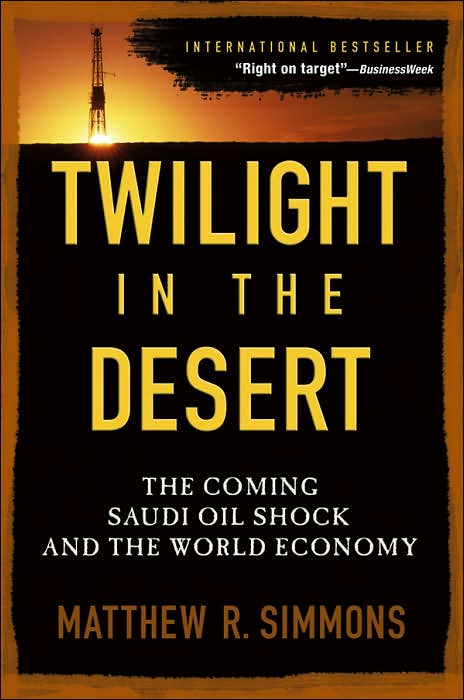
Hat tip to Aaron Edelheit for this PDF of Matt Simmons's PowerPoint presentation to the Commercial Club of Boston last month: "The Oil and Gas System is Sick". I hope it won't ruin any surprise if I tell you that Simmons, the author of the book Twilight in the Desert, thinks oil and natural gas prices are heading much higher. I happen to agree, but I'd feel surer if Simmons offered a compelling explanation for the massive correction in oil and natural gas prices last fall. On p.33 of the PDF he lists three common explanations,
–Speculators left the game that created spike
–Unraveling economy killed off demand
–Gluts are now endemic:
~Tank farms brimming with oil
~Super-tankers now floating oil gluts
■But, none of these “facts” were true.
■Only clear fact: “Crude oil fell 74% in 12 weeks” (September 22nd–December 22nd).
And then on P.34 Simmons offers this,
Are We Missing “The Black Swan?”
■Credit default swap index soared as crude oil plunged.
■Credit freeze began when oil collapsed.
■This had to hurt traders’ ability to own oil contracts.
■If any traders ever had to liquidate contracts, this would cause oil prices to temporarily fall.
■Glencore(aka Marc Rich & Co AG) Energy Trading credit default swaps illustrate the squeeze.
Which seems to contradict his point on the previous slide that the collapse wasn't the result of speculators leaving the game. Perhaps Simmons explicated this during a Q&A.
The image above, of the cover of Simmons's book, comes from Barnes & Noble's website.
Saturday, February 28, 2009
Berkshire Hathaway's Annual Shareholder Letter
Berkshire Hathaway's annual shareholder letter (PDF) was released today. Berkshire's decline in book value in 2008 was less than I would have expected, 9.6%. Below are a few brief excerpts.
Buffett On Some of his Mistakes in 2008:
On Why Berkshire Sold Some of its Stakes in JNJ, PG, and COP:
On Treasury Securities:
On the limits of Regulation:
Buffett On Some of his Mistakes in 2008:
I told you in an earlier part of this report that last year I made a major mistake of commission (and maybe more; this one sticks out). Without urging from Charlie or anyone else, I bought a large amount of ConocoPhillips stock when oil and gas prices were near their peak. I in no way anticipated the dramatic fall in energy prices that occurred in the last half of the year. I still believe the odds are good that oil sells far higher in the future than the current $40-$50 price. But so far I have been dead wrong. Even if prices should rise, moreover, the terrible timing of my purchase has cost Berkshire several billion dollars.
I made some other already-recognizable errors as well. They were smaller, but unfortunately not that small. During 2008, I spent $244 million for shares of two Irish banks that appeared cheap to me. At yearend we wrote these holdings down to market: $27 million, for an 89% loss. Since then, the two stocks have declined even further. The tennis crowd would call my mistakes “unforced errors.”
On Why Berkshire Sold Some of its Stakes in JNJ, PG, and COP:
On the plus side last year, we made purchases totaling $14.5 billion in fixed-income securities issued by Wrigley, Goldman Sachs and General Electric. We very much like these commitments, which carry high current yields that, in themselves, make the investments more than satisfactory. But in each of these three
purchases, we also acquired a substantial equity participation as a bonus. To fund these large purchases, I had to sell portions of some holdings that I would have preferred to keep (primarily Johnson & Johnson, Procter & Gamble and ConocoPhillips). However, I have pledged – to you, the rating agencies and myself – to always run Berkshire with more than ample cash. We never want to count on the kindness of strangers in order to meet tomorrow’s obligations.
On Treasury Securities:
When the financial history of this decade is written, it will surely speak of the Internet bubble of the late 1990s and the housing bubble of the early 2000s. But the U.S. Treasury bond bubble of late 2008 may be regarded as almost equally extraordinary.
On the limits of Regulation:
For a case study on regulatory effectiveness, let’s look harder at the Freddie and Fannie example. These giant institutions were created by Congress, which retained control over them, dictating what they could and could not do. To aid its oversight, Congress created OFHEO in 1992, admonishing it to make sure the two behemoths were behaving themselves. With that move, Fannie and Freddie became the most intensely-regulated companies of which I am aware, as measured by manpower assigned to the task.
On June 15, 2003, OFHEO (whose annual reports are available on the Internet) sent its 2002 report to Congress – specifically to its four bosses in the Senate and House, among them none other than Messrs. Sarbanes and Oxley. The report’s 127 pages included a self-congratulatory cover-line: “Celebrating 10 Years of Excellence.” The transmittal letter and report were delivered nine days after the CEO and CFO of Freddie had resigned in disgrace and the COO had been fired. No mention of their departures was made in the letter, even while the report concluded, as it always did, that “Both Enterprises were financially sound and well managed.”
In truth, both enterprises had engaged in massive accounting shenanigans for some time. Finally, in 2006, OFHEO issued a 340-page scathing chronicle of the sins of Fannie that, more or less, blamed the fiasco on every party but – you guessed it – Congress and OFHEO.
Thursday, February 19, 2009
Alloy Steel Update
Ugly tape for Alloy Steel International (OTC BB: AYSI.OB) on a down day. Looks like a flat-lining EKG. No company-specific news today, but there have been some tentatively positive indicators related to the metals sector recently1. Picked up a few more shares today at .29.
1E.g.,
- Temasek, the $134 billion Singaporean sovereign wealth fund, recently hired Chip Goodyear, former CEO of blue chip miner BHP Billiton, as its new chief (Wall Street Journal: Temasek Shakes Up Its Top Ranks -- Ho Ching Out, 'Chip' Goodyear In at Singapore Fund; a Commodity Push?)
- China bought a stake in (over-levered) blue chip miner Rio Tinto (BBC: China takes a stake in Rio Tinto)
- The Baltic Dry Index was up 147% year-to-date as of February 17th (Bloomberg: "Shipping Index Surge Signals Commodity Currency Gains"). It's up about 166% as of today (but still down steeply from its 2008 highs).
On the other hand, the continuing global recession is obviously bearish, and as reader Sivaram noted in a recent comment thread ("Mohnish, How Are You Feeling"), Mohnish Pabrai mentioned in his annual investor letter that he has turned bullish on the commodity sector, which, given his recent track record, could be considered a bearish indicator.
Subscribe to:
Posts (Atom)

 Posts
Posts

