Showing posts with label Warren Buffett. Show all posts

Wednesday, November 4, 2009

Warren Buffett versus Pranab Mukherjee

Interesting juxtaposition on the front page of today's Financial Times: The paper leads with Berkshire's $27 billion buyout offer for the ~77% of Burlington Northern Santa Fe, and highlights this quote by Buffett:

It's an all-in wager on the future of the U.S.


That makes the bet seem a little riskier than it is, I think. The bet seems fairly agnostic about, say, the future of American manufacturing or exports. The railroad will make money shipping imports in from the ports or exports out to them. In any case, here's what the FT had below the fold: news that India sold dollars to buy 200 tons of gold. Excerpt:

Pranab Mukherjee, India's finance minister, said the acquisition reflected the power of an economy that laid claim to the fifth-largest global foreign reserves: "We have money to buy gold. We have enough foreign exchange reserves."

He contrasted India's strength with weakness elsewhere: "Europe collapsed and North America collapsed"

Wednesday, July 29, 2009

Keeping a Casual Eye on ASUR, Part II


As I mentioned in a previous post ("Keeping a Casual Eye on ASUR"), I closed out my positions in Asure Software (Nasdaq: ASUR) at .25, but I planned to keep a casual eye on the stock to see

if Red Oak succeeds in unlocking some shareholder value here. If so, it might be worth considering piggybacking on their next venture in micro cap shareholder activism.


Red Oak and other current ASUR shareholders just suffered a setback: after the close yesterday, ASUR management announced that the firm had lost its trial against its former law firm, and was liable for nearly $5 million in damages, attorney's fees, and interest. If that judgment stands, that would wipe out half of the cash on ASUR's balance sheet. The stock dropped 20% on this news, in response to which a commenter on the company's Yahoo! Finance message board wrote,

1. Warrent Buffett: "You should invest in a business that even a fool can run, because someday a fool will."

2. Now, I understand why Warrent Buffett doesn't like cigar butts anymore.

3. Why this pending lawsuit is not on the 10K?


The litigation actually was mentioned in the company's 10-K, but, to be honest, I didn't pay enough attention to it. I lucked out with the verdict being released now versus last month, when I still held the stock. I wonder if this verdict was a surprise to Red Oak Partners as well. I am going to e-mail David Sandberg at Red Oak now and ask him. I'll update this post with his answer if he is kind enough to respond.

Tuesday, May 19, 2009

A Sucker for a Pretty Business Journalist


Hat tip to Sivaram for alerting me to Michael Lewis's review of Alice Schroeder's Buffett biography in the New Republic1, "Master of Money". Lewis notes in the beginning of his review that,

Buffett has a long and happy history of admitting attractive, intelligent women into his life, which Schroeder describes without mentioning how neatly she fits into the pattern.


How she fits in the pattern, apparently, is that unlike other female business journalists -- e.g., CNBC's Becky Quick, and Liz Claman (now at Fox Business) who preceded her as the network's Buffett correspondent, Schroeder was intent on using her access to paint a warts-and-all portrait of Buffett as a person as well as as an investor. That leads to some interesting material, which is surveyed in Lewis's review. It's an entertaining read, as Lewis's essays usually are.

The photo above, of Warren Buffett and Alice Schroeder, comes from Khotanharmon.com.

1Now that Condé Nast has pulled the plug on Portfolio, perhaps TNR will be a regular home for Michael Lewis's essays.

Thursday, March 19, 2009

Buffett's Turn to Face Some Heat


In a recent post ("More Obama Supporters Concerned by the President's Recent Actions") we noted that Warren Buffett and Jim Cramer had made essentially the same criticism of Obama's recent handling of the economy: in an economic emergency, the president's primary focus ought to be dealing with that emergency, not trying to enact other policy priorities. Last week, Jim Cramer and his network, CNBC, became the targets of liberal comedian Jon Stewart. Stewart's criticisms of Cramer, some of which had merit, related mainly to Cramer's actions last year and earlier (e.g., Cramer's comments regarding Bear Stearns prior to that firm's collapse). Why bring that up now? As I speculated elsewhere recently (for example, in a comment on Dr. Mark Perry's Carpe Diem blog), Cramer seemed to be targeted because of his recent criticisms of President Obama -- particularly since he made an easier target than some other Obama supporters who recently criticized the President, e.g., Warren Buffett.

Yesterday, apparently, was Buffett's turn. An article in the business section of Wednesday's New York Times ("Buffett Is Unusually Silent on Rating Agencies") criticized Buffett for not using his influence (since he owns 20% of the company via Berkshire Hathaway) to get Moody's to clean up the way it assigns credit ratings. Now, this is a legitimate criticism of Buffett; in fact, it's one I've made myself1. But the timing of it seems a little odd, if you don't take into account Buffett's recent criticism of Obama. After all, Berkshire Hathaway has been a major holder of Moody's for years, and the role Moody's and the rest of the ratings oligopoly played in the credit crisis has been common knowledge since at least 2007. Can it be a coincidence that Buffett is getting criticized for this now, a week after he expressed concerns about Obama's handling of the economy on CNBC?

The illustration of Buffett above was credited to Minh Uong, and accompanied the New York Times article.

1For example, on June 12th last year, on GuruFocus I wrote,

Before we begin the ritualistic praise of Buffett here, let's remember that a company in which he was the largest shareholder through BRK, Moody's, facilitated these excesses by slapping triple-A ratings on so many of those CDOs. When you own ~19% of a company, you have a lot of access to what's going on there, if you want it. It's too bad that Buffett didn't exercise more oversight of Moody's during the credit boom.

Wednesday, March 18, 2009

Revisiting Warren Buffett's Criteria for Selecting Corporate Directors

Given the recent outrage about the high compensation for executives who did poor jobs running their companies, and given the role corporate boards of directors play in setting executive compensation, it's worth revisiting Warren Buffett's comments on selecting corporate directors. Buffett wrote this in his 2006 Berkshire Hathaway Shareholder Letter (p.19 in the PDF):

In selecting a new director [Yahoo! CFO Susan Decker], we were guided by our long-standing criteria, which are that board members be owner-oriented, business-savvy, interested and truly independent. I say “truly” because many directors who are now deemed independent by various authorities and observers are far from that, relying heavily as they do on directors’ fees to maintain their standard of living. These payments, which come in many forms, often range between $150,000 and $250,000 annually, compensation that may approach or even exceed all other income of the “independent” director. And – surprise, surprise – director compensation has soared in recent years, pushed up by recommendations from corporate America’s favorite consultant, Ratchet, Ratchet and Bingo. (The name may be phony, but the action it conveys is not.)

Charlie [Munger, Berkshire's Vice Chairman] and I believe our four criteria are essential if directors are to do their job – which, by law, is to faithfully represent owners. Yet these criteria are usually ignored. Instead, consultants and CEOs seeking board candidates will often say, “We’re looking for a woman,” or “a Hispanic,” or “someone from abroad,” or what have you. It sometimes sounds as if the mission is to stock Noah’s ark. Over the years I’ve been queried many times about potential directors and have yet to hear anyone ask, “Does he think like an intelligent owner?”


The problem of corporate executives or directors not acting in the interests of shareholders is a prime example of an agency conflict. We touched on this in a post last summer ("Agency Conflicts").

Thursday, March 12, 2009

More Obama Supporters Concerned by the President's Recent Actions


Last week we noted the concern expressed by two supporters of President Obama, Jim Cramer and Stewart Taylor, about the President's recent statements and actions (see "Buyer's Remorse" and ""More Buyer's Remorse"). This week brings more notes of concern from Obama supporters. On Monday on CNBC, Warren Buffett made a point similar to the one Taylor and Cramer made: in an economic emergency, the president's primary focus ought to be dealing with that emergency, not trying to enact other policy priorities. To underline the point, Taylor used the metaphor of a burning house: you put the fire out first; you don't water the lawn. Buffett used the analogy of World War II, saying that we have been hit with an "economic Pearl Harbor". From the transcript of his CNBC appearance Monday:

[I]f you're in a war, and we really are on an economic war, there's a obligation to the majority to behave in ways that don't go around inflaming the minority. If on December 8th when--maybe it's December 7th, when Roosevelt convened Congress to have a vote on the war, he didn't say, `I'm throwing in about 10 of my pet projects,' and you didn't have congress people putting on 8,000 earmarks onto the declaration of war in 1941.

[...]

[J]ob one is to win the war, job--the economic war, job two is to win the economic war, and job three. And you can't expect people to unite behind you if you're trying to jam a whole bunch of things down their throat. So I would--I would absolutely say for the--for the interim, till we get this one solved, I would not be pushing a lot of things that are--you know are contentious, and I also--I also would do no finger-pointing whatsoever. I would--you know, I would not say, you know, `George'--`the previous administration got us into this.' Forget it. I mean, you know, the Navy made a mistake at Pearl Harbor and had too many ships there. But the idea that we'd spend our time after that, you know, pointing fingers at the Navy, we needed the Navy. So I would--I would--I would--no finger-pointing, no vengeance, none of that stuff. Just look forward.


Warren Buffett may not have much else in common with the "dissident" feminist intellectual Camille Paglia, but she supported Obama as well -- and like Buffett, is concerned by some of what she has seen since he was inaugurated. In the first part1 of her Salon column Wednesday ("Obama's Clumsy, Smirky Staff is Sinking Him"), Paglia blamed the problems on Obama's staff:

Yes, free the president from his flacks, fixers and goons -- his posse of smirky smart alecks and provincial rubes, who were shrewd enough to beat the slow, pompous Clintons in the mano-a-mano primaries but who seem like dazed lost lambs in the brave new world of federal legislation and global statesmanship.

Heads should be rolling at the White House for the embarrassing series of flubs that have overshadowed President Obama's first seven weeks in office...

[...]

First it was that chaotic pig rut of a stimulus package, which let House Democrats throw a thousand crazy kitchen sinks into what should have been a focused blueprint for economic recovery. Then it was the stunt of unnerving Wall Street by sending out a shrill duo of slick geeks (Timothy Geithner and Peter Orszag) as the administration's weirdly adolescent spokesmen on economics. Who could ever have confidence in that sorry pair?


1The second part of the column is, inexplicably, about something completely different: Paglia's recent trip to experience Carnival in Bahai, Brazil, as the guest of a popular Brazilian singer.

Saturday, February 28, 2009

Berkshire Hathaway's Annual Shareholder Letter

Berkshire Hathaway's annual shareholder letter (PDF) was released today. Berkshire's decline in book value in 2008 was less than I would have expected, 9.6%. Below are a few brief excerpts.

Buffett On Some of his Mistakes in 2008:

I told you in an earlier part of this report that last year I made a major mistake of commission (and maybe more; this one sticks out). Without urging from Charlie or anyone else, I bought a large amount of ConocoPhillips stock when oil and gas prices were near their peak. I in no way anticipated the dramatic fall in energy prices that occurred in the last half of the year. I still believe the odds are good that oil sells far higher in the future than the current $40-$50 price. But so far I have been dead wrong. Even if prices should rise, moreover, the terrible timing of my purchase has cost Berkshire several billion dollars.

I made some other already-recognizable errors as well. They were smaller, but unfortunately not that small. During 2008, I spent $244 million for shares of two Irish banks that appeared cheap to me. At yearend we wrote these holdings down to market: $27 million, for an 89% loss. Since then, the two stocks have declined even further. The tennis crowd would call my mistakes “unforced errors.”


On Why Berkshire Sold Some of its Stakes in JNJ, PG, and COP:

On the plus side last year, we made purchases totaling $14.5 billion in fixed-income securities issued by Wrigley, Goldman Sachs and General Electric. We very much like these commitments, which carry high current yields that, in themselves, make the investments more than satisfactory. But in each of these three
purchases, we also acquired a substantial equity participation as a bonus. To fund these large purchases, I had to sell portions of some holdings that I would have preferred to keep (primarily Johnson & Johnson, Procter & Gamble and ConocoPhillips). However, I have pledged – to you, the rating agencies and myself – to always run Berkshire with more than ample cash. We never want to count on the kindness of strangers in order to meet tomorrow’s obligations.


On Treasury Securities:

When the financial history of this decade is written, it will surely speak of the Internet bubble of the late 1990s and the housing bubble of the early 2000s. But the U.S. Treasury bond bubble of late 2008 may be regarded as almost equally extraordinary.


On the limits of Regulation:

For a case study on regulatory effectiveness, let’s look harder at the Freddie and Fannie example. These giant institutions were created by Congress, which retained control over them, dictating what they could and could not do. To aid its oversight, Congress created OFHEO in 1992, admonishing it to make sure the two behemoths were behaving themselves. With that move, Fannie and Freddie became the most intensely-regulated companies of which I am aware, as measured by manpower assigned to the task.

On June 15, 2003, OFHEO (whose annual reports are available on the Internet) sent its 2002 report to Congress – specifically to its four bosses in the Senate and House, among them none other than Messrs. Sarbanes and Oxley. The report’s 127 pages included a self-congratulatory cover-line: “Celebrating 10 Years of Excellence.” The transmittal letter and report were delivered nine days after the CEO and CFO of Freddie had resigned in disgrace and the COO had been fired. No mention of their departures was made in the letter, even while the report concluded, as it always did, that “Both Enterprises were financially sound and well managed.”

In truth, both enterprises had engaged in massive accounting shenanigans for some time. Finally, in 2006, OFHEO issued a 340-page scathing chronicle of the sins of Fannie that, more or less, blamed the fiasco on every party but – you guessed it – Congress and OFHEO.

Thursday, February 5, 2009

Are Liberals Less Inclined to Pay Their Taxes?


That question occurred to me on reading the news that a fourth Obama Administration nominee, Labor Secretary nominee Rep. Hilda Solis, has unpaid tax issues (The Washington Post: "Solis Senate Session Postponed in Wake of Husband's Tax Lien Revelations"). This news, of course, comes after the revelations of unpaid taxes by Treasury Secretary Timothy Geithner1,2 (pictured above), former HHS Secretary nominee Tom Daschle, and former "Government Performance Czar" nominee Nancy Killefer. If coincidences don't come in threes, as the saying goes, then they don't come in fours either.

At first blush, it might seem counter-intuitive that affluent liberals would be less inclined to pay their taxes, since they tend to advocate for higher taxes on the affluent. Advocating for higher taxes on the affluent and being eager to pay them yourself are two different things though. Warren Buffett, for example, has famously lamented that he doesn't have a higher tax liability, and yet he deliberately avoids the capital gains tax on the shares of Berkshire Hathaway he donates to the Gates Foundation. I would be interested in any data that compared the level of tax compliance by conservatives and liberals, but I wonder if a similar dynamic is at work with taxes as with charitable donations.

Just as liberals tend to advocate for higher taxes on the affluent, they also tend to advocate for more government assistance to the less fortunate. While this might lead one to believe that liberals are more generous than conservatives, Arthur C. Brooks, professor of public administration at Syracuse, found that conservative households donate 30% more to charity than liberal households. Could it be that liberals feel less obligated to donate to charity or fully comply with tax laws because they feel that their advocacy for more progressive taxes and more generous welfare spending absolves them of some of their responsibility to contribute personally? Perhaps they feel they "gave" at the ballot box?

The photo above, of Treasury Secretary Timothy Geithner, is from the Affordable Housing Institute's website.

1I suspect Geithner's tax avoidance may have been motivated by what David Brooks has termed Status-Income Disequilibrium. As a high official at Treasury, the IMF, and then the New York Fed, Geithner earned a comfortable salary -- one higher than perhaps 99% of Americans -- but a pittance compared to some of the CEOs over whom he wielded authority. He probably thought he was sacrificing enough for the common good by renouncing more lucrative prospects in the private sector and working for the IMF instead, so why should he lower his take-home pay even more by paying his self-employment taxes?

2Atlantic blogger and journalist James Fallows, a former Carter Administration official and liberal in good standing, Had this to say about Timothy Geithner's non-payment of his taxes ("A Word about Timothy Geithner" -- scroll about a quarter of the way down for this):

I do not believe, and will never believe, that his failure to pay his own self-employment tax while at the IMF was an "oversight" or a "mistake." I have many many friends who have worked for this and similar organizations. I have myself over the years juggled the complexities of what is self-employment income and what is W-2 income and how to handle income from non-US sources -- and I have a lot less financial acumen than any Treasury Secretary aspirant should and must have. (Though I also use Turbo Tax!) Not a single person I have known from the IMF or similar bodies, not a one, believes that Geithner could have "overlooked" his need to pay US self-employment tax. When I have received similar income from international sources, the need was obvious even to me -- and I wasn't receiving and signing all the forms to the same effect Geithner would have gotten from the IMF. I could go on with details but I'll just say: if this were a situation more average Americans had experienced personally, he would not dare make his "mistake" excuse because everyone would say, "Are you kidding me???"

Thursday, January 29, 2009

"Buffett's Strategy is Stale"

That was the title of Doug Kass's column yesterday on TheStreet.com. Excerpt:

Over the past week, I have outlined the potholes in Berkshire Hathaway's investment portfolio and the sharp drop in market value in some of Warren Buffett's largest holdings.

It was not my intention to overly dramatize the short-term miscues nor was it my intention to understate the remarkable long-term investment achievements of Warren Buffett. It was my intention to underscore that the strategy of investing in companies that have apparent moats to protect their business -- and these moats have been so dear to Buffett's investment strategy over multiple decades -- could either:

* have been abandoned by the Oracle of Omaha, owing to his reluctance to alter/sell off his strategic and principal holdings and maintain a tax-efficient portfolio approach; or

* have been influenced by his mistaken analysis of the changing competitive landscape facing some of his portfolio companies (in other words, the moat has been flooded!).


Kass goes on to offer American Express as an example of a Berkshire holding with a putative moat whose product has become commoditized, and he estimates Buffett's long term average annual return on his American Express to be about 2% per year. In his previous column (the same one he links to in the above excerpt), Kass argued that the banks in which Berkshire holds large positions no longer have moats either.

Tuesday, September 30, 2008

Subprimes and The Efficient Market Theory

Many active investors who don't believe that markets are fully efficient (if they did, of course, they wouldn't be active investors) nevertheless believe that markets are mostly or frequently efficient (see, for example, Warren Buffett making this point in his 1988 Berkshire Hathaway Chairman's Letter). How then to explain the yawning gap between the market prices of certain mortgage-backed securities and their supposed hold-to-maturity or intrinsic values?

Brian Wesbury, chief economist of First Trust, reiterated on CNBC today a point he made in a recent Forbes column: if 100% of the mortgages in a subprime mortgage CDO defaulted, owners of the security would recover something -- perhaps 40 cents on the dollar -- from the sale of the houses. And yet, two months ago, Merrill Lynch unloaded some CDOs for about 22 cents on the dollar (Barry Ritholtz argued at the time that, since Merrill was financing about 75% of the sale itself, the actual sale price for the assets was about 5.47 cents on the dollar).

If what Wesbury says is right (and it seems reasonable), why aren't institutional investors lining up to bid on subprime-backed paper for 22 cents on the dollar?

Monday, August 11, 2008

The Credit Crisis a Year Later


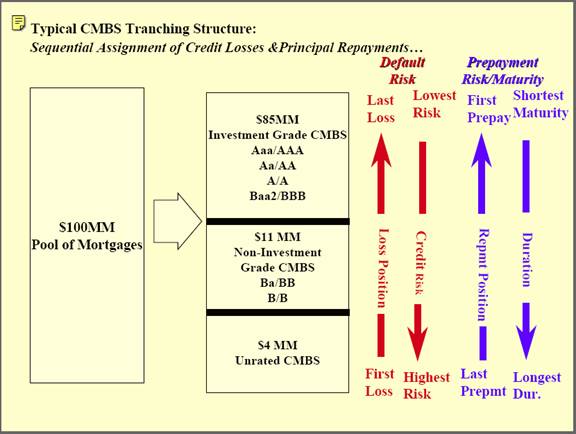
Articles with similar titles are sprouting up in the financial media now, so I thought it would be worth posting a link to John Mauldin's excellent essay on this from last August, "The Panic of 2007". Mauldin's essay includes helpful charts such as the one above and offers a lucid explanation of CDOs comprised of mortgage backed securities.

One suggestion Mauldin had back then for ameliorating the crisis was for Warren Buffett to take over Moody's, which he owns about 20% of through Berkshire Hathaway (as he took over Salomon Brothers years ago), to restore faith in the rating agencies. Of course, that didn't come to pass (instead, Buffett later created a muni bond insurer, Berkshire Hathaway Assurance, to profit from the crisis in which Moody's and the other rating agencies played a supporting role) but I wonder if it would have helped anyway. At Salomon Brothers, the problems were regulatory violations (of Treasury auction rules) that Buffett wasn't aware of (and of course wouldn't have condoned) at the time they were committed; at Moody's the problem was the way it did business, awarding triple-A credit ratings to so many questionable mortgage backed CDOs. As an insider, one would think that Buffett would have been aware of this practice at the time, so he might not have had the same credibility coming in to clean the stables at Moody's that he had coming into Salomon.

Saturday, July 26, 2008

Why Worry about Small, Thinly-Traded Stocks?

That question was posed by a someone commenting on the previous post ("How One Investor Found a Home Run Stock"). I initially responded in a comment, but it was a good enough question to warrant answering it more fully in a separate post.

As I noted in my comment, the reason such small stocks are worth paying attention to is that these stocks are more likely to be mis-priced, since they usually have no analyst coverage, little media attention, are ignored by most institutional investors, etc. This gives them the potential for higher returns than more widely-followed stocks. Recent academic literature supports this. See, for example, "Information Diffusion Based Explanations of Asset Pricing Anomalies", by Bolmatis and Sekeris. In this study the authors found that,

Stocks that have no-trade days outperform other stocks by a wide margin, even after correcting for their higher risk as captured by their larger betas. This result is expected when comparing stocks with large differences in information availability.


Mark Hulbert, of the Hulbert Financial Digest, wrote about this study last month in the New York Times (Strategies: "Roses among the Wall Flowers"), and fund manager Aaron Edelheit commented on this article in his blog ("This is What I Do for a Living!"). In that post, Edelheit wrote,

Academic studies finally back up what I have found in 10 years of investing:

No trade stocks outperform


In addition to Edelheit, another professional investor who has achieved excellent returns by investing in these sorts of stocks is Paul Sonkin, of the Hummingbird Value Funds.

It's true that investing in such small cap stocks is risky, but it's also true that there's plenty of risk in investing in many large cap stocks, as investors who bought shares in such stalwarts as Citigroup or Motorola over a year ago can attest to. Perhaps the conventional wisdom of risk-versus-reward (i.e., large cap is less risky than smaller cap; domestic is less risky than foreign) needs to be reconsidered. If an investor is going to take on significant risk investing in common stocks, he ought to have the potential of a significant upside to compensate him for taking on that risk.

Here is another way to think about size-versus-risk. Think of a small, local business where you live, one that is profitable and that has been so for decades. If there were a way for you to buy a small piece of that business (at a fair price, of course) would you buy it? Chances are, if that small, local business were publicly-traded it would be a micro-cap. Would that, in and of itself, make it a more risky1 investment?

Another point the commenter made was that the recent paucity of comments on this blog was due to my posts about "super-obscure" stocks. He may well be right. I'd venture that for most people, reading about stocks you don't own and have no intention of buying is boring. I remember, years ago, as a trainee in a small brokerage/investment bank in Midtown Manhattan, how boring it was to read the WSJ's "Abreast of the Market" column everyday as I was instructed to do. I didn't own any of those stocks, and so I had no interest in them. Perhaps I'll add some more general interest posts in the future, but I'll continue to write about small stocks, because that is what interests me. If you are more interested in reading about more widely-followed companies, including Dow Components, Buffett picks, etc., you may want to peruse the Value Strategies & Ideas" forum on GuruFocus.

1Risky in terms of the chance of you suffering a permanent loss of principal, not risky in terms of price volatility.

Saturday, July 5, 2008

Does Warren Buffett's Secretary Have a Higher Effective Tax Rate than Him?

On her Atlantic blog ("Tax talk"), Megan McCardle writes,

And [University of Chicago Economics Professor and erstwhile Obama economic adviser Austan] Goolsbee justly points out that under the current system, Warren Buffet's secretary has a higher average tax rate than he does.


To be precise, Megan writes "average" tax rate, but since the effective tax rate represents the percentage of one's income that one actually pays in taxes, I assume she meant effective tax rate1. Does Buffett's secretary (I've also heard the claim made about his housekeeper) have a higher effective tax rate than him? I'm skeptical about this.

According to these data from the non-partisan Congressional Budget Office, effective federal tax rates in America (taking into account payroll taxes as well) are highly progressive. In 2005, the lowest quintile of earners had an average effective federal tax rate of 4.3%, and the highest quintile had an average effective federal tax rate of 25.5% (the top 1% paid 31.2%). It's possible that the ultra-wealthy such as Buffett have lower effective tax rates than the top 1%, because nearly all of the income of the ultra-wealthy comes from capital gains, but I doubt the ultra-wealthy have lower effective tax rates than housekeepers and secretaries. I'd be more inclined to believe that Buffett's physician has a higher effective tax rate than him than that his housekeeper does. Perhaps Buffett will make public his and his secretary's and housekeeper's tax returns so others can verify this.

In the meantime, the issue of Buffett's taxes versus his secretary's taxes raises a couple of meta-questions:

- Does it make sense to make tax policy based on a small number of outliers such as America's multi-billionaires?

- Would proposed changes in tax policy materially affect these billionaires?

The answer to both questions appears to be "no". Multi-billionaires have far more control over how and when they get paid -- and how and when they get taxed -- than any other tax payers. I doubt Buffett's taxes will be materially affected by any tax code changes made in Washington next year.

The real impact of any changes in tax policies will fall mostly on the "working rich": the surgeon, high-end salesman, or other worker making $250k-$500k+. There will be little if any impact on the Buffetts of this country. Buffett, I would think, knows this, but he is politically savvy enough to position this as an issue of the super-wealthy such as himself paying their 'fair share'. Whether Buffett really thinks he doesn't pay enough in taxes is another question. Two data points suggest otherwise.

The first is Buffett's occasional boasting in his annual letters to Berkshire Hathaway shareholders about how much Berkshire (of which Buffett remains the largest individual shareholder) pays in federal taxes. This, for example, is from his 2006 Letter:

Berkshire will pay about $4.4 billion in federal income tax on its 2006 earnings. In its last fiscal year the U.S. Government spent $2.6 trillion, or about $7 billion per day. Thus, for more than half of one day, Berkshire picked up the tab for all federal expenditures, ranging from Social Security and Medicare payments to the cost of our armed services. Had there been only 600 taxpayers like Berkshire, no one else in America would have needed to pay any federal income or payroll taxes.


The second data point that suggests Buffett isn't really worried that he pays too little in taxes is the method in which he makes his generous donations to the Gates Foundation. Currently, Buffett donates shares of Berkshire Hathaway to the foundation. If Buffett were truly concerned that he didn't pay enough in taxes, he could easily remedy this by selling his Berkshire Hathaway shares first, paying the capital gains taxes on the sales, and then donating the net cash proceeds to the Gates Foundation. Presumably, Buffett donates the shares instead because he feels he pays enough in taxes already, or because he feels that the Gates Foundation will spend his money more wisely than the federal government will. Whatever the reason, avoiding the capital gains tax by donating the shares is inconsistent with Buffett's lamentations about not paying enough in taxes.


1Update: The phrase "average tax rate" is a synonym for the phrase "effective tax rate". Thanks to commenter Jason for indirectly pointing that out.

Saturday, June 28, 2008

From Joel Greenblatt to Jim Rogers, Part I: The Magic Formula

The intent of this series of posts is to put my later posts about specific investment ideas in context, by describing the evolution of my thinking on investing over the last year and a half, as I've made mistakes and tried to learn from them. I'm going to break this up into a few posts, just to keep each post from being too long.

The Magic Formula

For those unfamiliar with the Magic Formula, it's Joel Greenblatt's Buffett- and Graham-inspired mechanical system of buying a basket of "good" and "cheap" stocks. From Graham, Greenblatt got the emphasis on buying a basket of cheap stocks. In the Magic Formula, Greenblatt uses earnings yield, defined as EBIT/Enterprise Value, to measure "cheapness". Greenblatt uses EBIT instead of earnings to account for differences in interest payments and taxes among different companies, and he uses enterprise value instead of price to account for different levels of net cash or net debt. From Buffett, Greenblatt got the emphasis on finding "good" companies, defined as companies with high returns on tangible capital. Greenblatt calls this return on invested capital (ROIC) and defines it as [EBIT/(Net working capital + Net fixed assets)]. Greenblatt set up a website, Magic Formula Investing.com, to make it easy for individual investors to follow this system. The site ranks its universe of thousands of (mostlyAmerican) stocks by earnings yield and by return on invested capital, and lists those stocks that have the best combined scores (i.e., not necessarily the "cheapest" or the "best", but the stocks that represent the best combination of "cheap" and "good" according to the system).

After reading Joel Greenblatt's The Little Book that Beats the Market in late 2006, I began investing the better part of my money according to the methodology in the book in early 2007. During this time, I read a number of books on value investing (e.g., The Essays of Warren Buffett, Benjamin Graham's The Intelligent Investor, etc.) that reinforced some of the principles of Greenblatt's Magic Formula.

I knew enough about the boom in commodities to be sure to include some of the handful of commodity companies that appeared on the list, but also included companies in other sectors. Aside from the commodity companies, all of which did well, and a couple of small cash-rich drug companies that were bought out for modest premiums, virtually every other stock in the portfolio plummeted. Judging from the lamentations on Yahoo! Finance's Magic Formula Investing Message Group, this has been a common experience.

In fairness to Joel Greenblatt, he did warn in his book that his Magic Formula system (like any mechanical system) wouldn't work all the time, and could under-perform the market for a few years in a row. In the book (pp. 71-73), Greenblatt also alluded to the hot-cold-hot roller coaster performance of O'Shaughnessy's screens in the 1990s, and to a period of under-performance experienced by his friend and fellow money manager Richard Pzena (neither O'Shaughnessy nor Pzena is mentioned by name in the book, but their identities are fairly clear from the descriptions). Nevertheless, the jaw-dropping Magic Formula losses last year (in what was, admittedly, an awful year for most broad-based value strategies) contrasted sharply with the back-tested performance of the Magic Formula system in Greenblatt's book. Over a 17-year testing period, the all-cap portfolio (with a minimum market cap of $1 million) only had one down year (the bear market year of 2002), and that year it merely had a single-digit loss.

After analyzing some of my losers, and see what some successful investors did differently, the lessons I took away were the importance of paying attention to the relevant macro trends, and that in a market when most stocks and most sectors are performing poorly, excessive diversification can be a liability.