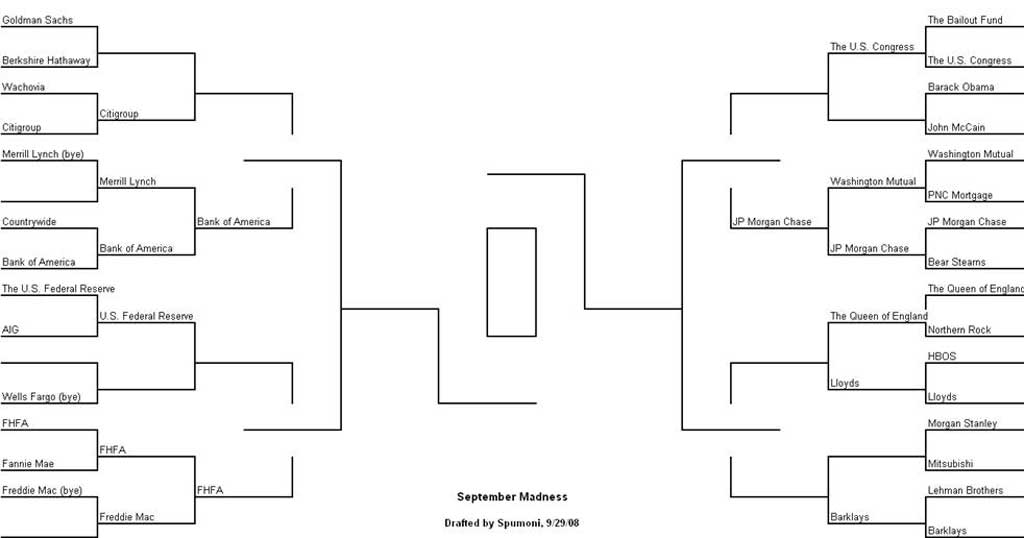
Hat tip to Barry Ritholtz
The only way that buying the questionable assets will increase capital on the liability side of the balance sheet is if the Treasury overpays for them.
The “super-bond” would [...] be seen by customers as a legitimate cushion of protection. However, in the event of bankruptcy, it would have a senior claim in front of both stockholders and even senior bondholders. Do that, and you've actually got a mechanism to protect the financial system while at the same time protecting customers and taxpayers. Ideally, the super-bond accrues a relatively high rate of interest so that financials have an incentive to shift to private financing as soon as possible, but you would also defer the interest until the bank meets a minimal level of profitability to make sure that the financing doesn't strain the institution's liquidity.
But then, Congress didn't do this because nobody thinks in terms of balance sheets.
The financial system has reached the point of maximum peril. After years of profligacy, banks have all but stopped lending to each other as the US Congress decides whether to extend support. If the unravelling of the banking system continues, the economic consequences will be dire. Yet there is an even greater risk: that the politicians now contemplating Wall Street’s follies draw the wrong conclusions and take the wrong decisions, losing their confidence in markets altogether.
It would not be the first time. After the Wall Street Crash, markets were deemed to have failed and US lawmakers attempted to regulate short-cuts through the crisis. The widely-copied Smoot-Hawley Tariff Act quadrupled the effective tax rate on thousands of imports and deepened the “Great Contraction” of 1929 to 1933. The price of popular anti-market sentiment was much higher in some of Europe’s fledgling democracies: fascism.
Despite the severity of the current crisis, such extreme reactions remain very unlikely. Yet there is plenty of room for policymakers to compound the damage already inflicted by the irresponsible conduct of the financial sector. It is time, then, to remember what open markets have achieved, and what lies in wait for societies that suppress them.
It is no help that some of the loudest critics have little interest in what went wrong, less in how to fix it, and none at all in safeguarding against problems in future.
[...]
The current crisis is routinely described as a symptom of deregulation, but it is equally the child of earlier, ill-fated interventions. Subprime mortgages grew because the prime mortgage sector was dominated by Fannie Mae and Freddie Mac, two institutions founded, regulated and effectively underwritten by the government.
[...]
Capital markets clearly need better regulation but policymakers should guard against unintended consequences. Markets are places of trial and, very frequently, error. Their genius is not perfect efficiency, but the rewarding of success and the weeding out of failure. No better alternative has ever presented itself.
This is a difficult time to defend free markets. Nevertheless they must be defended, not only on their matchless record when it comes to raising living standards, but on the maxim that it is wise to let adults exercise their own judgment.
Market freedom is not a “fundamentalist religion”. It is a mechanism, not an ideology, and one that has proved its value again and again over the past 200 years. The Financial Times is proud to defend it – even today.
Dear Joe,
I understand your reluctance to vote for a bill that 90% of the people who voted for you are against. That is generally not good politics. They don't understand why taxpayers should spend $700 billion to bail out rich guys on Wall Street who are now in trouble. And if I only got my information from local papers and news sources, I would probably agree. But the media (apart from CNBC) has simply not gotten this story right. It is not just a crisis on Wall Street. Left unchecked, this will morph within a few weeks to a crisis on Main Street. What I want to do is describe the nature of the crisis, how this problem will come home to your district, and what has to be done to avert a true, full-blown depression, where the ultimate cost will be far higher to the taxpayers than $700 billion. And let me say that my mail is not running at 10 to 1 against, but it is really high. I am probably going to make a lot of my regular readers mad, but they need to hear what is really happening on the front lines of the financial world.
First, let's stop calling this a bailout plan. It is not. It is an economic stabilization plan. Run properly, it might even make the taxpayers some money. If it is not enacted very soon (Monday would be fine), the losses to businesses and investors and homeowners all over the US (and the world) will be enormous.
[...]
If we act now, we will start to see securitization of mortgages, credit cards, auto loans, and business loans so that the economy can begin to function properly.
What happens if we walk away? Within a few weeks at most, financial markets will freeze even more. We will see electronic runs on major banks, and the FDIC will have more problems than you can possibly imagine. The TED spread and LIBOR will get much worse. Businesses which use the short-term commercial paper markets will start having problems rolling over their paper, forcing them to make difficult cuts in spending and employment. Larger businesses will find it more difficult to get loans and credit. That will have effects on down the economic food chain.
[...]
This deal needs to be done by Monday. Every day we wait will see more and more money fly out the doors of the banks, putting the FDIC at ever greater risk. Panic will start to set in, moving to ever smaller banks. Frankly, we are at the point where we need to consider raising the FDIC limits for all deposits for a period of time, until the Stabilization Plan quells the panic.
I understand that this is a really, really bad idea according classical free-market economic theory. You know me; I am as free market as it comes. But I also know that without immediate action a lot of people are really going to be hurt. Unemployment is not a good thing. Losses on your home and investments hurt. It is all nice and well to talk about theories and contend the market should be allowed to sort itself out; and if we have a deep recession, then that is what is needed. But the risk we take is not a deep recession but a soft depression. The consequences of inaction are simply unthinkable.
Joe, I am telling you that the markets are screaming panic. Yes, Senator Richard Shelby has his 200 economists saying this is a bad deal. But they are ivory tower kibitzers who have never sat at a trading desk. They have never tried to put a loan deal together or had to worry about commercial paper markets collapsing. I am talking daily with the people on the desks who are seeing what is really happening. Shelby's economists are armchair generals far from the front lines. I am talking to the foot soldiers who are on the front lines.
Every sign of potential disaster is there. You and the rest of the House have to act. It has to be bipartisan. This should not be about politics (even though Barney Frank keeps talking bipartisan and then taking partisan shots, but I guess he just can't help himself). It should be about doing the right thing for our country and the world. I know it will not be fun coming back to the district. Talking about TED spreads and LIBOR will not do much to assuage voters who are angry. But it is the right thing to do. And I will be glad to come to the town hall meeting with you and help if you like.
Global markets have been holding their breath at the outcome of the talks, and bankers warned of a catastrophic response if the talks did collapse. “It feels as if we are 15 minutes away from the end of the world,” the head of equities at a big UK bank told the Financial Times.
WSJ: How do you balance the high cost of innovation with the pressure to cut cancer-drug prices?
Dr. Levinson: Since 1976, when our company was founded, the biotech industry has lost $90 billion in aggregate. I think it's the biggest money-losing industry of all time. It is hemorrhaging. There are some exceptions: We are doing well, and Amgen is doing well. But for most of the 1,300 to 1,400 companies -- 300 or 400 of them public -- this is a money-losing enterprise.
You don't just crank these drugs out. My lab cloned a portion of the breast-cancer gene in 1982. And we started making antibodies to it in the mid-'80s. Then we got cell-culture results in the late '80s and by the early '90s we were getting animal results. And then approval was in December '98. So this goes back a long, long time. Unless these companies can get a return, we are not going to get the new medicines that are making such a difference to patients' lives right now.

 Posts
All Comments


