[The Fed] has committed itself to an inflation target of just under 2 percent. Of course, none of that assures us that the Fed will hit the bull’s-eye. It might miss and produce, say, inflation of 3 percent or 4 percent at the end of the crisis — but not 8 or 10 percent.
[...]
SKEPTICAL? Then let’s see what the bond market vigilantes really think.
The market’s implied forecast of future inflation is indicated by the difference between the nominal interest rates on regular Treasury debt and the corresponding real interest rates on Treasury Inflation Protected Securities, or TIPS. These estimates change daily. But on Friday, the five-year expected inflation rate was about 1.6 percent and the 10-year expected rate was about 1.9 percent. Notice that the latter matches the Fed’s inflation target. I don’t think that’s a coincidence.
But if the inflation outlook is so benign, why have Treasury borrowing rates skyrocketed in the last few months? Is it because markets fear that the Fed will lose control of inflation? I think not. Rising Treasury rates are mainly a return to normalcy.
In January, the markets were expecting about zero inflation over the coming five years, and only about 0.6 percent average inflation over the next decade. The difference between then and now is that markets were in a panicky state in January, braced for financial Armageddon; they have since calmed down.
Showing posts with label Professor John Taylor. Show all posts
Showing posts with label Professor John Taylor. Show all posts
Monday, June 22, 2009
Alan Blinder on the Inflation Debate
In recent posts (e.g., this one) we noted the views of Paul Krugman, John Taylor, and others on whether the Fed's responses to the financial crisis might lead to high inflation in future. Yesterday, Alan Blinder, the Princeton economist, former Fed governor, and long-time Democratic policy adviser weighed in on the debate in his Sunday New York Times Business Section column, Economic View: "Why Inflation isn't a Danger"). Blinder's argument essentially boils down to this: The Fed is aware that if it doesn't rein in the money supply in a timely manner as the crisis abates, this will lead to inflation. The Fed has planned for this, and has the competence to pull this off. Further, bond market participants appear to support this view. Blinder wrote,


Friday, June 5, 2009
More on the Inflation Debate: Hussman and Wolf Weigh In

In his market commentary this week, "Anything But Academic", John Hussman weighed in on the debate between Paul Krugman and John Taylor. Dr. Hussman first summarizes Dr. Krugman's thesis:
Krugman's argument boils down to the recognition that "monetary velocity" is currently very low - that is very accurate. The problem is that unless it remains low indefinitely, the more than doubling of the U.S. monetary base over the past year, along with the additional issuance of Treasury debt, leaves a far larger quantity of government liabilities to be absorbed until and unless those liabilities are extinguished by fiscal surpluses. The only way to absorb them without driving up the price level is to hold down velocity indefinitely, or to have an equal expansion in real economic output without any further expansion on the monetary side.
And then summarizes Dr. Taylor's thesis (while parenthetically noting his personal connection to Taylor):
In the other academic corner is John Taylor, an economics professor at Stanford (and more to the point, one of my former dissertation advisors), who wrote in the Financial Times last week “To bring the debt-to-GDP ratio down to the same level as at the end of 2008 would take a doubling in prices. That 100 percent increase would make nominal GDP twice as high, and thus cut the debt-to-GDP ratio in half, back to 41 from 82 percent. A 100 percent increase in the price level means about 10 percent inflation for 10 years[1], but that would not be smooth – probably more like the great inflation of the late 1960s and 1970s, with boom followed by bust and recession every three or four years, and a successively higher inflation rate after each recession.”
Dr. Hussman seems to agree with Krugman's benign view of inflation in the short-term (i.e., the next few years) but share Taylor's view of a doubling of the price level within the next 10 years. Hussman also included an entertaining anecdote in his column which I'll quote below.
There's an economists' riddle that goes “Why are the debates in academia so bitter?” – the answer – “Because the stakes are so low.”[2] Now, very often, that's true. I remember a presentation that Paul Krugman gave at Stanford where he was talking about a model of economic development. Paul drew a diagram on the board, and as he described it, he drew a few little arrows indicating migration of businesses from one area to another. A respected economic theorist at Stanford, Mordecai Kurz (who never drew an arrow without a differential equation), immediately jumped up and shouted “You haven't described the dynamics!!” to which Paul responded that he was indicating a general movement of economic activity toward one place to improve efficiency. Dr. Kurz pounded the table and screamed “Then erase the arrows!! ERASE THE ARROWS!!” and then stormed out of the room and slammed the door behind him. I think that was probably the exact moment that I decided to go into finance.
Martin Wolf also weighed in on this debate in his Financial Times column earlier this week, "Rising government bond rates prove policy works". It's worth reading in its entirety, as is Hussman's commentary, but here are the most salient excerpts:
Is the US (and a number of other high-income countries) on the road to fiscal Armageddon? Are recent jumps in government bond rates proof that investors are worried about fiscal prospects? My answers to these questions are: No and No. This does not mean there is no reason for worry. It is rather that there are powerful arguments against fiscal retrenchment right now and strong reasons for welcoming recent moves in the bond markets.
[...]
People need to believe that the extraordinarily aggressive monetary and fiscal policies of today will be reversed. If they do not believe this, there could well be a big upsurge in inflationary expectations long before the world economy has recovered. If that were to happen, policymakers would be caught in a painful squeeze and the world might indeed end up in 1970s-style stagflation.
The exceptional policies used to deal with extreme circumstances are working. Now, as a result, policymakers are walking a tightrope: on one side are premature withdrawal and a return to deep recession; on the other side are soaring inflationary expectations and stagflation. It is irresponsible to insist either on immediate tightening or on persistently loose policies. Both the US and the UK now risk the latter. But their critics risk making an equal and opposite mistake. The answer is both clear and tricky: choose sharp tightening, but not yet.
The illustration above, by Ingram Pinn, accompanied Martin Wolf's column.
[1]Here Dr. Hussman, a former options mathematician, repeats the basic math error Dr. Taylor made in his Financial Times column: due to compounding, it wouldn't take 10 years for 10% annual inflation to double the price level; it would only take about 7.3 years. This error was noted by an FT letter writer earlier this week, who in turn made his own mathematical error in his letter, which was corrected by a subsequent letter writer. All of this raises the question of why one of the world's leading business newspapers didn't have a numerate enough editor to catch Taylor's error in the first place.
[2]Dick Armey, the economics professor and former GOP House Majority Leader once shared this same quote when asked by a reporter if the debates in academia were more civil than those in Congress.
Wednesday, January 14, 2009
What was the Proximate Cause of the Market Meltdown in the Fall?
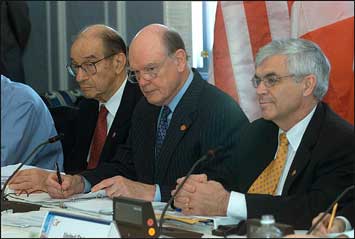
Conventional wisdom suggests that the collapse of Lehman Brothers precipitated the meltdown that followed, but Kim Thomas, in a letter to the editor of the Financial Times yesterday ("Not All Observers Agree on effect of Lehman Collapse"), offers a different take, drawing on research by Stanford University economics professor John Taylor (the gentleman on the right in the photo above). The text of Mr. Thomas's letter is below.
Sir, Contrary to the assertion by Edward Luce (“Obama signals overhaul of economy”, January 9), it is not a truth universally acknowledged that the failure of the authorities to save Lehman Brothers triggered the financial meltdown.
An event study by John Taylor of Stanford University (in The Financial Crisis and the Policy Responses: An Empirical Analysis of What Went Wrong, available at www.stanford.edu/~johntayl/ ) using the three-month Libor-OIS spread as a measure found a small increase in financial market turmoil, within the normal range of fluctuations, occurring on September 15, the Monday after the weekend decisions not to bail out Lehman Brothers.
That was followed by a slight decrease in turmoil around the time of the American International Group intervention of September 16 and then a moderate rise, still within the normal range of fluctuations, for the rest of that week. It was only after the announcement of the troubled asset relief programme on September 19 and particularly after the testimony of Treasury secretary Hank Paulson and Fed chairman Ben Bernanke of September 23 before the Senate banking committee - in which they presented a two-and-a-half page proposal for legislation with no plans for oversight and few restrictions on use of the funds - that the measure of turmoil began what Prof Taylor describes as a "relentless upward movement" that lasted three weeks until it "went through the roof".
Prof Taylor argues that the failure to bail out Lehman Brothers was only one element in a sequence of government policy decisions that had exhibited a lack of consistency and clarity of purpose since at least the Bear Stearns intervention the previous March. He suggests the lack of coherent policy was first laid bare for all to see on September 23.
After that the public seemed to conclude that conditions must be much worse than they had been led to believe previously, and firms suddenly faced considerably more uncertainty in making business and investment decisions.
Kim C. Thomas,
San Jose, CA, US
The photo above is from Professor Taylor's Stanford website.
Subscribe to:
Comments (Atom)

 Posts
Posts

