Look. You can play hot potato with the toxic assets all day long, and only outcome will be that the public will suffer the losses that would otherwise have been properly taken by the banks' own bondholders. You can tinker with the accounting rules all you want, and it won't make the banks solvent. It may improve “reported” earnings for a spell, but as investors who care about the stream of future cash flows that will actually be delivered to us over time, it is clear that modifying the accounting rules doesn't create value. It simply increases the likelihood that financial institutions will quietly go insolvent. I recognize that the accounting changes may reduce the immediate need for regulatory action, since banks will be able to pad their Tier 1 capital with false hope. But we have done nothing to abate foreclosures, and we are just about to begin a huge reset cycle for Alt-A's and option-ARMs. As the underlying mortgages go into foreclosure, it will ultimately become impossible to argue that the toxic assets would be worth much even in an “orderly transaction.”
Meanwhile, in a bizarre convolution of reality reminiscent of Alice in Wonderland, the Financial Times reported last week: “US banks that have received government aid, including Citigroup, Goldman Sachs, Morgan Stanley and JPMorgan Chase, are considering buying toxic assets to be sold by rivals under the Treasury's $1,000bn plan to revive the financial system.” And why not? They can put up a few percent of their own money, and swap each other's toxic assets financed by a bewildered public suddenly bearing more than 90% of the downside risk. The “investors” in this happy “public-private partnership” keep half the upside while ordinary Americans take the downside off of their hands. Some partnership.
With regard to the economy, there is quite a bit of optimism that the recent market advance represents a forward-looking call that the economy will recover in the second half of the year. Indeed, some analysts have noted that year-over-year consumer spending has only declined very slightly, hailing this as evidence that economic concerns are overblown. The difficulty is that consumer spending has never declined on a year-over-year basis, except in this downturn, so that slight decline is actually the worst showing for consumer spending in the available data. Likewise, capacity utilization has plunged to levels seen only in 1974 and 1982, both which were accompanied by far deeper valuation extremes than at present.
Showing posts with label CDOs. Show all posts
Showing posts with label CDOs. Show all posts
Tuesday, April 7, 2009
"Fighting Recklessness with Recklessness"
That's the title of John Hussman's latest market commentary. Excerpt:


Tuesday, March 31, 2009
"My Manhattan Project"
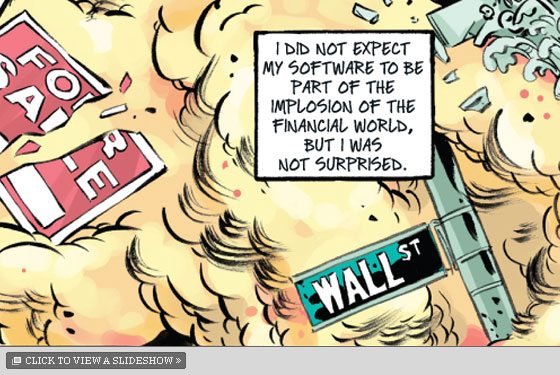
In New York Magazine, Michael Osinsky, the creator of a software program that facilitated mortgage securitization, looks back on his career, "My Manhattan Project: How I helped build the bomb that blew up Wall Street." (Hat Tip: Real Clear Markets). An interesting read, though the title overstates the case. This excerpt from the piece is closer to the mark:
The packaging of heterogeneous home mortgages into uniform securities that can be accurately priced and exchanged has been singled out by many critics as one of the root causes of the mess we’re in. I don’t completely disagree. But in my view, and of course I’m inescapably biased, there’s nothing inherently flawed about securitization. Done correctly and conservatively, it increases the efficiency with which banks can loan money and tailor risks to the needs of investors. Once upon a time, this seemed like a very good idea, and it might well again, provided banks don’t resume writing mortgages to people who can’t afford them.
Osinksy is right that there's nothing inherently wrong with securitization, and critics of the packaging of heterogeneous mortgages are right too. A security created from a pool of homogeneous mortgages -- say, $200k 30 year fixed rate mortgages with loan-to-value ratios of 80% and borrower credit scores of 720+ -- wouldn't be inherently flawed. It would also be a lot easier for investors to price.
The image above is from the New York Magazine article.
Monday, August 11, 2008
The Credit Crisis a Year Later
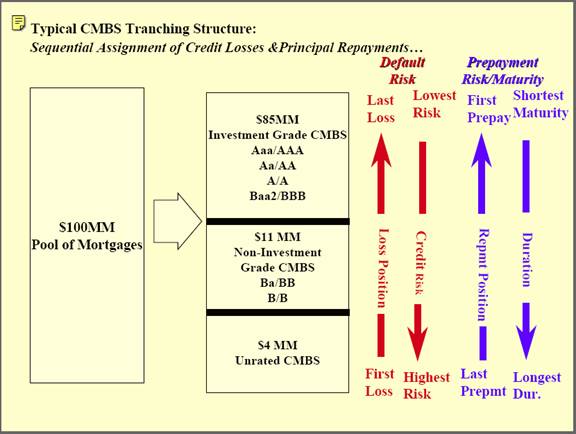
Articles with similar titles are sprouting up in the financial media now, so I thought it would be worth posting a link to John Mauldin's excellent essay on this from last August, "The Panic of 2007". Mauldin's essay includes helpful charts such as the one above and offers a lucid explanation of CDOs comprised of mortgage backed securities.
One suggestion Mauldin had back then for ameliorating the crisis was for Warren Buffett to take over Moody's, which he owns about 20% of through Berkshire Hathaway (as he took over Salomon Brothers years ago), to restore faith in the rating agencies. Of course, that didn't come to pass (instead, Buffett later created a muni bond insurer, Berkshire Hathaway Assurance, to profit from the crisis in which Moody's and the other rating agencies played a supporting role) but I wonder if it would have helped anyway. At Salomon Brothers, the problems were regulatory violations (of Treasury auction rules) that Buffett wasn't aware of (and of course wouldn't have condoned) at the time they were committed; at Moody's the problem was the way it did business, awarding triple-A credit ratings to so many questionable mortgage backed CDOs. As an insider, one would think that Buffett would have been aware of this practice at the time, so he might not have had the same credibility coming in to clean the stables at Moody's that he had coming into Salomon.
Subscribe to:
Posts (Atom)

 Posts
Posts

