Showing posts with label inflation. Show all posts

Sunday, July 12, 2009

John Mauldin's Latest

A couple of items worth noting in John Mauldin's latest "Thoughts from the Frontline" weekly e-mail. The first relates to the effects of high frequency program trading on the markets. The second is about a topic we've wondered about here before (e.g., in this post), why Japan's government bond yields are so low despite that country's massive debt as a percentage of its GDP. Below are brief excerpts from Mauldin's column on both topics.

On program trading:

I want to direct the attention of those in the US finance industry to a white paper written by Themis Trading, called "Toxic Equity Trading Order Flow on Wall Street." Basically, they outline why volume and volatility have jumped so much since 2007; and it's not due to the credit crisis. They estimate that 70% of the volume in today's markets is from high-frequency program trading. They outline how large brokers and funds can buy and sell a stock for the same price and still make 0.5 cents. Do that a million times a day and the money adds up. Or maybe do it 8 billion times. It requires powerful computers, complicity of the exchanges (because the exchanges get paid a lot), and highly proximate computer connections. Literally, the need for speed is so important that to play this game you have to have your servers physically at the exchange. Across the river in New Jersey is too slow. Forget Texas or California. This is a game played out in microseconds.

The retail world doesn't get to play. This is a game only for big boys who can afford to pay for the "arms" needed to fight this war. But the rest of us pay for the game, as that half cent is like a tax on transactions, not to mention the increased daily volatility, which skews pricing. Think it doesn't affect you? That "tax" is paid by mutual funds, your pension fund, and every large institution.

Frankly, this is outrageous. The more I read the madder I got. And it is going to get worse as computers get faster and software more intelligent. We need rules to level the playing field. Themis suggests one simple one: just make it a rule that all bids have to be good for at least one second. That would cure a lot of problems. One lousy second! In a world of microseconds, that is an eternity.

Goldman Sachs went after an employee who stole some of their latest and greatest software this last week. The US assistant attorney general said in the courtroom that the software had the potential to manipulate the market. Imagine that. I am shocked. There is gambling going on in the back room? Gee, commissioner, I had no idea.


The comment that the stolen Goldman Sachs software "had the potential to manipulate the market" raises a fairly obvious question: did this software only have the potential to manipulate the market in the former employee/thief's hands (i.e., did it not have the same potential in the hands of Goldman Sachs employees?)? On to Mauldin's Japan comments.

"Land of the Setting Sun":

Japan's population is shrinking, and the number of workers per retiree is rising. Japan has the highest ratio of debt to GDP in the developed world. And that debt is growing by 7-8% a year, and does not include local debt. Interest rates cannot go lower. Savings are falling rapidly and will not be able to cover the need for new debt issuance, by a long shot. Within a few years, because of the aging of the population, savings will go negative. Social security payments are rising. GDP is shrinking, and export trade is off about 30-40%, depending on the industry. Machine tools are down 80%!

If rates were to go up by 1%, let alone 2%, over time Japan's percentage of tax revenue dedicated to interest payments would double to 18% and then to 40% and then just keep going up. It is conceivable that it will take 100% of tax revenues in less than ten years, at the current trajectory. Why? Because Japan is going to have to start to compete with the rest of the world to sell its bonds. Who but the Japanese would buy a Japanese bond at 1.3%? From a country that is rapidly going to 200% of debt-to-GDP? Doesn't really seem like a smart trade to me. And as the data shows, the ability of the Japanese consumer to buy more debt is rapidly waning.

The Japanese government is coming to a crossroads with no good exits.

Monday, June 22, 2009

Alan Blinder on the Inflation Debate

In recent posts (e.g., this one) we noted the views of Paul Krugman, John Taylor, and others on whether the Fed's responses to the financial crisis might lead to high inflation in future. Yesterday, Alan Blinder, the Princeton economist, former Fed governor, and long-time Democratic policy adviser weighed in on the debate in his Sunday New York Times Business Section column, Economic View: "Why Inflation isn't a Danger"). Blinder's argument essentially boils down to this: The Fed is aware that if it doesn't rein in the money supply in a timely manner as the crisis abates, this will lead to inflation. The Fed has planned for this, and has the competence to pull this off. Further, bond market participants appear to support this view. Blinder wrote,

[The Fed] has committed itself to an inflation target of just under 2 percent. Of course, none of that assures us that the Fed will hit the bull’s-eye. It might miss and produce, say, inflation of 3 percent or 4 percent at the end of the crisis — but not 8 or 10 percent.

[...]

SKEPTICAL? Then let’s see what the bond market vigilantes really think.

The market’s implied forecast of future inflation is indicated by the difference between the nominal interest rates on regular Treasury debt and the corresponding real interest rates on Treasury Inflation Protected Securities, or TIPS. These estimates change daily. But on Friday, the five-year expected inflation rate was about 1.6 percent and the 10-year expected rate was about 1.9 percent. Notice that the latter matches the Fed’s inflation target. I don’t think that’s a coincidence.

But if the inflation outlook is so benign, why have Treasury borrowing rates skyrocketed in the last few months? Is it because markets fear that the Fed will lose control of inflation? I think not. Rising Treasury rates are mainly a return to normalcy.

In January, the markets were expecting about zero inflation over the coming five years, and only about 0.6 percent average inflation over the next decade. The difference between then and now is that markets were in a panicky state in January, braced for financial Armageddon; they have since calmed down.

Friday, June 5, 2009

More on the Inflation Debate: Hussman and Wolf Weigh In


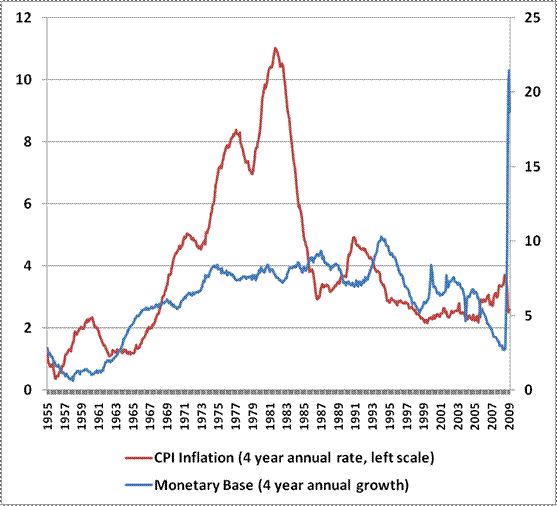
In his market commentary this week, "Anything But Academic", John Hussman weighed in on the debate between Paul Krugman and John Taylor. Dr. Hussman first summarizes Dr. Krugman's thesis:

Krugman's argument boils down to the recognition that "monetary velocity" is currently very low - that is very accurate. The problem is that unless it remains low indefinitely, the more than doubling of the U.S. monetary base over the past year, along with the additional issuance of Treasury debt, leaves a far larger quantity of government liabilities to be absorbed until and unless those liabilities are extinguished by fiscal surpluses. The only way to absorb them without driving up the price level is to hold down velocity indefinitely, or to have an equal expansion in real economic output without any further expansion on the monetary side.


And then summarizes Dr. Taylor's thesis (while parenthetically noting his personal connection to Taylor):

In the other academic corner is John Taylor, an economics professor at Stanford (and more to the point, one of my former dissertation advisors), who wrote in the Financial Times last week “To bring the debt-to-GDP ratio down to the same level as at the end of 2008 would take a doubling in prices. That 100 percent increase would make nominal GDP twice as high, and thus cut the debt-to-GDP ratio in half, back to 41 from 82 percent. A 100 percent increase in the price level means about 10 percent inflation for 10 years[1], but that would not be smooth – probably more like the great inflation of the late 1960s and 1970s, with boom followed by bust and recession every three or four years, and a successively higher inflation rate after each recession.”


Dr. Hussman seems to agree with Krugman's benign view of inflation in the short-term (i.e., the next few years) but share Taylor's view of a doubling of the price level within the next 10 years. Hussman also included an entertaining anecdote in his column which I'll quote below.

There's an economists' riddle that goes “Why are the debates in academia so bitter?” – the answer – “Because the stakes are so low.”[2] Now, very often, that's true. I remember a presentation that Paul Krugman gave at Stanford where he was talking about a model of economic development. Paul drew a diagram on the board, and as he described it, he drew a few little arrows indicating migration of businesses from one area to another. A respected economic theorist at Stanford, Mordecai Kurz (who never drew an arrow without a differential equation), immediately jumped up and shouted “You haven't described the dynamics!!” to which Paul responded that he was indicating a general movement of economic activity toward one place to improve efficiency. Dr. Kurz pounded the table and screamed “Then erase the arrows!! ERASE THE ARROWS!!” and then stormed out of the room and slammed the door behind him. I think that was probably the exact moment that I decided to go into finance.


Martin Wolf also weighed in on this debate in his Financial Times column earlier this week, "Rising government bond rates prove policy works". It's worth reading in its entirety, as is Hussman's commentary, but here are the most salient excerpts:

Is the US (and a number of other high-income countries) on the road to fiscal Armageddon? Are recent jumps in government bond rates proof that investors are worried about fiscal prospects? My answers to these questions are: No and No. This does not mean there is no reason for worry. It is rather that there are powerful arguments against fiscal retrenchment right now and strong reasons for welcoming recent moves in the bond markets.

[...]

People need to believe that the extraordinarily aggressive monetary and fiscal policies of today will be reversed. If they do not believe this, there could well be a big upsurge in inflationary expectations long before the world economy has recovered. If that were to happen, policymakers would be caught in a painful squeeze and the world might indeed end up in 1970s-style stagflation.

The exceptional policies used to deal with extreme circumstances are working. Now, as a result, policymakers are walking a tightrope: on one side are premature withdrawal and a return to deep recession; on the other side are soaring inflationary expectations and stagflation. It is irresponsible to insist either on immediate tightening or on persistently loose policies. Both the US and the UK now risk the latter. But their critics risk making an equal and opposite mistake. The answer is both clear and tricky: choose sharp tightening, but not yet.


The illustration above, by Ingram Pinn, accompanied Martin Wolf's column.

[1]Here Dr. Hussman, a former options mathematician, repeats the basic math error Dr. Taylor made in his Financial Times column: due to compounding, it wouldn't take 10 years for 10% annual inflation to double the price level; it would only take about 7.3 years. This error was noted by an FT letter writer earlier this week, who in turn made his own mathematical error in his letter, which was corrected by a subsequent letter writer. All of this raises the question of why one of the world's leading business newspapers didn't have a numerate enough editor to catch Taylor's error in the first place.

[2]Dick Armey, the economics professor and former GOP House Majority Leader once shared this same quote when asked by a reporter if the debates in academia were more civil than those in Congress.

Thursday, June 4, 2009

Quantitative Easing and Inflation in Japan


Apropos of a recent post ("Are Inflation Fears Overdone"), a lucid article by Owen F. Humpage and Michael Shenk of the Cleveland Fed last December on Japan's quantitative easing policy (straight forwardly titled, "Japan’s Quantitative Easing Policy") included the chart above, drawn from IMF data.

Monday, April 20, 2009

Has Greg Mankiw Jumped the Shark?


You be the judge. From his "Economic View" column in the New York Times yesterday, "It May Be Time for the Fed to Go Negative":

Imagine that the Fed were to announce that, a year from today, it would pick a digit from zero to 9 out of a hat. All currency with a serial number ending in that digit would no longer be legal tender. Suddenly, the expected return to holding currency would become negative 10 percent.

That move would free the Fed to cut interest rates below zero. People would be delighted to lend money at negative 3 percent, since losing 3 percent is better than losing 10.

Of course, some people might decide that at those rates, they would rather spend the money — for example, by buying a new car. But because expanding aggregate demand is precisely the goal of the interest rate cut, such an incentive isn’t a flaw — it’s a benefit.


Would your first response to this scenario be to buy a new car? I bet a lot of people would decide instead to buy gold, or to exchange their U.S. dollars for the currency of a country less likely to pick a number out of a hat and invalidate a tenth of its currency.

Later in his column, Mankiw offers a more reasonable way that the Fed could create negative real interest rates, by committing to a certain level of inflation (presumably one higher than the Fed's current 2% target). Is this the best way to spur aggregate demand though? If this is a balance sheet driven recession, as some observers have termed it, and the problem is that many consumers can't service their debts, why not deal with that more directly?

For those whose mortgages are underwater, restructuring them using John Hussman's idea of property appreciation rights might make make sense. That would lower monthly borrowing costs for those mortgagers and enable them to increase their discretionary spending. For mortgagers who aren't currently underwater, the idea of Glenn Hubbard and Christopher Mayer, to use the GSEs to lower mortgage rates down to their historic spread of about 1.6% above 10-year Treasuries might make sense. According to Yahoo! Finance, the average rate on 30-year fixed rate, conforming mortgages today is 4.88%; since 10-year Treasuries currently yield 2.75%, under the Mayer and Hubbard plan mortgage rates might average 4.35%. Refinancing higher-rate mortgages at 4.35% would also lower borrowing costs and enable tens of millions of Americans to increase their discretionary spending.

The image above, of the Happy Days character Fonzie (played by Henry Winkler) jumping the shark1 comes from Media Bistro.

1For those unfamiliar with the phrase, see the Urban Dictionary's definition of "jumping the shark".

Tuesday, March 24, 2009

John Hussman's Latest Market Commentary


In his market commentary yesterday ("Fed and Treasury - Putting off Hard Choices with Easy Money (and Probable Chaos)"), Dr. Hussman reiterated his call for the government to require bond holders in financial institutions to assume some losses in order to recapitalize those firms:

Make no mistake - we are selling off our future and the future of our children to prevent the bondholders of U.S. financial corporations from taking losses. We are using public funds to protect the bondholders of some of the most mismanaged companies in the history of capitalism, instead of allowing them to take losses that should have been their own. All our policy makers have done to date has been to squander public funds to protect the full interests of corporate bondholders. Even Bear Stearns' bondholders can expect to get 100% of their money back, thanks to the generosity of Bernanke, Geithner and other bureaucrats eager to hand out the money of ordinary Americans.


Though I believe that the consequences (via credit default swaps and the like) are overstated of letting bondholders take a haircut, and will ultimately be no worse than having the public take the losses, the fact is that we don't even need the bonds of major financial institutions to go into default. What we do need to do is offer those bondholders a choice:


1) The U.S. government takes receivership of the financial institution, changes the management, wipes out the stockholders and a chunk of the bondholders claims entirely, continues the operation of the institution in receivership, eventually reissues the company to private ownership, and leaves the bondholders with the residual. This is not “nationalization,” but receivership – a form of “pre-packaged bankruptcy” that protects the customers and allows the institution to continue to operate, followed by re-privatization. As I've previously noted, this would fully protect all of the customers and depositors at no probable expense to the public. Alternatively;


2) The bondholders voluntarily agree to move a portion of their claims lower down in the capital structure, swapping debt for equity (preferred or common), allowing the bank to have a larger cushion of Tier-1 capital, avoiding insolvency, and hopefully allowing the bank to recover by its own bootstraps, preferably assisted by debt restructuring on the borrower side (via property appreciation rights and the like). Similar debt/equity swaps would be an appropriate strategy toward failing U.S. automakers as well.


Hussman also added a note on inflation:

The reason we're not seeing inflation here and now is that despite a near doubling in the monetary base, we've seen a buildup in goods inventories combined with a surge in safe-haven demand for government liabilities. So investors have absorbed the increased supply of government liabilities without a collapse in their marginal utility. This will not persist indefinitely, so unfortunately, any nascent economic recovery in the next couple of years will be against the headwinds of both Alt-A mortgage defaults (coming to your neighborhood in 2010), and inflationary pressures as soon as safe haven demand for Treasuries eases back even moderately.


The graph above, of 4 year annual CPI growth versus 4 year annual growth in government spending, accompanied Hussman's column.

Sunday, December 7, 2008

"The Velocity Factor"

In John Mauldin's latest Thoughts from the Frontline newsletter, "The Velocity Factor" (PDF), Mauldin argues that the Federal Reserve "not really expanding the money supply, so far" because the expansionary effects of Federal Reserve actions so far have been offset, to a large extent, by the decrease in the velocity of money as financial innovations that increased velocity (e.g., securitization) are being unwound. Mauldin asks,

How much monetization will be enough to halt deflation and overcome the slowdown in the velocity of money and the rise in personal savings? No one knows. There is no fancy equation or model which can encompass all the factors, or at least not one I know of.

We will also soon see which of the additional deflation-fighting policies that Bernanke outlined in his 2002 "helicopter" speech the Fed will adopt. It is highly likely that we will see more than a few of them. It is quite possible that we will see the Fed start to set rates on longer-term bills and even bonds in an effort to pull down longer-term rates for corporations and individuals.

We will explore all the deflation-fighting options and what the results might be in future letters, but remember that there will come a time when the Fed will have to "take back" some of the liquidity they are going to provide. That means we could be in for a multi-year period of slow growth after we pull out of this recession. And this recession could easily last through 2009.


Here is a link to the 2002 "helicopter" speech by Ben Bernanke that Mauldin referred to above: "Deflation: Making Sure "It" Doesn't Happen Here".

Friday, July 18, 2008

Seven Questions for William Poole

The former St. Louis Fed president speaks with Foreign Policy about the GSEs, the credit crisis, and the economy, "Seven Questions: How Bad Will it Get?". Intro:

When William Poole warned in 2003 that Fannie Mae and Freddie Mac lacked the capital to weather a financial storm, his advice went unheeded. Five years later, the outspoken former president of the Federal Reserve Bank of St. Louis is far too polite to say “I told you so,” but he does have a message for the Fed: Wait too long to tackle inflation, and you’ll face an even worse recession in the years to come.


It's worth reading this brief interview in its entirety.

Monday, June 30, 2008

Bill Gross's Open Letter to Barack Obama


In his July Investment Outlook, the manager of the world's largest bond fund offers some advice and predictions to the man he thinks will be the next president: "Dear President Obama".

I don't agree with all the politics there, but that's immaterial. What's of interest, from an investing perspective, is Bill Gross's prediction that an additional $500 billion in government spending will be needed to stimulate the economy; that this will lead to our first $1 trillion deficit, rising inflation, and rising bond yields over the next 4-8 years. "Your term will not go down in history as investor friendly.", Gross writes.

If the views of Jim Rogers and Vitaliy Katsenelson on U.S. stock market over the next several years didn't give you pause, perhaps Bill Gross's predictions will. Those who follow traditional financial planners' suggestions about asset allocation (e.g., keeping a large percentage of one's portfolio in domestic stock and bond index funds) may come to regret it.