Look. You can play hot potato with the toxic assets all day long, and only outcome will be that the public will suffer the losses that would otherwise have been properly taken by the banks' own bondholders. You can tinker with the accounting rules all you want, and it won't make the banks solvent. It may improve “reported” earnings for a spell, but as investors who care about the stream of future cash flows that will actually be delivered to us over time, it is clear that modifying the accounting rules doesn't create value. It simply increases the likelihood that financial institutions will quietly go insolvent. I recognize that the accounting changes may reduce the immediate need for regulatory action, since banks will be able to pad their Tier 1 capital with false hope. But we have done nothing to abate foreclosures, and we are just about to begin a huge reset cycle for Alt-A's and option-ARMs. As the underlying mortgages go into foreclosure, it will ultimately become impossible to argue that the toxic assets would be worth much even in an “orderly transaction.”
Meanwhile, in a bizarre convolution of reality reminiscent of Alice in Wonderland, the Financial Times reported last week: “US banks that have received government aid, including Citigroup, Goldman Sachs, Morgan Stanley and JPMorgan Chase, are considering buying toxic assets to be sold by rivals under the Treasury's $1,000bn plan to revive the financial system.” And why not? They can put up a few percent of their own money, and swap each other's toxic assets financed by a bewildered public suddenly bearing more than 90% of the downside risk. The “investors” in this happy “public-private partnership” keep half the upside while ordinary Americans take the downside off of their hands. Some partnership.
With regard to the economy, there is quite a bit of optimism that the recent market advance represents a forward-looking call that the economy will recover in the second half of the year. Indeed, some analysts have noted that year-over-year consumer spending has only declined very slightly, hailing this as evidence that economic concerns are overblown. The difficulty is that consumer spending has never declined on a year-over-year basis, except in this downturn, so that slight decline is actually the worst showing for consumer spending in the available data. Likewise, capacity utilization has plunged to levels seen only in 1974 and 1982, both which were accompanied by far deeper valuation extremes than at present.
Showing posts with label mortgages. Show all posts
Showing posts with label mortgages. Show all posts
Tuesday, April 7, 2009
"Fighting Recklessness with Recklessness"
That's the title of John Hussman's latest market commentary. Excerpt:


Tuesday, March 31, 2009
"My Manhattan Project"
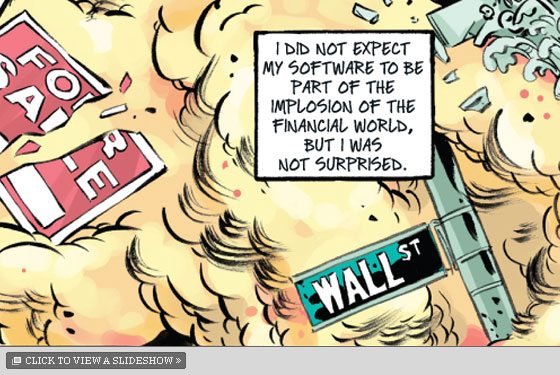
In New York Magazine, Michael Osinsky, the creator of a software program that facilitated mortgage securitization, looks back on his career, "My Manhattan Project: How I helped build the bomb that blew up Wall Street." (Hat Tip: Real Clear Markets). An interesting read, though the title overstates the case. This excerpt from the piece is closer to the mark:
The packaging of heterogeneous home mortgages into uniform securities that can be accurately priced and exchanged has been singled out by many critics as one of the root causes of the mess we’re in. I don’t completely disagree. But in my view, and of course I’m inescapably biased, there’s nothing inherently flawed about securitization. Done correctly and conservatively, it increases the efficiency with which banks can loan money and tailor risks to the needs of investors. Once upon a time, this seemed like a very good idea, and it might well again, provided banks don’t resume writing mortgages to people who can’t afford them.
Osinksy is right that there's nothing inherently wrong with securitization, and critics of the packaging of heterogeneous mortgages are right too. A security created from a pool of homogeneous mortgages -- say, $200k 30 year fixed rate mortgages with loan-to-value ratios of 80% and borrower credit scores of 720+ -- wouldn't be inherently flawed. It would also be a lot easier for investors to price.
The image above is from the New York Magazine article.
South Park's Take on the Financial Crisis
Hat tip to the Atlantic's Business Channel. This is pretty funny -- pay close attention to the choices on the chart at the end.
Monday, March 30, 2009
Hussman Ties It All Together
In his latest market commentary ("On the Urgency of Restructuring Bank and Mortgage Debt, and of Abandoning Toxic Asset Purchases"), Dr. Hussman lucidly recaps his previous objections to the government's responses to the financial crisis and offers alternative solutions. On the issue of credit default swaps, Hussman writes that the government ought to,
This is similar to George Soros's recent comments on credit default swaps (e.g., in this Wall Street Journal op/ed last week, "One Way to Stop Bear Raids"), and it's consistent with the long-standing doctrine in the insurance business that only those with an "insurable interest" (i.e., something to lose if something bad happens to the insured) are allowed to take out insurance policies1. This reduces the chance that a policy holder will try to deliberately damage the insured in order to collect on the insurance policy.
Hussman covers a lot more ground in this week's commentary, and his essay is worth reading in full.
1In the early days of the insurance business, this doctrine wasn't in force, and it was possible to, for example, take out a life insurance policy on a complete stranger, despite the perverse incentives that would create.
[L]egislate a restriction on the use of credit default swaps (essentially insurance contracts against the failure of a company's bonds), requiring that such swaps may be used for bona-fide hedging purposes only. That is, a credit default swap could not be entered for purely speculative purposes, but only to offset the default risk of the same or similar bonds held by the investor.
This is similar to George Soros's recent comments on credit default swaps (e.g., in this Wall Street Journal op/ed last week, "One Way to Stop Bear Raids"), and it's consistent with the long-standing doctrine in the insurance business that only those with an "insurable interest" (i.e., something to lose if something bad happens to the insured) are allowed to take out insurance policies1. This reduces the chance that a policy holder will try to deliberately damage the insured in order to collect on the insurance policy.
Hussman covers a lot more ground in this week's commentary, and his essay is worth reading in full.
1In the early days of the insurance business, this doctrine wasn't in force, and it was possible to, for example, take out a life insurance policy on a complete stranger, despite the perverse incentives that would create.
Friday, March 27, 2009
Lula: "White People with Blue Eyes" Caused Financial Crisis

From today's Financial Times ("Brazil president blames white people for crisis"):
Brazil's President Luiz Inácio Lula da Silva yesterday blamed the global economic crisis on "white people with blue eyes" and said it was wrong that black and indigenous people should pay for white people's mistakes, writes Jonathan Wheatley .
Speaking in Brasília at a joint press conference with Gordon Brown, the UK prime minister, Mr Lula da Silva told reporters: "This crisis was caused by the irrational behaviour of white people with blue eyes, who before the crisis appeared to know everything and now demonstrate that they know nothing."
He added: "I do not know any black or indigenous bankers so I can only say [it is wrong] that this part of mankind which is victimised more than any other should pay for the crisis."
Lula ought to know about the victimization of black and indigenous people. After all, Brazil was the last country in the Western Hemisphere to abolish black slavery, and as recently as five years ago, Brazil acknowledged that tens of thousands of its indigenous citizens were working as slave laborers. It's interesting that Lula says he doesn't know of any black or indigenous bankers though. Perhaps all the bankers in Brazil are white, but this isn't the case in the United States. We've had African Americans at the highest levels of the financial industry -- for example, Stan O'Neal as CEO of Merrill Lynch, and Don Parsons as a director (and soon to be chairman) of Citigroup. We've also had people of all races and backgrounds involved in originating toxic mortgages -- including Brazilians. In fact, two years ago, the Wall Street Journal reported on a "mostly Brazilian ring that allegedly conspired to defraud people by persuading them to buy homes they couldn't afford" ("How the Subprime Mess Hit Poor Immigrant Groups"). Here's an excerpt from that article:
SOUTH SAN FRANCISCO, Calif. -- Naira Costa, a 27-year-old housekeeper, met her husband at Message of Peace, an evangelical church that is a spiritual and social haven for Brazilians in the Bay Area. When the couple considered buying a house a few years ago, the church's head deacon, Soario Santos, ministered to that need, too.
Mr. Santos, a fellow Brazilian, served the Pentecostal church on nights and weekends. During the day, he worked as a loan officer at a mortgage brokerage owned by a Brazilian immigrant. Mr. Santos and other church officers also working at the same real-estate business routinely approached churchgoers to encourage them to buy homes.
Weak credit and low wages weren't barriers, Ms. Costa recalls. "He told us that a house easily would appreciate $100,000 in a year," enabling the owner to refinance, says Ms. Costa. "We trusted him implicitly. Everyone at the church was buying houses from him."
Today, Ms. Costa and other former Message of Peace parishioners claim that Mr. Santos was a key part of a mostly Brazilian ring that allegedly conspired to defraud people by persuading them to buy homes they couldn't afford. Ms. Costa, the housekeeper, secured a $713,000 sub-prime mortgage. In another instance, a Brazilian baby sitter borrowed $495,000. Now, the home buyers are beset by foreclosures and additional stains on their already-tainted credit.
The graphic above, from a Knight-Ridder article on modern slavery in Brazil, comes from a website called Mongabay.com
Tuesday, March 24, 2009
John Hussman's Latest Market Commentary
In his market commentary yesterday ("Fed and Treasury - Putting off Hard Choices with Easy Money (and Probable Chaos)"), Dr. Hussman reiterated his call for the government to require bond holders in financial institutions to assume some losses in order to recapitalize those firms:
Make no mistake - we are selling off our future and the future of our children to prevent the bondholders of U.S. financial corporations from taking losses. We are using public funds to protect the bondholders of some of the most mismanaged companies in the history of capitalism, instead of allowing them to take losses that should have been their own. All our policy makers have done to date has been to squander public funds to protect the full interests of corporate bondholders. Even Bear Stearns' bondholders can expect to get 100% of their money back, thanks to the generosity of Bernanke, Geithner and other bureaucrats eager to hand out the money of ordinary Americans.
Though I believe that the consequences (via credit default swaps and the like) are overstated of letting bondholders take a haircut, and will ultimately be no worse than having the public take the losses, the fact is that we don't even need the bonds of major financial institutions to go into default. What we do need to do is offer those bondholders a choice:
1) The U.S. government takes receivership of the financial institution, changes the management, wipes out the stockholders and a chunk of the bondholders claims entirely, continues the operation of the institution in receivership, eventually reissues the company to private ownership, and leaves the bondholders with the residual. This is not “nationalization,” but receivership – a form of “pre-packaged bankruptcy” that protects the customers and allows the institution to continue to operate, followed by re-privatization. As I've previously noted, this would fully protect all of the customers and depositors at no probable expense to the public. Alternatively;
2) The bondholders voluntarily agree to move a portion of their claims lower down in the capital structure, swapping debt for equity (preferred or common), allowing the bank to have a larger cushion of Tier-1 capital, avoiding insolvency, and hopefully allowing the bank to recover by its own bootstraps, preferably assisted by debt restructuring on the borrower side (via property appreciation rights and the like). Similar debt/equity swaps would be an appropriate strategy toward failing U.S. automakers as well.
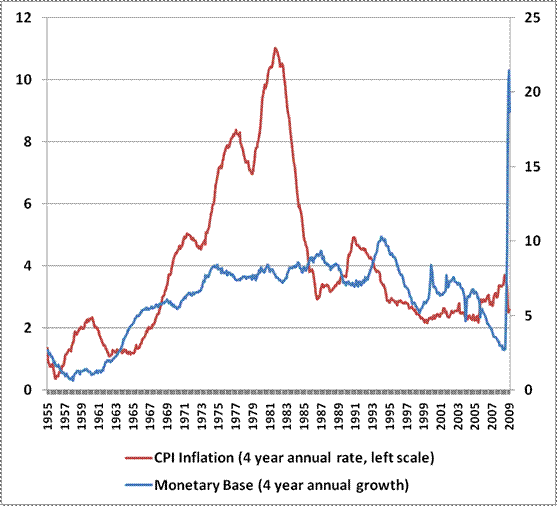
Hussman also added a note on inflation:
The reason we're not seeing inflation here and now is that despite a near doubling in the monetary base, we've seen a buildup in goods inventories combined with a surge in safe-haven demand for government liabilities. So investors have absorbed the increased supply of government liabilities without a collapse in their marginal utility. This will not persist indefinitely, so unfortunately, any nascent economic recovery in the next couple of years will be against the headwinds of both Alt-A mortgage defaults (coming to your neighborhood in 2010), and inflationary pressures as soon as safe haven demand for Treasuries eases back even moderately.
The graph above, of 4 year annual CPI growth versus 4 year annual growth in government spending, accompanied Hussman's column.
Tuesday, February 17, 2009
John Hussman on "How To Climb Out of the Global Financial Hole"
From Dr. Hussman's market commentary today, "How To Climb Out of the Global Financial Hole":
The emphasis above is Hussman's. Hussman reiterates here a point he's made previously (e.g., "You Can't Rescue the Financial System If You Can't Read a Balance Sheet"), that forcing bondholders to take a haircut, or swap some of their debt for equity, would obviate the need for bailout funds from taxpayers in some cases. His advocacy of allowing bankruptcy judges to modify loans while awarding "property appreciation rights" (PARs) to lenders (his fourth bullet point above) raises a question though: if PARs existed now, would it be necessary for judges to intervene, i.e., wouldn't lenders have an incentive to write-down mortgages in return for PARs, particularly if such rights would be marketable, as Hussman envisions? Perhaps before allowing judges to re-write mortgages, the government ought to create a market for PARs and see if this helps expedite more voluntary restructuring of mortgage debt.
Another question Hussman's commentary raises relates to his point (in the third bullet point above) about the benefit of owning all the pieces of a securitized mortgage issue, i.e., that it would let the owner re-structure the underlying mortgages, making more of them viable and thus marketable. Why aren't more deep-pocketed institutional fixed income investors doing this already?
1"Lend freely at the penalty rate".
• Financials that are insolvent and are likely to survive only with large and sustained infusions of taxpayer funds should be allowed to fail in pre-packaged bankruptcies that wipe out both the shareholders and the bondholders of those institutions. Customers and depositors will not be hurt, and it won't cost taxpayers a penny. As Stiglitz notes, “you should not chase good money after bad.”
• The government should continue to provide capital directly to large, diversified financial institutions which remain solvent but have some impairment to capital. Preferred stock is a reasonable form, though a high (possibly deferred) yield to the government is preferable to a low one (Bagehot's Rule[1]). Tight restrictions against using taxpayer capital for compensation and bonuses are certainly appropriate. These institutions include major banks like Citigroup, Bank of America, Wells Fargo, J.P. Morgan, and others, which appear to be experiencing pressure not because of insolvency, but because of uncertainty about potential future loan losses, and the ongoing availability of publicly provided capital.
• Troubled assets should only be purchased if all of the pieces of a given issuance can be collected. The ability to aggregate all of the pieces is necessary because that's the only way the underlying mortgages can be restructured. If, for example, all of the pieces could be purchased at an average of 40 cents on the dollar (which is well above where many of these securities are marked), the underlying mortgages could be reduced by as much as 60%, making them solvent and likely to be repaid. The restructured loans might eventually even be re-sold into the market through the GSEs at no taxpayer expense.
• The most direct method of intervening is at the point of foreclosure through the courts. One way of doing this would be to give judges the ability to write down principal, and to assign the balance as a deferred “property appreciation right” (PAR) to the lender. This would reduce foreclosure rates, preserve the value of the existing mortgage securities, and avoid concerns about fairness. A more ambitious government-sponsored program would be to make the PARs an obligation of homeowners to the Treasury administered through the IRS, asserting a claim on the price appreciation of the home or subsequent property owned by the homeowner. The foreclosure court would reduce principal, assign an offsetting PAR obligation to the homeowner, and assign the lender that same share in the Treasury's PAR Fund (basically a national pool of those PAR obligations). The PARs would then be marketable. Though they would undoubtedly sell at a discount to the face amount since not all the PARs will be repaid, they would be backed by a pool of real assets that are likely regain their value in the long-term, if not the near term. The Treasury could aggregate these claims and pay them out proportionately to the lenders, but would not even have to guarantee full payment – just enforce the claims by collecting and paying out.
The emphasis above is Hussman's. Hussman reiterates here a point he's made previously (e.g., "You Can't Rescue the Financial System If You Can't Read a Balance Sheet"), that forcing bondholders to take a haircut, or swap some of their debt for equity, would obviate the need for bailout funds from taxpayers in some cases. His advocacy of allowing bankruptcy judges to modify loans while awarding "property appreciation rights" (PARs) to lenders (his fourth bullet point above) raises a question though: if PARs existed now, would it be necessary for judges to intervene, i.e., wouldn't lenders have an incentive to write-down mortgages in return for PARs, particularly if such rights would be marketable, as Hussman envisions? Perhaps before allowing judges to re-write mortgages, the government ought to create a market for PARs and see if this helps expedite more voluntary restructuring of mortgage debt.
Another question Hussman's commentary raises relates to his point (in the third bullet point above) about the benefit of owning all the pieces of a securitized mortgage issue, i.e., that it would let the owner re-structure the underlying mortgages, making more of them viable and thus marketable. Why aren't more deep-pocketed institutional fixed income investors doing this already?
1"Lend freely at the penalty rate".
Monday, September 8, 2008
John Paulson Gets Ready to Go Long
John Paulson of Paulson & Co., whose hedge funds posted huge returns last year by betting against sub prime mortgages, is starting a new fund on October 1st to invest in mortgage backed securities and selected financial institutions, according to today's Financial Times ("Paulson moves into Recovery Mode").
Saturday, August 16, 2008
"Dr. Doom"
Tomorrow's New York Times Magazine features an article by Stephen Mihm about NYU economist and author Nouriel Roubini, "Dr. Doom". On the real estate/mortgage bust, Roubini tells Mihm,
That seems a little hyperbolic. In a recent post ("America's Smartest Banker") we mentioned a few local banks that seem to have weathered the credit crunch fine, and are still making mortgage loans. Surely there are other local banks around the country that have been prudently run as well. In another recent post ("Profiting from the Credit Crunch/Real Estate Bust") we noted entrepreneurs in nearly opposite corners of the country making money by buying distressed mortgages. Why won't this sort of approach -- expanded as more seek profits in distressed mortgages -- eventually mop up most of the mortgage mess? Granted, when the dust settles, mortgages won't be as widely available as they were before to those with poor credit or those unable to make down payments, but a return to more rational lending standards will be a good thing for the financial system and the country as a whole.
“You either nationalize the banks or you nationalize the mortgages,” he said. “Otherwise, they’re all toast.”
That seems a little hyperbolic. In a recent post ("America's Smartest Banker") we mentioned a few local banks that seem to have weathered the credit crunch fine, and are still making mortgage loans. Surely there are other local banks around the country that have been prudently run as well. In another recent post ("Profiting from the Credit Crunch/Real Estate Bust") we noted entrepreneurs in nearly opposite corners of the country making money by buying distressed mortgages. Why won't this sort of approach -- expanded as more seek profits in distressed mortgages -- eventually mop up most of the mortgage mess? Granted, when the dust settles, mortgages won't be as widely available as they were before to those with poor credit or those unable to make down payments, but a return to more rational lending standards will be a good thing for the financial system and the country as a whole.
Wednesday, August 13, 2008
Profiting from the Credit Crunch/Real Estate Bust
A friend and business associate directed my attention to this article in our local paper, The Record, about a couple of entrepreneurs, Jacob Benaroya and Danielle Brooks, that started a hedge fund to invest in distressed mortgages: "Firm finds value in bad loans". The partners founded the firm, Biltmore Capital, at the peak of the real estate boom three years ago. Excerpt:
Last month, a similar article about entrepreneurs investing in distressed mortgages appeared in the OC Register, "Investor says only one road to foreclosure profit". Here's an excerpt from that article:
That interview is worth reading.
Typically, Biltmore buys loans at about 50 cents on the dollar, although mortgages on truly distressed properties - for example, in Detroit - can be picked up for as little as 10 cents on the dollar.
[snip]
The eight-employee company expects to buy $100 million of mortgage debt in 2008. Benaroya said that could triple in 2009, as more subprime loans go bad. The company works in housing markets all over the nation, though the greatest concentration of bad loans is in the Rust Belt states, where the economy and job markets are troubled, and Florida, California, Arizona and Nevada, where there was a lot of overbuilding.
Although foreclosures have risen in New Jersey, they are nowhere near the rate in those distressed markets.
Ilan Kaufthal, a member of the board of Biltmore Capital, said he expects high returns in this business for the next year or two, because non-performing mortgages can be bought at such deep discounts.
"I think it's an extraordinary opportunity over the next few years for people who have the liquidity and cash to buy these mortgages," said Kaufthal, a former Bear Sterns executive who has also invested in Biltmore.
Last month, a similar article about entrepreneurs investing in distressed mortgages appeared in the OC Register, "Investor says only one road to foreclosure profit". Here's an excerpt from that article:
Robert Lee, a Huntington Beach-based investor in distressed home loans, says there is still plenty of pain ahead for the housing and mortgage markets.
Last year I shadowed Lee for a day and wrote a story about it. I had met him at a seminar and was impressed by his enthusiasm for investing in dud loans. Recently he and partner David Phelps have expanded their Web site foreclosuretrackers.com to cover all of Southern California as well as Clark County, Nevada. Last fall, the site just covered foreclosure filings in Orange County.
I quizzed Lee about the mortgage market, his business, and his prediction for a housing rebound. I have a feeling this interview will appeal more to housing bears than bulls.
That interview is worth reading.
Wednesday, July 9, 2008
Something to Munch On: "Recession is not the worst possible outcome"
In his recent column in the Financial Times ("Recession is not the worst possible outcome"), Wolfgang Münchau writes,
Münchau goes on to say that the prime cause of our current situation was 15 years of bad economic policies, particularly keeping real interest rates too low for too long. Given that he wonders, "whether the recipes that got us into this mess are also most suited to get us out again."
Worth reading in its entirety, though some of Münchau's prescriptions would seem unlikely to be implemented in the U.S. for political reasons, e.g., gearing monetary policy primarily toward price stability (instead of the Fed's current dual mandate: price stability and full employment), or imposing maximum loan-to-value ratios on mortgages (recall the resistance a few months ago to proposals to raise the down payments on FHA loans to 3.5% from 3%).
If this had been a mere financial crisis, it would be over by now. The fact that we are suffering its fourth wave tells us there might be something at work other than merely financial euphoria and bad regulation.
Münchau goes on to say that the prime cause of our current situation was 15 years of bad economic policies, particularly keeping real interest rates too low for too long. Given that he wonders, "whether the recipes that got us into this mess are also most suited to get us out again."
Worth reading in its entirety, though some of Münchau's prescriptions would seem unlikely to be implemented in the U.S. for political reasons, e.g., gearing monetary policy primarily toward price stability (instead of the Fed's current dual mandate: price stability and full employment), or imposing maximum loan-to-value ratios on mortgages (recall the resistance a few months ago to proposals to raise the down payments on FHA loans to 3.5% from 3%).
Subscribe to:
Posts (Atom)

 Posts
Posts

