Showing posts with label Citigroup. Show all posts

Monday, February 23, 2009

Hussman Pivots


In his latest weekly commentary ("The Economy Needs Coordination, Not Money, From the Government"), Dr. Hussman seems to pivot a little on a couple of positions he took in his last market commentary (from which we excerpted in this post, John Hussman on "How to Climb out of a Global Financial Hole"). Last week, Hussman wrote this about Citigroup and some other large banks,

The government should continue to provide capital directly to large, diversified financial institutions which remain solvent but have some impairment to capital. Preferred stock is a reasonable form, though a high (possibly deferred) yield to the government is preferable to a low one (Bagehot's Rule[1]). Tight restrictions against using taxpayer capital for compensation and bonuses are certainly appropriate. These institutions include major banks like Citigroup, Bank of America, Wells Fargo, J.P. Morgan, and others, which appear to be experiencing pressure not because of insolvency, but because of uncertainty about potential future loan losses, and the ongoing availability of publicly provided capital.


Market action over the last week seems to have prompted a different view of Citi from Hussman today,

Take a look at Citibank's balance sheet as of the third quarter of 2008. The company had about $2 trillion in assets, versus about $132 billion in shareholder equity, for a gross leverage ratio of about 16-to-1. That's not a comfortable figure, because it indicates that a decline of about 6% in those assets would wipe out Citibank's equity and make the bank technically insolvent. Unfortunately, we saw credit default spreads screaming higher last week, while the bank's stock dropped below $2 a share, so evidently the market is deeply concerned about the possible immediacy of that outcome.


Instead of the government providing additional capital to Citi, now Hussman favors a sort of receivership,

But keep looking at the liability side of Citibank's balance sheet. There is over $360 billion in long-term debt to the company's bondholders, and another $200 billion in shorter term borrowings. None of that is customer money. That puts the total capital available to absorb losses at $132 + $360 + $200 = $692 billion, which is about 35% of the $2 trillion in assets carried by Citibank. That's a huge cushion for customers, who are unlikely to lose even if Citibank becomes insolvent. Should that occur, the proper response of government will not be to defend Citi's bondholders at taxpayer expense, but rather, to take Citi into receivership, wipe out the shareholders and most of the bondholders, and sell the assets along with the liabilities to customers to another institution.


On the broader point of dealing with foreclosures, Hussman still highlights the need for government coordination and the creation of PARs (proper appreciation rights) to compensate lenders for writing down the principal amounts of mortgages, but takes a slightly different tack on the issue of mortgage "cram-downs". Last week, Hussman wrote,

The most direct method of intervening is at the point of foreclosure through the courts. One way of doing this would be to give judges the ability to write down principal, and to assign the balance as a deferred “property appreciation right” (PAR) to the lender.


And this week, Hussman writes,

If you simply let bankruptcy judges push down principal values with no other recourse to lenders, you undermine the basic principles of contract law that underpin our economy. If you provide government funds to reduce the mortgage principal of some homeowners, with nothing for those who have played by the rules, you create huge inequities and incentives for good homeowners to go delinquent.


It may be that Hussman is being consistent here, i.e., that he's OK with allowing judges to reduce the principal on mortgages provided they compensate lenders with a PAR equivalent to amount the principle was reduced. Perhaps Dr. Hussman will clarify this next week. I suspect, though, that if the government facilitated a market for PARs (as Hussman recommends), most lenders would write down their mortgages in return for PARs voluntarily.

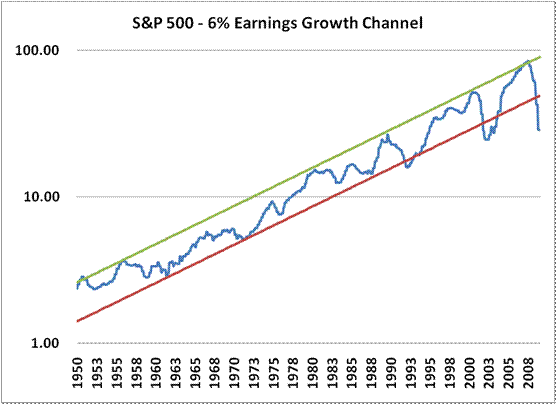
The chart above, which was included in Hussman's column, illustrates a point Hussman made about the steep recent decline in S&P earnings (earnings have historically grown 6% from one cyclical peak to the next cyclical peak).

Thursday, February 12, 2009

Andy Kessler on the Fixing the Banks

From his op/ed column in yesterday's Wall Street Journal, "Why Markets Dissed the Geithner Plan":

Mr. Geithner wants to "stress test" banks to see which are worth saving. The market already has. Despite over a trillion in assets, Citigroup is worth a meager $18 billion, Bank of America only $28 billion. The market has already figured out that the banks and their accountants haven't fessed up to bad loans and that their shareholders are toast.

[...]

Mr. Geithner should instead use his "stress test" and nationalize the dead banks via the FDIC -- but only for a day or so.

First, strip out all the toxic assets and put them into a holding tank inside the Treasury. Then inject $300 billion in fresh equity for both Citi and Bank of America. Create 10 billion new shares of each of the companies to replace the old ones. The book value of each share could be $30. Very quickly, a new board of directors should be created and a new management team hired. Here's the tricky part: Who owns the shares? Politics will kill a nationalized bank. So spin them out immediately.

Some $6 trillion in income taxes were paid by individuals in 2006, 2007 and 2008. On a pro-forma basis, send out those 10 billion shares of each bank to taxpayers. They paid for the recapitalization.

Each taxpayer would get about $100 worth of stock for each $1,000 of taxes paid. Of course, each taxpayer has the ability to sell these shares on the open market, maybe at $40, maybe $20, maybe $80. It depends on management, their vision, how much additional capital they are willing to raise, the dividend they declare, etc. Meanwhile, the toxic assets sitting inside the Treasury will have residual value and the proceeds from their eventual sale, I believe, will more than offset the capital injected. That would benefit all citizens, not the managements and shareholders who blew up the banking system in the first place.

Saturday, February 7, 2009

Richard Pzena's Picks For 2008


Hat tip to GuruFocus poster Abeck for this Barron's interview with Richard Pzena dated December 31st, 2007: "Opportunity Amid the Ruins". Excerpt:

Barron's: What is your downside risk [of holding Citigroup]?

Richard Pzena: There is some short-term downside risk. Looking out three years-plus, you have a really spectacular risk/reward trade. The odds that Citigroup sells for less than 30 in three years are very low, and the odds of it selling for substantially above that are very high.

Barron's: Do you feel the same about other banks?

RP: Bank of America [BAC] is the same story. They are going through a downturn, so they're going to have losses and provisions. We're estimating earnings of $3.70 a share for 2007 and $4.10 for '08. Right now, people aren't buying banks because the next quarter might be bad. Whenever investors become hypersensitive to the next piece of information, value opportunities arise.

You have to have a strong stomach to do this. I always joke about it, but the most common question we get from clients in any market environment is "don't you read the paper? How could you possibly do this, given what is going on?" And the response is, these shares don't trade at these valuations unless this kind of stuff is going on. If this proves to be fatal to Citi or Fannie or Freddie, we'll get killed. If it proves not to be fatal, as we suspect, then over the long term we're going to make a lot of money.


The article included this table listing Pzena's six stock picks (Fannie, Freddie, Citi, BofA, Alcatel-Lucent, and Capital One) and their prices as of the end of 2007.

The photo above, of Richard Pzena, is from the Barron's article linked to in this post.

Tuesday, November 25, 2008

"Citi's Taxpayer Parachute"

In an editorial today, the Wall Street Journal asks why Robert Rubin and other Citigroup directors still have jobs, "Citi's Taxpayer Parachute". Excerpt:

"Citi never sleeps," says the bank's advertising slogan. But its directors apparently do. While CEO Vikram Pandit can argue that many of Citi's problems were created before he arrived in 2007, most board members have no such excuse. Former Treasury Secretary Robert Rubin has served on the Citi board for a decade. For much of that time he was chairman of the executive committee, collecting tens of millions to massage the Beltway crowd, though apparently not for asking tough questions about risk management.

The writers at the Deal Journal blog remind us of one particularly egregious massaging, when Mr. Rubin tried to use political muscle to prop up Enron, a valued Citi client. Mr. Rubin asked a Treasury official to lean on credit-rating agencies to maintain a more positive rating than Enron deserved. What signal will President-elect Barack Obama send if his Administration, populated with Mr. Rubin's protégés, allows this uberfixer to continue flying hither and yon on the corporate jet while taxpayers foot the bill?