Showing posts with label Green Tech. Show all posts
Showing posts with label Green Tech. Show all posts
Friday, September 4, 2009
Van Jones, Green Jobs Czar
Longtime readers may remember this post about Van Jones from last fall ("A Green New Deal?"). At the time, I didn't know he'd be picked by the Obama Administration to be a 'green jobs czar', but I figured his ideas would have some valence with team Obama. Now he has gotten into trouble for some past statements and actions unrelated to his green jobs advocacy (See The New Republic: "Is Obama's Green Jobs Guru In Trouble?". HT: Ta-Nehisi Coates). In a way, this is unfortunate, because it detracts attention from the weakness of his "green collar economy" thesis. How can a robust, job-creating economy be built on winterizing homes and installing more expensive sources of energy?


Monday, December 22, 2008
USEG Management Agrees with Commenter J.K.

In a comment on a recent post ("Why We Will Be Using Fossil Fuels for Decades to Come"), commenter J.K. wrote,
Forget wind and solar(-except maybe satellite based), the real next gen energy is geothermal. You don't have to rely on conducive weather conditions or harming the environment. We probably will be using predominantly fossil fuels for the forseable future though. Hopefully not.
U.S. Energy Corp. (Nasdaq: USEG) executives had mentioned on previous occasions that they were considering investments in alternative energy, and today USEG issued a press release announcing that it had invested $3.445 million for a 25% stake in Standard Steam Trust LLC, a privately-held geothermal energy company based in Denver, CO. From the press release,
``After spending considerable time reviewing the renewable energy sector, we firmly believe that our entry into geothermal provides our company with a strong position in a market that has tremendous growth potential,'' said Mark Larsen, President of U.S. Energy Corp. ``Geothermal is a renewable subsurface fuel, and our partners are applying their extensive experience in modern oil and gas plays to geothermal exploration. This sector shows significant promise at a time when carbon management is playing an increasing role in the generation of clean energy in our nation,'' he added.
Since Standard Steam Trust is privately-held, it's hard to speculate on whether USEG paid a fair price for its stake, but it is probably prudent, for political reasons if nothing else, for a diversified natural resources company to position itself as a player in "clean" or "renewable" energy as well. Perhaps this will give USEG some environmental bona fides that will help it somewhat in getting the necessary approvals for its molybdenum mine.
The graphic above, on harnessing geothermal energy, comes from the Seattle Post-Intelligencer.
Saturday, November 15, 2008
'A Green New Deal'?
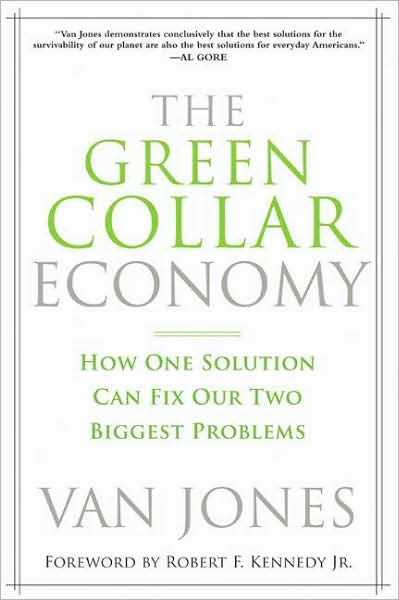
In a recent post ("The Election") we speculated on some investment implications of Obama's victory and noted the conventional wisdom that this was bullish for green tech. In Barnes & Noble yesterday, I leafed through the book pictured above, by Van Jones1. Van Jones sees green tech as a jobs program for blue collar workers, who can be employed building windmills, putting up solar panels, retrofitting buildings, etc.
I'm skeptical of how much of America's energy needs can be filled by solar and wind, but Jones seems to have a handle on the zeitgeist of today's progressives (i.e., liberals). Below is a short video of Jones giving the elevator pitch for his idea.
1Van Jones is an attorney by profession, as is Robert Kennedy Jr., who wrote the forward to Jones's book (Kennedy became an environmentalist after he was busted for heroin possession in the early 1980s, and did community service for Riverkeeper as part of his plea bargain). In fact, most of the blurbs praising Jones's book come from those without science backgrounds. The tendency of environmental advocacy groups to be run by non-scientists was one noted by Michael Crichton in his novel State of Fear.
Wednesday, November 5, 2008
The Election

Why Obama Won
In two words: The economy.
According to The Political ("Exit polls: Economy top issue"),
The economy dominated voters’ concerns at historical levels in the presidential election Tuesday, according to preliminary exit polls conducted by The Associated Press and the major television networks.
Fully 62 percent of voters said the economy was the most important issue, six times more than cited the war in Iraq (10 percent), health care (9 percent) or terrorism (9 percent).
In a few posts last month (e.g., "Contingency and Causation" and "More from 'The Irrational Electorate'"), we referred to an article by Larry Bartels in The Wilson Quarterly, "The Irrational Electorate". In that article Bartels noted,
...studies of economy-driven voting almost invariably find that voters are strongly influenced by economic conditions during the election year, or even some fraction of it, but mostly ignore how the economy performed over the rest of the incumbent’s term.
The acute worsening of the financial crisis in mid-September erased Senator McCain's small lead in the polls and Senator Obama never looked back.
What sort of economic policies will President Obama pursue?
Broadly speaking, Obama supporters have fallen into two groups: those who voted for him because they thought he was an orthodox liberal (as some of his earlier statements, his background, and his voting record might suggest) and those who voted for him because they thought he was more of a pragmatic centrist (as some of his statements during the campaign, and some of the advisers he surrounded himself with -- e.g., Robert Rubin, Paul Volcker -- might suggest). We'll find out which group was right soon enough.
Is this a historic realignment?
Some pundits have claimed this, but I'm skeptical. Clearly, the Republican brand has been damaged, but the bursting of the credit bubble won't leave Democrats unscathed either. Democrats have benefited from invidious comparisons between the economy and budget under President George W. Bush and President Clinton (e.g., a budget surplus under Clinton and deficits under Bush), but going forward the basis for comparison is going to be a lot different. The deficits during the first years of the Obama administration are going to be easily more than twice as large as the largest deficit during the Bush years. Unemployment rates, and eventually, inflation and interest rates, will probably look significantly worse too. Granted, this will be due largely to the continuing effects of the credit bust, but then the surpluses under Clinton were largely due to the dot-com bubble. Presidents, and their parties, get the blame or the credit for economic conditions when they are in power.
Investment Implications
The conventional wisdom is that green energy and, perhaps to a lesser extent, infrastructure will be beneficiaries of President Obama's policies. That sounds reasonable. A big winner will probably be the venture capital firm Kleiner Perkins1, which has been savvy enough to get in early on the green tech bubble and sign on Al Gore as a partner. Unfortunately, Kleiner Perkins isn't publicly traded, and if does go public in the next few years, its IPO will probably be a signal that the green tech bubble is about to burst.
A commenter on CNBC today mentioned another investment idea -- life insurers -- which should benefit from the reinstatement of the estate tax (since the wealthy often buy life insurance policies to cover their estate tax liabilities).
If Jim Rogers and others are right that the yawning deficits ahead will eventually lead to much higher interest rates, than it might make sense to short Treasury bonds, as Rogers says he is doing (or to invest in a fund such as RRPIX that inversely tracks Treasury bonds).
The photo above of Obama and McCain is from The Dallas News.
1A small venture capital firm that is publicly traded, Harris & Harris Group (Nasdaq: TINY), has about 41% of its portfolio invested in what it calls "Cleantech". This page on Harris & Harris's website lists its Cleantech portfolio companies, and provides links for more information about each of them. I've owned a few shares of Harris & Harris since the early 1990s, before it became focused on nanotechnology, and then Cleantech.
Subscribe to:
Posts (Atom)

 Posts
Posts

