Tuesday, December 2, 2008
Vaalco Energy Update
Shares of Vaalco Energy (NYSE: EGY) are up about 33% over the last week, closing at $7.05 today, despite oil prices hitting a three-year low. I've got a limit order in to sell 5% of my Vaalco shares here to free up cash, which I may use to buy a few more shares of Alloy Steel International (OTC BB: AYSI.OB).


More on the Obama Transition
In his New York Times column on Sunday ("Everybody's Business: Obama's Team Isn’t Exactly a Break With the Past"), Ben Stein was cautiously optimistic about President-elect Obama's economic picks overall, but had this to say about Obama's pick for Treasury Secretary, Timothy Geithner:
In his column in Monday's Financial Times ("Bernanke and the risk of deflation"), Clive Crook asks who, among Obama's economic picks, will actually be in charge:
During the presidential campaign, I heard Mr. Obama talk many times about “change you can believe in.” But what does Mr. Geithner have to do with change?
He’s the pre-eminent careerist of old-time finance, and a basic part of the team that got us into this mess. He was pro-deregulation for most of his career. He went along with failing to rescue Lehman Brothers, a decision now generally considered a catastrophic mistake. He led the Federal Reserve Bank of New York while money-center banks made lethal mistakes of faulty risk management — and he did zero to stop it, as far as is known.
In what sense is he “change you can believe in”? How is he part of the solution, not part of the problem? I know he is a protégé of Robert E. Rubin. But isn’t Mr. Rubin himself the essence of the Washington-New York finance axis of power? He was a fine Treasury secretary while the tech boom made all things new, but Citigroup hasn’t exactly thrived during his tenure. Again, where is the change?
In his column in Monday's Financial Times ("Bernanke and the risk of deflation"), Clive Crook asks who, among Obama's economic picks, will actually be in charge:
He has put together a superbly talented team, but with so many strong-willed members one wonders who is in charge. Lawrence Summers at the National Economic Council? Timothy Geithner at the Treasury? This potentially unstable new duumvirate immediately aroused speculation about Mr Bernanke’s future influence and likely tenure at the Fed – an unhelpful development. If this were not complicated enough, next came the announcement of a new Economic Recovery Advisory Board, headed by none other than Paul Volcker.
Mr Obama has emphasised that he will be in command. He better had be. Yet it remains to be seen whether he can control this group of eminences and communicate his policy with sufficient authority. Unlike John McCain, Mr Obama never boasted of his ignorance of economics but the new president is no more master of these issues than his former rival. Boldness seldom comes out of committee, nor does forthright explanation. He is going to need a chief of economic policy – and it would be good if that person, and everybody else, knew who it was.
Monday, December 1, 2008
The Sopranos' Over-the-Top Take on Selling a Sketchy Stock
In the comment thread of an earlier post ("Destiny Media Update"), a commenter's Sopranos reference brought to mind this scene, set in the boiler room of a 'boutique' investment bank, where an honest broker is disciplined for refusing to pump shares of a scam dot-com company called Webistics to his clients.
A Concern about Edelheit
In a previous post ("You pick the next post"), I mentioned I was thinking of writing a post about a concern I had about Aaron Edelheit's investment process. Perhaps that wasn't the best choice of words. I think Edelheit's general strategy of trying to buy obscure North American companies trading at single-digit multiples to his estimates of their forward earnings makes sense (although, as I've mentioned elsewhere, post-October there may be a better balance of risk versus reward in looking for currently profitable companies trading at low earnings multiples). Edelheit's track record is also impressive. The concern I have, which was prompted by a couple of his recent blog posts, is about whether Edelheit maintains an appropriate level of skepticism in his interactions with the management of the companies in which he invests.
ThinkEquity's 8th commandment of research (See the previous post for the other nine, "ThinkEquity's Ten Commandments of Research") is relevant here:
One of the challenges of investing in micro-cap companies is that there are often few, if any, independent sources of information on the company, so an investor is more reliant on information supplied by the company itself (e.g., its SEC filings, conference calls, etc.). Because of that, it's important to maintain a level of skepticism when evaluating forward-looking statements by management. This is easier said than done, particularly after one has invested in a position: we all like to believe our initial thesis was right, and this can compromise our objectivity in evaluating information subsequently.
In fairness to Edelheit, he seems to limit his investments to companies where the managers put their money where their mouths are, by buying their own stock (e.g., Nasdaq.com shows that Destiny Media's insiders have been buying their company's stock over the last year).
These were the two posts that made me question Edelheit's level of skepticism, "Excellent Video on Car Bailouts", and "Adversity and Underprivilege". In the first post, Edelheit wrote approvingly of an appearance by New York Times columnist Tom Friedman on CNBC, and in the second post, Edelheit wrote approvingly of an essay by Malcolm Gladwell. Friedman and Gladwell are both highly-influential, best-selling writers, but they tend toward glib oversimplifications. A healthy level of skepticism is warranted when reading them. In his recent posts on Friedman and Gladwell, Edelheit's apparent credulity made me wonder if he has been similarly credulous in evaluating statements made by managers of the companies he owns. Of course, it's reasonable to assume that he is more rigorous in his vocation of investing than in his avocation of blogging, but since he is blogging eponymously, he may want to consider whether his recent posts may have raised the same concern in his clients or potential clients who read his blog.
For a skeptical take on Tom Friedman's commentary about the Detroit automakers, see my recent posts "Iraq, the Automakers, and the Limitations of Technology", and "Great Moments in Business Journalism". For a skeptical take on Malcolm Gladwell, see Michiko Kakutani's review of Gladwell's latest book, "Outliers", in the New York Times. Below is an excerpt from Kakutani's review.
ThinkEquity's 8th commandment of research (See the previous post for the other nine, "ThinkEquity's Ten Commandments of Research") is relevant here:
5 Independent Sources for Each Initiation of Coverage.We will have regular dialogue with company management, but they will always see the glass as "half full."
One of the challenges of investing in micro-cap companies is that there are often few, if any, independent sources of information on the company, so an investor is more reliant on information supplied by the company itself (e.g., its SEC filings, conference calls, etc.). Because of that, it's important to maintain a level of skepticism when evaluating forward-looking statements by management. This is easier said than done, particularly after one has invested in a position: we all like to believe our initial thesis was right, and this can compromise our objectivity in evaluating information subsequently.
In fairness to Edelheit, he seems to limit his investments to companies where the managers put their money where their mouths are, by buying their own stock (e.g., Nasdaq.com shows that Destiny Media's insiders have been buying their company's stock over the last year).
These were the two posts that made me question Edelheit's level of skepticism, "Excellent Video on Car Bailouts", and "Adversity and Underprivilege". In the first post, Edelheit wrote approvingly of an appearance by New York Times columnist Tom Friedman on CNBC, and in the second post, Edelheit wrote approvingly of an essay by Malcolm Gladwell. Friedman and Gladwell are both highly-influential, best-selling writers, but they tend toward glib oversimplifications. A healthy level of skepticism is warranted when reading them. In his recent posts on Friedman and Gladwell, Edelheit's apparent credulity made me wonder if he has been similarly credulous in evaluating statements made by managers of the companies he owns. Of course, it's reasonable to assume that he is more rigorous in his vocation of investing than in his avocation of blogging, but since he is blogging eponymously, he may want to consider whether his recent posts may have raised the same concern in his clients or potential clients who read his blog.
For a skeptical take on Tom Friedman's commentary about the Detroit automakers, see my recent posts "Iraq, the Automakers, and the Limitations of Technology", and "Great Moments in Business Journalism". For a skeptical take on Malcolm Gladwell, see Michiko Kakutani's review of Gladwell's latest book, "Outliers", in the New York Times. Below is an excerpt from Kakutani's review.
Both [of Gladwell's two previous bestsellers, "The Tipping Point" and "Blink"] use PowerPoint-type catchphrases (like the “stickiness factor” and “the Rule of 150”) to plant concepts in the reader’s mind. And both project a sort of self-help chirpiness, which implies that they are giving the reader useful new insights into the workings of everyday life.
“Outliers,” Mr. Gladwell’s latest book, employs this same recipe, but does so in such a clumsy manner that it italicizes the weaknesses of his methodology. The book, which purports to explain the real reason some people — like Bill Gates and the Beatles — are successful, is peppy, brightly written and provocative in a buzzy sort of way. It is also glib, poorly reasoned and thoroughly unconvincing.
ThinkEquity's Ten Commandments of Research
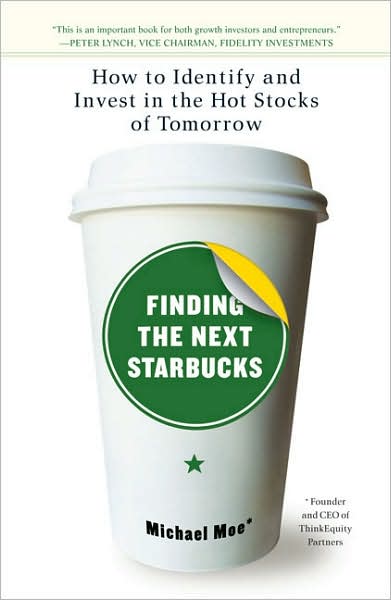
A post about Edelheit is coming up next, but since that post will refer to ThinkEquity's Ten Commandments of Research", I figured I'd post those ten commandments separately first. These ten commandments (listed below) were also mentioned in the book Finding the Next Starbucks: How to Identify and Invest in the Hot Stocks of Tomorrow (pictured above), by ThinkEquity founder Michael Moe.
- Be right on the fundamentals.
Earnings growth drives stock price. There is essentially a 100% correlation with how a company does and how its stock performs over time.
- Be Proactive — Not Reactive.
Reporting what happened is what a news reporter does. We get paid to look over the horizon and around corners.
- When in Doubt — Get it Out.
The difference between value-added information and a commodity could be minutes.
- When Wrong — Admit it.
The best investors and analysts are wrong a lot. The worst thing to do is rationalize a mistake. Be intellectually and morally honest.
- The Cockroach Theory.
You seldom find just one cockroach in a kitchen. Likewise, if you find a problem at a growth company, there are always more behind it. It's rarely a one-quarter issue — the first loss is the best loss.
- Research is About Information and Insight.
Information is valuable if it is proprietary. Insight is valuable if we know what that information means.
- The 4 P's are Key for any Successful Growth Company.
People, Product, Potential, Predictability. The first "P" (people) is the most important.
- 5 Independent Sources for Each Initiation of Coverage.
We will have regular dialogue with company management, but they will always see the glass as "half full."
- 3 Main Reasons for a Stock to Move Up or Down.
In addition, we will identify near term catalysts for price movements.
- Make Clients Money — and everything will take care of itself.
ThinkEquity investment philosophy is that over time, revenue and earnings growth is what drives company valuations. Our ultimate goal is to identify companies that have high and sustainable earnings growth.
Sunday, November 30, 2008
You Pick the Next Post
Here are a few topics I've been thinking of posting about. Let me know which (if any) are of interest, and I'll try to write a post it tomorrow.
- Plaxico Burress: Why the NY Giants will probably trade him in the off-season, due to his off-field antics.
- A concern about Aaron Edelheit: why a couple of his recent blog posts raise questions about his investment process.
- U.S. Energy Corp.'s Q3 conference call: A few weeks late, but I neglected to write a post on this.
- David Brooks's column in Thursday's New York Times: What he misses; contrasting it with Paul Sedan's column in the Christian Science Monitor from earlier in the week.
- Regulation T: A commenter requested a post on this a few weeks ago, and I've been meaning to write it.
- Plaxico Burress: Why the NY Giants will probably trade him in the off-season, due to his off-field antics.
- A concern about Aaron Edelheit: why a couple of his recent blog posts raise questions about his investment process.
- U.S. Energy Corp.'s Q3 conference call: A few weeks late, but I neglected to write a post on this.
- David Brooks's column in Thursday's New York Times: What he misses; contrasting it with Paul Sedan's column in the Christian Science Monitor from earlier in the week.
- Regulation T: A commenter requested a post on this a few weeks ago, and I've been meaning to write it.
Friday, November 28, 2008
Destiny Media Update

Destiny Media Technologies (OTC BB: DSNY.OB), an Aaron Edelheit pick, closed up about 56% today, on more than three times average volume, with no news released. The most recent news from the company was this November 4th press release: "Universal Music Australia Chooses Play MPE® To Digitally Deliver Pre-release Music".
The image above is of an ad for Destiny Media's Play MPE® secure media delivery system.
Update -- Destiny Media announced its year-end results just after midnight: "Destiny Media Announces Record Year End Results". Revenues up 80% year-over-year, and up 33% sequentially; net loss dropped 56% over previous quarter; profits anticipated "imminently1"
1As we noted in an earlier post, last quarter the company predicted it would be profitable in its fiscal first quarter, i.e., its next quarter. We'll see in a few months.
Subscribe to:
Posts (Atom)

 Posts
Posts

